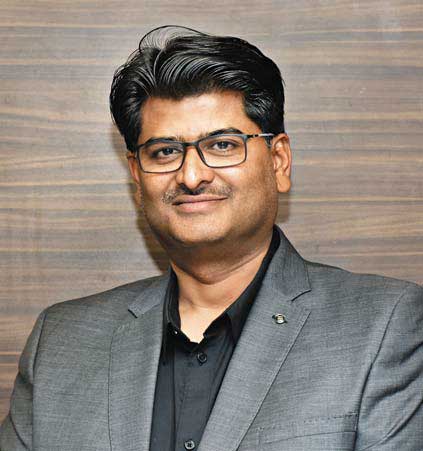
Umashankar Choudhary, Unit Head, JK Cement throws light on the alternative fuels and raw materials that can be used in the production of cement which can lead to a significant reduction in energy and fuel consumption and also meet the organisation’s goals of achieving a lesser carbon footprint in the environment.
What are the raw materials and fuels currently used by your organisation in the cement manufacturing process?
In the process of cement manufacturing, the major constituent is clicker which we produce in our plants. Major raw materials for this clinker production are limestone which contributes to 97 to 98 per cent and the rest are additives. Mainly we use the DCP dust which is added around 2 per cent. This is also an alternative raw material because we are focusing on alternative raw material as well as alternative fuels for the clinker manufacturing.
In cement, we add additives like on gas, slag, and gypsum. Gypsum is of two types, namely, chemical and mineral. We use both chemical and mineral gypsum as per their availability and cost economy. As we speak about fuels, the major fuel is coal. However, now we want to maximise the use of alternative fuels, so we have started using RDF, MSW, hazardous industrial waste in the form of RDF which constitutes to about 70 to 80 per cent of the alternative fuel mix.
Please tell us more about the constitution of these alternative fuels and why they are chosen as alternative fuels.
Alternative fuels are chosen because they are available in abundance. Our plant is located in Karnataka and Goa is also nearby. We collect MSW, mainly the plastic waste and RDF in collaboration with the municipalities of the nearby areas. Goa is a hub of industries. We take all types of pharmaceutical wastes, bio medical waste from Karnataka, Goa and overall, a vicinity of 200 kilometers from our plant. Our contribution is about 77 to 80 per cent of plastic waste, consisting of mainly RDF and MSW. And rest of the waste is industrial waste which we get from various industries.
Except for limestone, which other raw materials can be used for clinker production?
As I mentioned earlier that we have to move towards maximising the use of alternative raw materials, lime mud that comes from the paper industry becomes and alternative raw material for us. It works well in place of limestone because of its higher lime content. Sometimes we even get about 45 to 55 per cent lime also. And at the same time, we have to promote low grade limestone with which we create a lighter clinker.
This low energy clinker hires 35 per cent lesser heat consumption than the conventional clinker production. It also contributes to huge reduction of carbon dioxide emission in terms of calcination and fuel reduction. This energy limestone in which MGO content is 13 to 15 per cent is being used as mineralizer. This material cannot be used in conventional cement manufacturing process. This high MGO limestone reduces the fuel consumption also.
What steps is your organisation taking to reduce the carbon footprint created by it?
The Confederation of Indian Industry (CII) is taking a good initiative for green gold ratings. Our Muddapur, Karnataka plant has received the Green Gold rating from CII in 2020. In this rating all sustainability goals are being included under various articles.
The major activities done to reduce the carbon footprint are energy efficiency, water conservation, renewable energy use, green house gases emission reduction, waste management, material conservation, recycling of materials, green supply chain, green ecology and infrastructure too.
For promoting of these activities, we are focusing our efforts on how to increase the production of blended cement up to 60 to 65 per cent of our total cement production. We are increasing additives up to the maximum permitted limits in blended cement like PPC. We are working on how to maximise the flag edition.
We have developed a new type of premium blended cement in place of Ordinary Portland cement (OPC) because we want to maximally promote the blended cements. This premium brand shall replace the OPC cement as it will be increasing the use of alternative fuels up to 30 per cent as compared to the current operation in the kiln which is 20 per cent alternative fuels. With this we have a clear roadmap of achieving 30 per cent GSR in the near future. Alongside a waste recovery system is also under progress.
We are targeting our energy roadmap to reach 55 unit per tonne of cement, an activity under progress, which is the national benchmark. We are adopting a shortest route for internal as well as external transport to minimise the greenhouse gas emissions.
Our organisation is focusing on all these activities to reduce the carbon footprint from the environment.
Tell us more about the role of technology and automation in the reduction of
carbon emission.
As I have mentioned that we are achieving a 20 per cent GSR. Furthermore, the cement plant is not able to cope up because the chloride per centage is more. What we shall now do is to utilise a chlorine bypass system that will help to further increase the GSR and take it up to 50 per cent GSR.
Once this is established, we are also proposing the installation of standard combustion system also to increase the utilization of alternative fuels, wastage recovery system, solar power plants and windmills as alternative sources of electronic energy. Also proposed is a system where we can produce low energy clinker and work with clay calcination
which can serve as an alternative to conventional clinker. We are now working on LC3 cement, which is a global standard technological innovation in the cement industry.
What happens to the waste generated by the cement manufacturing process in your organisation?
Generally, in cement industry there is no waste. However, some cement manufacturing processes have zero discharge, therefore there is no wastage. Agro waste and inhouse wastes are also processed in our pyroprocessing systems.
Our plants also use fly ash in the cement manufacturing process to make PPC as well as premium grade PPC cement also. There are some wastes produced such as electronic waste or medical waste which are further given to authorised recyclers to scrap properly.
Tell us more about the steps taken towards contributing towards the circular economy by your organisation?
The concept of circular economy has been applied in the cement industry for decades. Utilising byproducts of other industries and other secondary materials, we are a playing major role of ulitising more than 40 types of waste from various industries and we are using them as alternative fuels and raw materials in the cement manufacturing process.
A cement plant can be considered synonymous to Lord Shiva. It has the capability to inhale and hold waste of all types and can be use that with certain changes in our raw mix and cool mix. We have started using alternative fuels and raw materials in our cement plants since 2016. Now we are co-processing more than 1.25 lakh tonnes per year of alternative fuels. Last year we co-processed over 75 thousand tonnes and this year we have achieved 1.3 to 1.4 lakh tonnes of alternative fuels. Co-processing reduces the consumption of carbon intensive fuels as well as contributes towards the circular economy that can be used waste materials which would otherwise end up in landfills.
Supplementary cement materials such as fly ash from coal fired powered station, blast furnace slag and waste from the steel industry we are using as raw materials in the clinker manufacturing process.
What are the technological innovations or alternatives the organisation could opt for in future to ensure environment sustainability?
Our organisation is already in the process of working on the chlorine bypass system and combustion system. Other than this we have also aligned our business model with the UN 2030 agenda for sustainable development. We have committed a Science Based Target Initiative (SBTI) for business ambition to a well below 2 degree Celsius. Our company has also joined UN CC 2050 race to zero campaign under BCCA to achieve net zero emission for cement
and concrete.
Our target is to reduce specific thermal energy which is 704 by 2030. Specific power consumption that is around 65 by 2030. We have to increase our WHR capacity for efficiency improvement to 45 kilowatts per hour per tonne of clinker. To have to also increase green power mix use up to 75 per cent by 2030.
We are working on a road to green transportation. This is a transition to a greater use of electrical energy and renewable resources. Our target is to achieve a clinker ratio of 65 per cent by 2030. We are also working on increasing blended cement and how to minimise the use of exhaustible resources and move towards alternative resources.
By when is your organisation expected to achieve Net Zero and how much carbon emission has been reduced by 2021?
Our company has aligned itself to the UN mission of achieving Net Zero. We have been continuously working towards achieving that goal and our target is to achieve 80 per cent of that by 2030. As mentioned earlier, we have targeted to achieve thermal energy consumption of 704 for the whole organisation and not an individual plant.
For individual plants, like this, Muddapur plant, we are running on with a 685 specific heat and the total power is 62 to 65. In the totality of the whole organisation, we have taken up the target of 2030 and will achieve the same. Net zero achievement shall be around 2050.
What I would also like to add on here is that the cement industry in the future is only going to survive on alternative fuels and raw materials. We have to source, utilise and promote the use of alternatives as in India, the average thermal rate is only 4 to 5 per cent. We have to identify the plants where it is only 2 to 3 per cent and start from there and take it up to 20 to 30 per cent. The Indian average should be 20 per cent to achieve a sustainable environment. Plants that are using alternative fuels and alternative raw materials have to work hard to achieve this thermal substitution rate.
These are natural resources, and the reserves will deplete after some years. We have to consciously think about the next generation and make an effort. Cement industry has to take a lead to towards a sustainable journey. They must move forward and take certifications on a global scale for greener methods and processes too.
Kanika Mathur













 Concrete1 month ago
 Concrete4 weeks ago
 Concrete1 month ago
 Concrete3 weeks ago