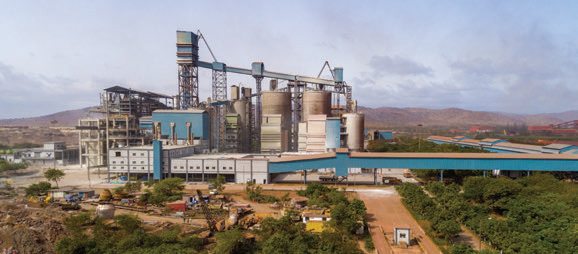
Manoj Kumar Rustagi, EVP – Business Strategy & Capex Projects, Sustainability and R&D, JSW Cement Limited, talks about aligning efforts with sustainable development goals.
Manoj Kumar Rustagi, EVP – Business Strategy & Capex Projects, Sustainability and R&D, JSW Cement Limited, talks about aligning efforts with sustainable development goals.
Our business strategy has been based on the underlying concept of a circular economy across industries, making us a responsible corporate, and delivering superior quality products and building materials to our customers.
Our business model works on the principle of using industrial waste to manufacture superior quality cement or cementitious products in the most efficient and environment-friendly manner. We primarily focus on low-carbon products, utilisation of renewable energy, co-processing of waste materials in place of fossil fuels, deploying electric commercial vehicles, installation of Waste Heat Recovery System (WHRS), and other initiatives aligned with the low carbon economy and ecosystem.
During FY 2020-21, we have established our long-term targets for 2030, aligning to the sustainable development goals on various aspects related to climate change, biodiversity, water and waste-water, energy, circular economy, supply chain and air emissions.
Addressing climate change
We have undertaken definitive steps and measures to reduce our overall carbon footprint.
- Deployed latest technology and energy-efficient processes with roller press grinding system for manufacturing cement and cementitious products.
- Utilisation of industrial waste i.e., blast furnace slag / fly ash in manufacturing cement and cementitious products.
- Co-processing of alternative fuel in the clinker plant at our Nandyal and Fujairah unit to reduce consumption of fossil fuels.
- Utilisation of waste hot gases from clinker plant for slag drying, thus saving coal/diesel.
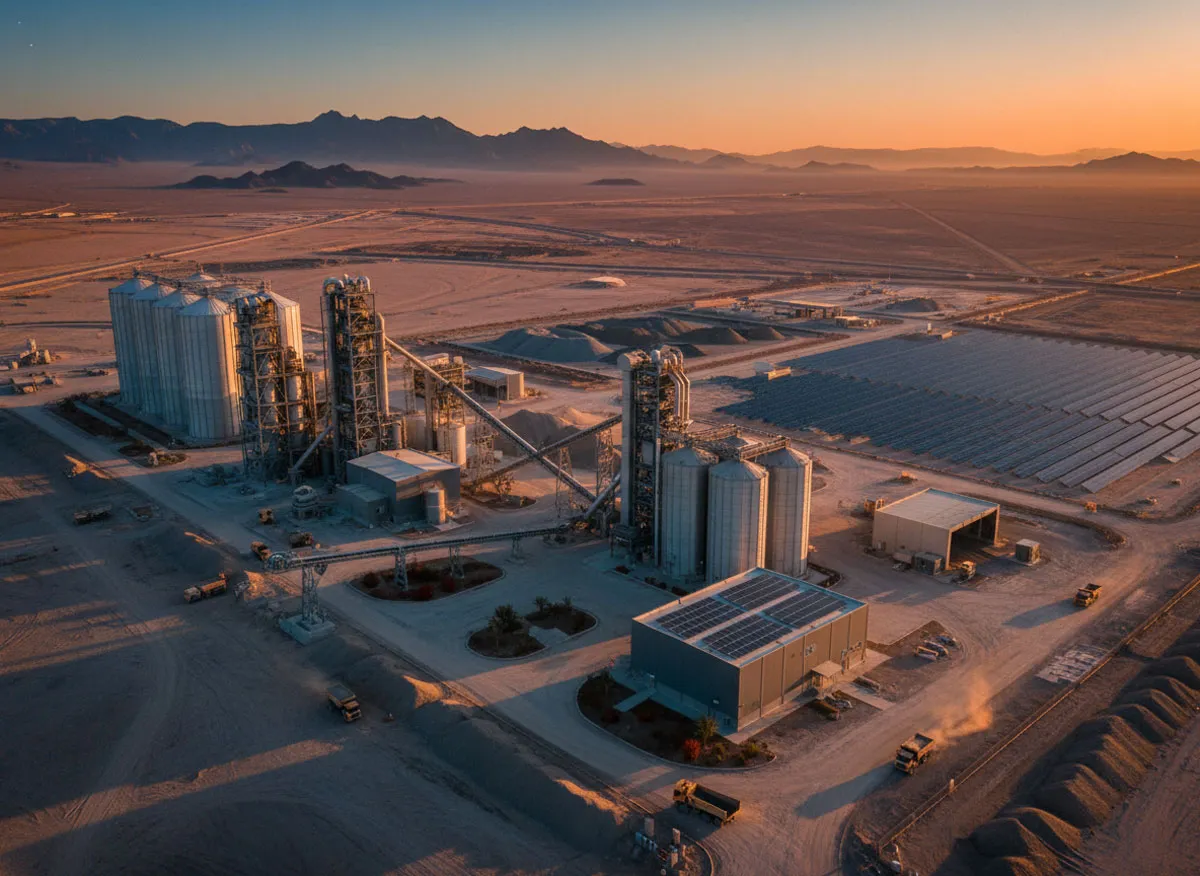
- Utilising solar power at the Nandyal unit – 5.5 MW and the Salboni unit – 3.5 MW.
- Installing 12.2 MW capacity waste heat recovery systems (WHRS) at our Nandyal unit (Project in Progress).
- Established rainwater harvesting facilities inside the plant premises across our plant locations.
- Development of greenbelt in and around our plant premises.
Salboni and Vijayanagar Plant: Improving energy efficiency with PAT targets
During FY 2020-21, the Salboni and Vijayanagar plants were considered as designated consumer (DC) in the Perform, Achieve, Trade Cycle (PAT) 2020-21 to 2022-23 as per the Bureau of Energy Efficiency (BEE). The targets specified by BEE were as follows:
1. Salboni Plant
- Baseline Specific Energy Consumption, SEC – 0.0227 toe/tonne of equivalent product
- Target Specific Energy Consumption (2022-23), SEC – 0.0210 toe/tonne of equivalent product
2. Vijayanagar Plant
- Baseline Specific Energy Consumption, SEC – 0.0438 toe/tonne of equivalent product
- Target Specific Energy Consumption (2022-23), SEC – 0.0372 toe/tonne of equivalent product
Both the plants are improving energy efficiency by implementing various measures related to product mix, optimisation of process energy, shift to the latest energy efficient equipment wherever feasible and energy efficiency improvement projects among others.
Sustainability initiatives
In aligning with the triple bottom line, we have undertaken definitive steps to produce quality cement and cementitious products in an efficient and environment-friendly manner.
1. Reduction in clinker ratio
As a continuous effort of the company, our R&D team is developing processes that will help us in conserving limestone and energy, which will in turn help us reduce the manufacturing cost of cement. During FY 2020-21, our R&D team developed an in-house additive used in cement grinding, which helps in the reduction of clinker consumed per tonne of cement produced. Through this initiative, we have avoided 24140 Tonnes of CO2 emissions at our Salboni and Jajpur plants.
2. Manufacturing of Composite Cement
Our company has put in efforts in R&D, to manufacture a new range of blended cement products called composite cement, which uses both, fly ash and blast furnace slag as supplementary cementitious materials. Our Jajpur grinding unit mainly produces composite cement and that forms ~68% of the overall product mix from the plant. This product helps us in reducing our manufacturing costs while utilising multiple industrial waste as supplementary cementitious materials to produce quality low carbon cement products as per BIS.
3. Use of alternate fuel / reduced solid fuels like coal / pet coke
During FY 2020-21, ~23,200 tonnes of waste was co-processed at our Nandyal plant, in our cement kiln in an environmentally friendly manner. We have successfully reduced 18,121 tonnes of CO2 emissions by utilising different types of wastes in place of traditional fuels.
4. Use of solar energy
5. During FY 2020-21, we have consumed ~ 1,15,04,567 units of solar power at our Nandyal and Salboni plant, thus avoiding ~ 10,469 tonnes of CO2 emissions
6. Circular economy
A major part of our product portfolio consists of blended cement products and cementitious materials, which are manufactured using industrial wastes or by-products. During FY 2020-21, around 88% of production was blended cements, a 1% increase as compared to the previous year. We have consumed 4.97 million tonnes of slag and 0.16 million tonnes of fly ash for our cement manufacturing process during FY 2020-21, thus reducing the consumption of natural resources such as limestone, water and energy.
7. Energy efficiency
Some of the energy efficiency initiatives implemented during FY 2020-21:
- Medium VoltageVariable Frequency Drive (MV VFD) installation in grinding mill at Jajpur
- Optimisation of compressed air utilisation at Jajpur
- Discharge chute modification for wagon loading and truck loading at Vijaynagar
- VFD installation in HAG coal conveying at Vijaynagar
- Reduction in pressure drop across cement mill dust collection circuit at Nandyal
- Replacing of conventional lighting to LED lighting in VRM -1 and Packing Plant at Dolvi
Apart from these initiatives, we have made significant efforts by committing to various initiatives related to climate change action.
- We are a signatory to the ‘Global Framework Principles on Heavy Industry Initiative,’ which has a vision to ‘Accelerate and scale-up the decarbonisation of heavy industry to align with a 1.5C global warming trajectory with urgency’.
- We have also committed to all three of the Climate Group’s campaigns – RE100, EV100 and EP100 in a single go and we are globally the first company in heavy industries to do so.
- Carbon Disclosure Project (CDP) is a not-for-profit charity that runs the global disclosure system for investors, companies, cities, states and regions to manage their environmental impacts. The CDP headquarter is based out of London, UK, and is working towards securing a thriving economy that works for the people and the planet by creating a global database on carbon emissions across industries. We have been participating in the CDP response for the last three years to ensure open and transparent communication to our stakeholders and the society at large. Our last year CDP response was a ‘B-’ rating, which is in the Management Band.
- We are part of Global Cement & Concrete Association (GCCA), globally as well as of the Indian chapter. GCCA is working on various initiatives on sustainability and innovation along-with its member companies, affiliates and partners. As part of this, there are working groups on various aspects of sustainability. We lead the working group related to communications and policy advocacy. We have also become a member of GCCA Innovandi network, which is a standalone entity that works on R&D programmes in minimising the carbon footprint of cement and is a global research network of technology suppliers, academic institutions and manufacturers of cement and concrete industry.
ABOUT THE AUTHOR:
Manoj Kumar Rustagi, EVP – Business Strategy & Capex Projects, Sustainability and R&D, JSW Cement Limited, is a senior business leader, who has significantly contributed to business strategy and project management, and other strategic initiatives, in the cement, steel and energy sectors in his 29 years of professional career. In his present role as Executive Vice President, he is leading sustainability, R&D, business strategy and capex projects for JSW Cement Limited, India. He is a Director on the boards of various subsidiary companies of JSW Cement Limited. He is also on the board of GCCA Private Limited, India, in his personal capacity. He is a Mechanical Engineering graduate from BITS Pilani, India and an MBA from Indian School of Business (ISB), India.
Sustainability Performance 2020-21
We have a distinctive performance on the carbon intensity and are one of the lowest specific carbon emitters globally within the cement industry.
As per GCCA GNR data the global average of scope 1 net CO2 emissions per tonne of cementitious product is ~ 600 kg and India average is ~ 560 kg.
Compared to this for FY 20-21 our specific carbon emission is ~ 200 kg, which translates into a saving of 2.9 million MT of CO2 saving compared to India average and 3.2 million MT of CO2 saving compared to global average. We understand our responsibility for the nation and have taken definitive measures to lead our industry towards a zero net carbon economy much before the 2070 target.
200kg ~23345 tonnes 81 litres
SCOPE-1 Net CO2 emissions per tonne of cementitious material of alternative fuels consumed 66% of raw material consumption is from waste derived resources Water Consumption per tonne of cementitious material
LTIFR Share of renewable energy in total power consumption
0.44 3.15%
Natural capital Natural capital
- Total fuel used: ~241959 tonnes
- Total gas consumed: ~ 3.48 Crore nm3
- Total water used: 618370 m3
- Total electrical energy consumed: ~36.55 crore kWh
- Thermal substitution rate: 4.23 % • 37 % of the total water consumption met from harvested water, thus reducing the dependency on groundwater and surface water resources
Emissions
- Absolute net CO2 emissions (Scope 1): 1521828 Tonnes
- Absolute net CO2 emissions (Scope 2): 322123 Tonnes