Connect with us

Economy & Market

Core sector output declines for 8th consecutive month

Published

on

Shares

The eight-core sector output, which had seen a sharp improvement in recent months, has contracted by 2.5 per cent in October 2020, registering eight consecutive months of decline in output. The core sector output has contracted by 5.5 per cent in the corresponding month last year. Despite the sharp improvement and double-digit growth seen in case of coal production and electricity owing to resumption of business activities, the decline has been on account of decline in output seen in case of refinery products (having the highest weight in the core index) and decline in steel output during the month.

The decline in output in core sector in October to some extent adds uncertainty to sustainability of the recovery process in the economy. Low base effect, to some extent has limited the downside in the overall growth. The growth in the core sector index has been revised for September 2020 to (-)0.1 per cent and (-)7.3 per cent for August 2020.

During April-October 2020, the core sector output has contracted by 13 per cent as against a positive growth of 0.3 per cent during the same period of FY20, which can be ascribed to the coronavirus pandemic induced nation-wide lockdown that brought production activities to a near standstill. All sectors barring fertilizers registered de-growth in industrial output during the first half of FY21. About 50 per cent of the sectors in the index have recorded double-digit negative growth during these seven months.

Key highlights:

  • Coal production grew by 11.6 per cent in October 2020, its second consecutive month of double digit growth compared with a sharp decline of (-)17.5 per cent registered in the corresponding month last year. The notable growth in October is an indication of revival in demand for coal amidst resumption of industrial activities and higher thermal power demand. A negative base also supported the growth in coal production.

  • Crude oil production contracted by 6.2 per cent in October 2020 compared with a negative growth of (-)6 per cent in September 2020 and (-)6.3 per cent in the corresponding month last year. This is the 35th consecutive month in which crude oil production has recorded a contraction. This fall in production can be ascribed to technical mishaps and closure of wells due to COVID-19.

  • Natural gas production declined by (-)8.6 per cent in October 2020 compared with (-)10.6 per cent in the previous month and (-)5.7 per cent in October 2019. This is the 17th consecutive month of decline in natural gas production. This fall in production can be ascribed to restricted/no gas offtake by consumers and shutdown at consumers??end. E&P players are also not aggressively producing gas as the gas produced from local fields is at an all-time low.

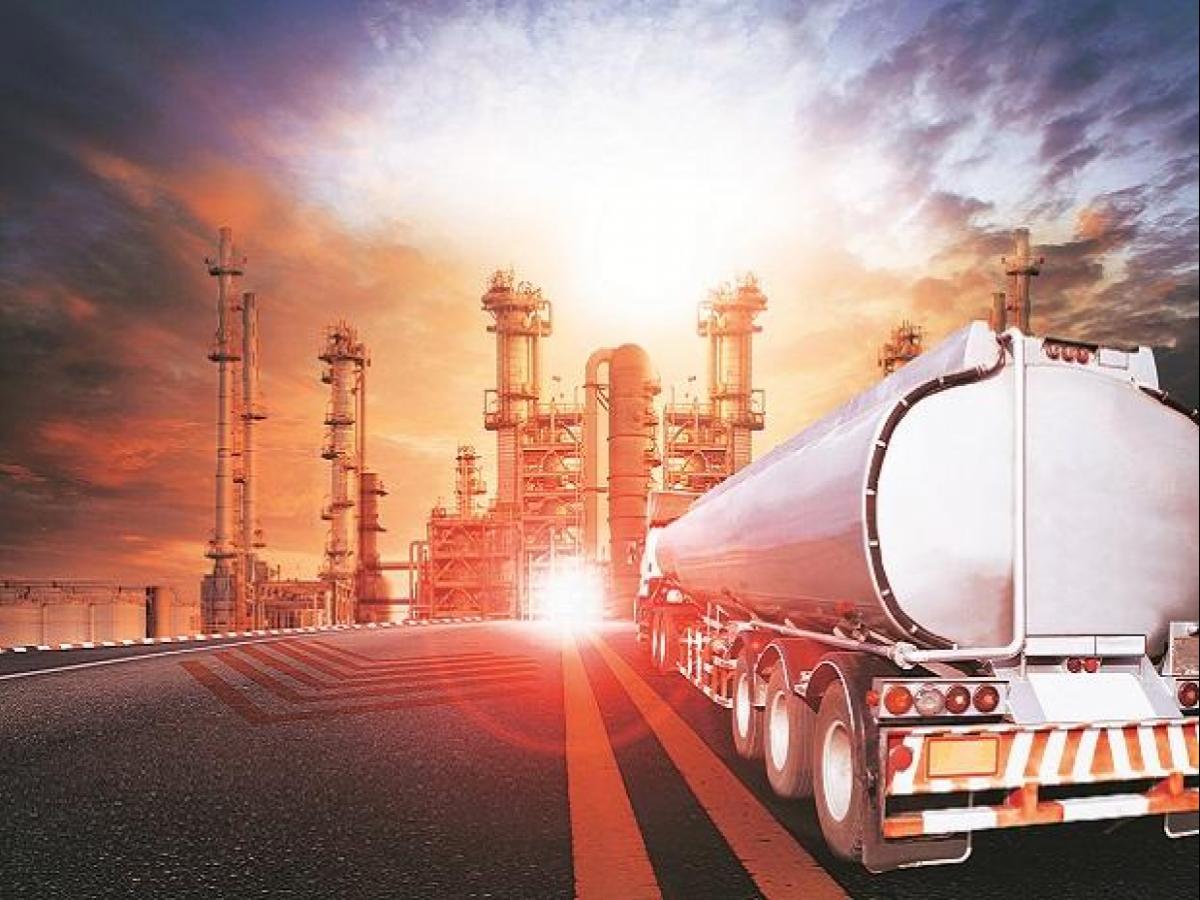
  • Refinery production, having high weightage in eight core, contracted sharply by 17 per cent in October and is the eighth consecutive month of decline in production. The capacity utilisation of refiners in October 2020 was 88 per cent compared with 105 per cent during October 2019.

  • Output of steel sector fell to three-month low of (-)2.7 per cent as against a positive growth of 2.8 per cent in the last month. On the other hand cement production recorded its first positive growth of 2.8 per cent in October 2020 after declining for seven consecutive months. This improvement can be ascribed to resumption of institutional projects and housing construction activities.

  • Output of fertilizers improved sharply by 6.3 per cent in October 2020 as against a flattish fall of (-)0.3 per cent in September 2020. This improvement is on account of robust restocking of fertilisers ahead of the rabi season.

  • Electricity production rose further to eight-month high of 10.5 per cent in October 2020 compared with a low base of (-)12.1 per cent in October 2019. This improvement reflects higher industrial and business activity and a similar pattern is witnessed in coal as well.

CARE Ratings??View

Despite a low base and improvement in business activities amidst unlocking of the economy, the fall in core sector output in October does show some volatility on the production side. Further unlocking of the economy could push this growth into positive territory in the next month. However, certain localised curfews imposed in a few States could weigh on production activity to some extent. IIP growth for this month may be expected to be between -1 to 0 per cent.

Courtesy: CARE Ratings??Core sector: October 2020

ABOUT THE AUTHOR:

Sushant Hede, Associate Economist at CARE Ratings. He can be contacted at: sushant.hede@careratings.com | Tel: +91-22-6837 43406

Disclaimer: This report is prepared by CARE Ratings Ltd. CARE Ratings has taken utmost care to ensure accuracy and objectivity while developing this report based on information available in public domain. However, neither the accuracy nor completeness of information contained in this report is guaranteed. CARE Ratings is not responsible for any errors or omissions in analysis/inferences/views or for results obtained from the use of information contained in this report and especially states that CARE Ratings has no financial liability whatsoever to the user of this report.


Continue Reading
Click to comment

Leave a Reply

Your email address will not be published. Required fields are marked *

Economy & Market

TSR Will Define Which Cement Companies Win India’s Net-Zero Race

Published

on

By

Shares

Jignesh Kundaria, Director and CEO, Fornnax Technology

India is simultaneously grappling with two crises: a mounting waste emergency and an urgent need to decarbonise its most carbon-intensive industries. The cement sector, the second-largest in the world and the backbone of the nation’s infrastructure ambitions, sits at the centre of both. It consumes enormous quantities of fossil fuel, and it has the technical capacity to consume something else entirely: the waste our cities cannot get rid of.

According to CPCB and NITI Aayog projections, India generates approximately 62.4 million tonnes of municipal solid waste annually, with that figure expected to reach 165 million tonnes by 2030. Much of this waste is energy-rich and non-recyclable. At the same time, cement kilns operate at material temperatures of approximately 1,450 degrees Celsius, with gas temperatures reaching 2,000 degrees. This high-temperature environment is ideal for co-processing, ensuring the complete thermal destruction of organic compounds without generating toxic residues. The physics are in our favour. The infrastructure is not.

Pre-processing is not the support act for co-processing. It is the main event. Get the particle size wrong, get the moisture wrong, get the calorific value wrong and your kiln thermal stability will suffer the consequences.

The Regulatory Push Is Real

The Solid Waste Management (SWM) Rules 2026 mandate that cement plants progressively replace solid fossil fuels with Refuse-Derived Fuel (RDF), starting at a 5 per cent baseline and scaling to 15 per cent within six years. NITI Aayog’s 2026 Roadmap for Cement Sector Decarbonisation targets 20 to 25 per cent Thermal Substitution Rate (TSR) by 2030. Beyond compliance, every tonne of coal replaced by RDF generates measurable carbon reductions which is monetisable under India’s emerging Carbon Credit Trading Scheme (CCTS). TSR is no longer a sustainability metric. It is a financial lever.

Yet our own field assessments across multiple Indian cement plants reveal a sobering reality: the primary barrier to scaling AFR adoption is not waste availability. It is the fragmented and under-engineered pre-processing ecosystem that sits between the waste and the kiln.

Why Indian Waste Is a Different Engineering Problem

Indian municipal solid waste is not the material that imported shredding equipment was designed for. Our waste streams frequently exceed 40 per cent to 50 per cent moisture content, particularly during monsoon cycles, saturated with abrasive inerts including sand, glass, and stone. Plants relying on imported OEM equipment face months of downtime awaiting proprietary spare parts. Machines built for segregated, low-moisture waste fail quickly and disrupt the entire pre-processing operation in Indian conditions.

The two most common failures we observe are what I call the biting teeth problem and the chewing teeth problem. Plants relying solely on a primary shredder reduce bulk waste to large fractions, but the output remains too coarse for stable kiln combustion. Others attempt to use a secondary shredder as a standalone unit without a primary stage to pre-size the feed, leading to catastrophic mechanical failure. When both stages are present but mismatched in throughput capacity, the system becomes a bottleneck. Achieving the 40 to 70 tonnes per hour required for meaningful coal displacement demands a precisely coordinated two-stage process.

Engineering a Made-in-India Answer

At Fornnax, our response to these challenges is grounded in one principle: Indian waste demands Indian engineering. Our systems are built around feedstock homogeneity, the holy grail of kiln stability. Consistent particle size and predictable calorific value are the foundation of stable kiln combustion. Without them, no TSR target is achievable at scale.

Our SR-MAX2500 Dual Shaft Primary Shredder (Hydraulic Drive) processes raw, baled, or loosely mixed MSW, C&I waste, bulky waste, and plastics, reducing them to approximately 150 mm fractions at throughputs of up to 40 tonnes per hour. The R-MAX 3300 Single Shaft Secondary Shredder (Hydraulic Drive), introduced in 2025, takes that primary output and produces RDF fractions in the 30 to 80 mm range at up to 30 tonnes per hour, specifically optimised for consistent kiln feeding. We have also introduced electric drive configurations under the SR-100 HD series, with capacities between 5 and 40 tonnes per hour, already operational at a leading Indian waste-processing facility.

Looking ahead, Fornnax is expanding its portfolio with the upcoming SR-MAX3600 Hydraulic Drive primary shredder at up to 70 tonnes per hour and the R-MAX2100 Hydraulic drive secondary shredder at up to 20 tonnes per hour, designed specifically for the large-scale throughput that higher TSR ambitions require.

The Investment Case Is Now

The 2070 Net-Zero target is not a distant goal for India’s cement sector. It starts today, with decisions being made on the plant floor.

The SWM Rules 2026 are already in effect, requiring cement plants to replace coal with RDF. Carbon credit markets are opening up, and coal prices are not going to get cheaper. Every tonne of coal a cement plant replaces with waste-derived fuel saves money on one side and generates carbon credit revenue on the other. Pre-processing infrastructure is no longer just a compliance requirement. It is a business investment with a measurable return.

The good news is that nothing is missing. The technology works. The waste is available in every Indian city. The government has provided the policy direction. The only thing standing between where the industry is today and where it needs to be is the commitment to build the right infrastructure.

The cement companies that move now will not just meet the regulations. They will be ahead of every competitor that waits.

About The Author

Jignesh Kundaria is the Director and CEO of Fornnax Technology. Over an experience spanning more than two decades in the recycling industry, he has established himself as one of India’s foremost voices on waste-to-fuel technology and alternative fuel infrastructure.

Continue Reading

Concrete

WCA Welcomes SiloConnect as associate corporate member

Published

on

By

Shares

The World Cement Association (WCA) has announced SiloConnect as its newest associate corporate member, expanding its network of technology providers supporting digitalisation in the cement industry. SiloConnect offers smart sensor technology that provides real-time visibility of cement inventory levels at customer silos, enabling producers to monitor stock remotely and plan deliveries more efficiently. The solution helps companies move from reactive to proactive logistics, improving delivery planning, operational efficiency and safety by reducing manual inspections. The technology is already used by major cement producers such as Holcim, Cemex and Heidelberg Materials and is deployed across more than 30 countries worldwide.

Continue Reading

Concrete

TotalEnergies and Holcim Launch Floating Solar Plant in Belgium

Published

on

By

Shares

TotalEnergies and Holcim have commissioned a floating solar power plant in Obourg, Belgium, built on a rehabilitated former chalk quarry that has been converted into a lake. The project has a generation capacity of 31 MW and produces around 30 GWh of renewable electricity annually, which will be used to power Holcim’s nearby industrial operations. The project is currently the largest floating solar installation in Europe dedicated entirely to industrial self-consumption. To ensure minimal impact on the surrounding landscape, more than 700 metres of horizontal directional drilling were used to connect the solar installation to the electrical substation. The project reflects ongoing collaboration between the two companies to support industrial decarbonisation through renewable energy solutions and innovative infrastructure development.

Continue Reading

Video Thumbnail
â–

    SIGN-UP FOR OUR GENERAL NEWSLETTER


    Trending News

    SUBSCRIBE TO THE NEWSLETTER


    Don't miss out on valuable insights and opportunities to connect with like minded professionals.


      This will close in 0 seconds