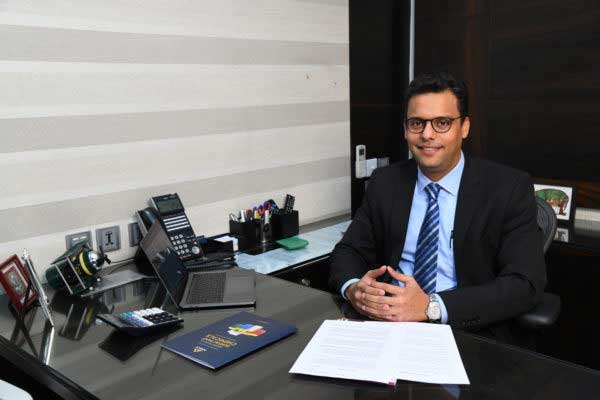
Apart from doing his usual business exceptionally well, Rishi Fogla is passionate about his social project. Let us hear from him about his pet project ??oice of Change.??He also shares his thoughts on the role of packaging in building a strong brand.
Kindly introduce your line of businesses to our readers, keeping the focus on cement as a product you serve.
I work in Fogla Corp as Executive Director. At Fogla, we have been catering to the demand of cement industry in the Indian subcontinent. We have two business divisions viz a) chemicals ??we are leading manufacturers and suppliers of surfactant chemicals ??LABSA, AOS, SLS and SLES, which are mainly used by the FMCG sector b) industrial packaging ??manufacturers of PP fabric and bags, FIBCs ??big bags/jumbo bags, HM HDPE drums.
My association with the cement industry is through the industrial packaging division. India is a developing country, which means infrastructure, construction, and building sectors are vital for the economy, which implies that the cement industry will grow exponentially, and hence the demand for packaging will also see a similar growth trajectory. Our products for the cement industry are of the highest quality, and we have been continuously innovating to cater to their needs to meet specific requirements.
Talking of Covid 19 pandemic, the second wave is posing a bigger risk to life and businesses. How has been the packaging industries??response to the second wave more specifically?
Last year, when the coronavirus hit us, we were caught unaware ??what the virus is going to do, how will it impact lives, livelihood and businesses, and what will happen tomorrow? This time because of our earlier experience we are prepared. We are more agile about what is going to happen. We are better equipped in terms of material requirements, we have maintained sufficient stocks of raw materials and other inputs, and we are able to deliver the packaging material to the cement industry on time so that the business connectivity is ensured.
Our SOPs are also integrated for the new wave of coronavirus. The situation is much under control as compared to that of last year even though the second wave is very different compared to the first one. Overall, we are much better off compared to last year. People in head office are working from home, while our factories are operational and working with strict SOPs even though a few positive cases have been reported.
Cement used to be a commodity and right now we are in the transition phase and are moving from commodity to brand. What role packaging can play in this transition?
Packaging is an integral part of ensuring that the brand is portrayed in totality. In the earlier days, cement was classified as a commodity. Today packaging has a vital role to play. If you go to a supermarket what attracts you first is the packaging of a product. It is the packaging of the product that catches your eye first. The customer is then tempted to try out the product.
The packaging comes first and then the content. When cement moves from B2B to B2C sector, the attractiveness of packaging is the first to have an encounter with the customer. The customer expects the packaging to be not just attractive, but more agile, more sophisticated and that is what we do. This is how we have been trying with cement companies for the last four to five years and I even look at it as if I am a cement user myself (we are cement for our various expansion projects). When a brand moves from a standard product to a premium one, packaging is on the preface. It has a role to play from its journey from commodity to brand.
Polypropylene or similar kinds of polymers are used on a very large scale in making bags for the cement industry. Latest packaging techniques such as lamination and other improvements have been carried out on bags. Please inform us more about such latest changes that are happening in the cement industry.
This change in bags is connected with the journey from commodity to brand. The journey has been from PP bags to PP laminated bags to BOPP bags. This change has evolved with our ethos. As an industry, we have to think about what we can do better tomorrow. With this approach, we work on changing the packaging products so as to bring in advantages to the consumer and the cement producer. When we move from PP to laminated PP bags, the quality of printing on the bag is much better. It is a kind of photogenic printing over block printing.
Cement being a hygroscopic material, immediately attracts moisture from the atmosphere. The lamination on the bag provides a kind of shield on the bag that prevents moisture from entering the bag. Lastly, now the bags are machine-made, while earlier the same job was being done by manual labour, therefore the quality of these bags made on machines is much higher and have minimum tolerance. When the bags get self-sealed, there is less loss of product during transit and even reduced dust emission. This results in customer satisfaction, which is our main goal.
How is the demand for PP laminated bags? How has been the transition from PP to PP laminated bags? Has it slowed down during pandemic?
During Covid and post Covid, we can see the buyers prefer PP laminated over PP bags and the numbers have exceeded our expectations.
On the social front, your company has been working on a special project called ??oice of change?? Could you please elaborate on this project?
I will take a little more time on the subject because it is very close to my heart. I find that focus of proper education is lacking in our country. With the population growth and youth coming to the job market in large numbers, only education can make a difference. That is the only asset one can live with it for the rest of his life.
Fogla Foundation was incorporated three years back and the first project we took was the ??oice of Change??connected to educating children. We nurture a few government public schools which are in the backward areas in West Bengal. What we create there is a pseudo parliament run by children in the school. It is same as the moral science of the good olden days. We make sure that whether a boy or a girl, they are able to come out of their shell. Normally because of their background, they do not open up. It is with the understanding that these children will be able to make their own decisions in their lives going forward. What we actually do in the school, is to create a ministry just like that of a government. They have a Prime Minister and other Ministers and they meet every fortnight and discuss about the subjects that affect them. They have a budget which they can decide on how to spend. A midday meal is an example which they get, they can decide how within a given budget they can improve. How wastage of food can be minimised so that maximum children are benefited. Are all the children eating properly? The food minister is supposed to look into these aspects. A home minister will find out why a particular child is not coming to school or has remained absent. This whole process brings in the out-of-the box thinking apart from the bookish knowledge they get. The taboo that exists among the backward people needs to be eliminated. This stratum of the society has to come out of the bubble and dream of something different and big. This approach is bringing in a big change.
I would say the whole exercise is participative and a sort of ownership is being created amongst children, ensuring success. Kindly tell us at what stage is the project at?
At present we are associated with seven schools in South Bengal and next year our budget is to reach out to around fifty schools.
How has been the support from school management and the other teaching fraternity to your project?
We are getting tremendous support. There is a feeling of togetherness amongst all of us, which has helped us to partner with them for achieving the end goal of creating an enlightened environment for the school children.
What is the significance of the name ??oice of change??
Going forward, education can only change our future. The voice of a small child becomes a change factor. We want to facilitate that change.










 Concrete4 weeks ago
 Concrete2 weeks ago
 Concrete2 weeks ago
 Concrete4 weeks ago