Indian concrete equipment users are setting records with the synchronised use of high-capacity equipment.
Demand for concrete equipment is looking up. "We have observed a steady increase in demand for concrete equipment in the past few years from companies developing infrastructure projects," says CR Jyothiraj, General Manager, Concrete Equipment Business Unit, Sany India.
"The Government of India’s focus on improving Indian infrastructure has paved the way for roads projects to be awarded and concreting equipment is in high demand,"says VG Sakthikumar, Managing Director, Schwing Stetter India, Convenor for Membership Committee, ICEMA, and Chairman of the Mechanisation Committee, Builders Association of India.
According to Ranjit More, Managing Director, Universal Construction Machinery,"Most of the current demand is for road development, industrial construction and real-estate development. Demand from builders has especially seen an upswing, with some demanding reversible drum mixers of 15-20 cu m capacity, a step up from the smaller machines they used to deploy."
The industry is positive about its future prospects. "We are sure that after the formation of a new government at the Centre, there will be a boost in government spending and lot of new projects will start, which will further enhance demand for our innovative concreting equipment products," says Kalpesh Soni, General Manager, Marketing, KYB Conmat.
Happy medium
"Demand for mid-sized 30-45 cu m batching plants is on the rise as is demand for 20-30 cu m mobile plants," says More. He attributes the higher demand for mid-sized machines (as opposed to larger-capacity machines) to their suitability to the size of projects being implemented, construction companies’ fragmented approach to increasing capacity, and slow lending by non-banking financial corporations (NBFCs), compelling construction companies to rely on their internal cash flow. "If lending by NBFCs were to pick up, it would probably boost demand for equipment," he adds. Soni expects this trend to persist. "Given the thrust on infrastructure development, we anticipate higher demand for our mid-sized batching plants from the rail, metro-rail, roads, airport, water bodies and real-estate sectors," he says.
Bigger is better
"We are seeing increased demand for bigger-capacity batching plants, concrete mixers, concrete pumps and truck-mounted boom pumps to speed up the implementation of projects and meet the need for higher productivity and reach, at a lower operating cost,"says Sanjay Saxena, Senior Vice President, Heavy Equipment and Concrete Business, Sany India.
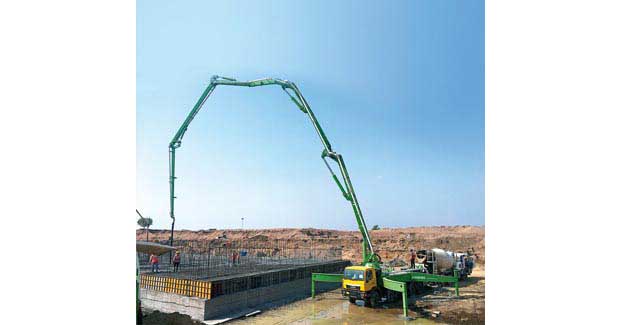
To cater to this demand, Sany has introduced a new-generation series of batching plants of 90 to 300 cbm per hour capacity, the HZS series, with twin-shaft mixing technology batching plant. The company has also introduced 62-m, truck-mounted boom pumps in the market, the longest currently available in India, and a new series of concrete mixers with 10 cu m capacity.
Connected equipment
Customers are increasingly demanding connected equipment and want to tap the benefits of IT to better operate and monitor their equipment, shares Jyothiraj. Sany offers state-of-the-art technology that empowers customers by giving them complete control over their equipment fleet.
"Digitalisation in equipment across all categories (concrete batching plants, concrete pumps, concrete transit mixers and concrete self-loading mixers) is a current trend in demand,"observes Sakthikumar. Schwing’s digitalisation innovations include Schwing Infra IoT In, IoT ready and IoT abled.
At Universal Construction Machinery, a conscious attempt to educate customers on using technology to control multiple machines remotely has paid off, according to More.
"Customers are receptive to our range of smart machines with inbuilt SCADA systems that can be managed remotely by means of laptops or smartphones."
Record concrete pour in Andhra Pradesh
Three Sany 120 cu m batching plants installed by Navayuga Engineering at the Polavaram dam project site in Andhra Pradesh were part of an entry in Guinness World Records for the production of 32,100 cu m of concrete – the most concrete produced and poured in 24 hours continuously. In all, 3.4 million cu m of concrete are needed for this ongoing multipurpose dam for the irrigation department of the state. At the Polavaram site, Navayuga Engineering is operating three 120 cu m Sany twin-shaft batching plants. These new-generation plants allow optimum batch size, have an intermediately aggregate weighing and discharge system, additional waiting hopper and a separate cement and fly-ash weighing system that give the customer 15 per cent higher productivity, 15 per cent less power consumption and 20 per cent lower operating cost for needing fewer spares than conventional batching plants of the same capacity.
Choice of pumps
The Sany 62-m boom pump working at the Polavaram dam project site in Andhra Pradesh offers all the features of Sany higher-capacity boom pumps such as intelligent boom technology with one button stabilisation, boom anti-vibration technology, anti over swing technology, energy-saving technology, one button for low/high pressure changeover, self-diagnosis of faults, etc.
"Users are more aware of global technological advancements in concreting equipment and are willing to adopt such technologies for higher productivity, efficiency, greater convenience and lower operating costs," remarks CR Jyothiraj, General Manager, Concrete Equipment Business Unit, Sany India.
"We use truck-mounted, 50 m boom concrete pumps for our high-rise projects and trailer pumps for lower heights, says Ashok Gupta, Chairman & Managing Director, Ajnara India. "Pumps drastically cut down on the need for manual labour to transfer concrete on a construction site. We prefer pumps fitted with a split panel electrical system, a hydraulic system with manual overrides and 5 Z fold boom sections with a 9-inch barrel size. For either pump, care is important while knowledge of the functioning of a pump and concrete is essential to optimise efficiency."
Building a 196-m RCC dam in 196 days
HCC made use of roller compacted concrete (RCC) to construct the 521-m, 160-MW Teesta IV Low Dam in the Brahmaputra basin for the NHPC, marking the third time the technology has been used in India after the Ghatghar and the Middle Vaitarna dams. RCC has the same ingredients as conventional concrete but in different ratios, increasingly with the partial substitution of fly-ash for Portland cement. Also, the produced mix is drier and essentially has no slump.
For the Teesta IV Low Dam, HCC needed a huge set-up for the continuous feeding of concrete. It set up a four-stage crusher plant to produce over 4,000 tonne of aggregate everyday (at peak time) in four different size fractions – 50 to 25 mm, 25 to 12.5 mm, 12.5 to 5 mm and 5 to 0 mm – with silos for storing and procession aggregates and three fully automated batching and mixing plants equipped with powerful twin-shaft mixers with the capacity to produce over 120 cu m per hour of RCC (one was kept as backup), chilling plants and ice flex manufacturing plants. An inundation system of 4,000 tonne per day capacity helped reduce the temperature of aggregates before mixing. All these plants were connected by a web of conveyor belts covered from top to reduce dust pollution, to produce and drop the RCC at the dam location.
The dropped RCC was collected in dumpers standing on the dam body, relayed to the required location and poured. Once sufficient quantity was gathered, it was spread by dozers into over 300-mm thick layers and compacted with 10-tonne rollers. A nuclear density gauge was used to test the compactness of the RCC. On an average, 858 cum per day of concrete was placed. Thereafter, retarders helped keep alive each concrete layer until the next layer was laid.
Additional equipment needed to source the raw material included bulker trucks to bring 115 tonne (210 tonne at peak time) of fly-ash daily from 320 km away, and around 75 tonne (135 tonne at peak time) of cement from 50 km away, and dumper trucks to bring 2,500 tonne of boulders from around 25 km away. Hydras and tower cranes were used to lift and place the steel shuttering.
"Maintaining this equipment and finding space for it in the confined area of concrete placement was critical, and a big challenge," says Santosh Kumar, Project Manager, HCC. However, "adopting RCC technology helped reduce construction time by more than half, in this case to a record 196 days, and lower the construction cost by nearly 5-30 per cent, compared to conventional concrete gravity dams, depending on the size of the dam."










 Concrete4 weeks ago
 Concrete2 weeks ago
 Concrete2 weeks ago
 Concrete4 weeks ago