Technology offers improvement in efficiency, understanding the market and customer need is critical for the ready-mix industry to increase its market share.
Enabling technologies have brought in changes that redefined the landscape of construction and allied materials. The interesting visible change that is being witnessed or the first-mover advantage lies with the ready mix concrete (RMC), which is commonly referred to as the concrete mixers.
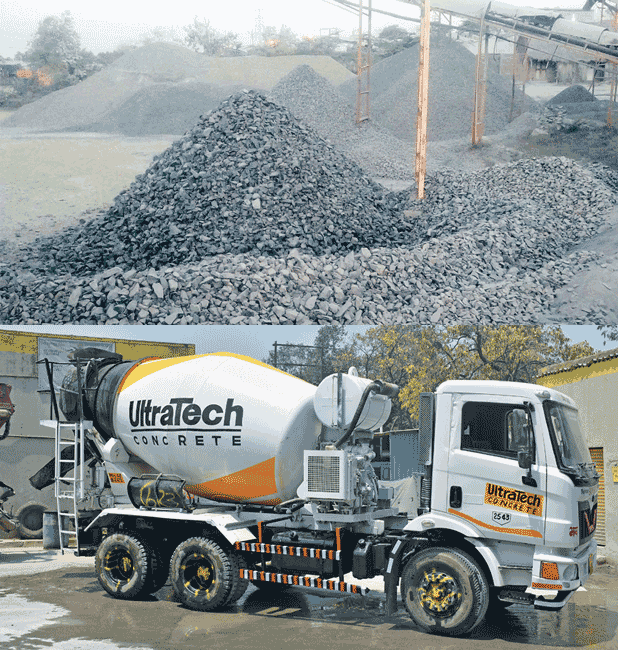
RMC is a type of concrete that is a factory-made product. It consists of a mixture of cement, water, sand and aggregates in a ready to place form. It is a fact that the RMC is best suited when high quantities of concrete or intermittent placing of concrete are required. RMC is also ideal for fast-track projects where the volume of concrete cannot be produced manually. This also is convenient where space is limited, or and where there is little room for a mixing plant and aggregate stockpiles.
In the pre-RMC period, these materials were procured separately, and concrete is mixed on-site by an extensive labour force. Here the (RMC) concrete is transacted by volume and measured in cubic metres (cm3).
Types of machinery There are three types of machines, which are commonly used by the RMC industry. The vertical axis mixers are the most widely used ones among the three. The application is for precast and pre-stressed concrete. This is used for smaller batches of concrete (0.75-3 m3), and multiple discharge points. The second one is a twin-shaft mixer, which is used for high intensity mixing with short mixing times. Used for making of high strength concrete, RCC and SCC, typically in batches of 2 – 6 m3. The most common among them is the drum mixers (reversing drum mixer and tilting drum mixers). These are capable of high production outputs (8 – 10 m3).
Growth drivers: The ever-increasing urbanisation, population, and road network connecting urban and rural areas are considered as the growth drivers for the ready mixers. The ready mix concrete has conquered the market quietly because of the advantages it offers. Easy to use, highly mobile, economical, improved quality and convenience provided by RMC have carved the edge for its self over the traditional ones. Added advantages like low inventory costs, reduction in wastage, con-sistency in quality, low labour cost also made the end-users to opt for RMC. The measurable result of this seen in the considerable dip in the total project cost.
In addition to the above said, factors such as changing volumes handled in given time also is a pro-pellers to the growth seen in the RMC market in the recent years.
Different market research reports speak about the global RMC segment is expected to see a quan-tum jump in growth owing to the ongoing capacity additions in developing countries/economies. Significant movements are witnessed in infrastructure (airports, ports, highway networks, rural road expansions) construction (commercial and residential), power plants, and so on.
The RMC market can be broadly classified as commercial, residential, infrastructure, industrial util-ities etc. Of which the commercial, infrastructure, and industrial services are likely to gain traction in the coming years. Indeed, the ready-mix concrete is majorly used in the non-residential applications. This also means that there is a surge in government spending on infrastructure, construction, and manufacturing sectors are also fuelling growth for the segment. The story is no different in India. To draw an example, the urban redevelopment initiatives like that of Dharavi redevelopment or Bhendi Bazaar could be one of the key drivers for RMC in the coun-try. Dharavi spread across 593 acres and the estimated project cost is Rs 26,000 crore. Bhendi Ba-zaar redevelopment will include rehousing 3,200 families and 1,250 shops present in the area.
The global story
A recently published report by Market Research Future proclaims that the global ready-mix concrete market is anticipated to register a CAGR of 8.02 per cent during the 2017-2023 periods. The introduction of foreign direct investment for the construction of infrastructure is likely to favour market growth.
Market Research Future report further says, "Considering the global scenario, the Asia Pacific re-gion is estimated to acquire the significant share in the worldwide market and is predicted to retain its dominance in the long run. The rising number of latest infrastructural projects, especially in economies likes Singapore, India, Thailand, and China.
"With the rapid urbanisation and industrialisation in these areas, the market is anticipated to flour-ish. Moreover, the ever-increasing population, favourable government policies, high availability of skilled workforce and cheap resources, and low labour and operational costs are contributing to the market growth. The advent of new infrastructure construction projects is also estimated to generate an inflated demand for the RMC market.
"In this region, China has accounted for the lion’s share owing to the refurbishment and expansion of old structures like railway terminals, and airports, along with the implementation of new infra-structural projects. India is also considered as a driving cause for the market owing to the develop-ment of smart cities."
However, the Indian ready-mix concrete market is still in an early stage of its development in India. The uptick in construction of new housing, urbanisation and infrastructure create a favourable cli-mate for RMC in the country. Indian market cement is one of the crucial contributors of Indian economy. With a target of achieving the $5 trillion economies, India offers massive potential in concrete and construction market. With an annual output of 460 million tonnes per year (mtpa) of cement production capacity, India is the second-largest producer of cement in the world.
However, the ready-mix concrete market is minuscule. While the share of ready mix concrete mar-ket in the developed countries stands above 55 per cent on an average, it is believed that the Indian market still hovering around the double-digit mark. For example, Devendra Kumar Pandey, Technical Head RMC business in One UltraTech, says the RMC contribution to the entire busi-ness is between 8-10 per cent, which is a reflection of the industry.
According to Pandey, for the RMC industry, real estate remains the primary growth driver with commercial and residential construction. He added, "At least for the last two years infrastructure has been a major anchor for RMC volumes. That means there were consistency volumes also means there was a good payment cycle that was coming. So even though volume-wise it was not the larg-est sector, which we are serving; still, it becomes an anchor to have a good kind of order profiles."
New trends
There is a movement towards specialised solution-oriented products in the market now. The indus-try sees a growing demand for concrete which is water-resistant, industrial flooring segments, deco-rative concretes.
Traditionally, some products were typically very compatible with manual and lever oriented process are being replaced now. Instead, these products are being replaced by concrete and mechanised product, which is less labour intensive and can be run in a more engineered way. Take the example of lightweight concrete. Traditionally, in the construction of a pillar, sand and broken bricks were used as fillers, which were a very manual process not very environmentally friendly. Now the super-efficient engineered lightweight concrete replaced them. It reduces the dead load on the structure and is equally-priced as the traditional materials (if the labour cost is taken into consideration). It helps the construction industry to overcome the challenge of non-availability of sand owing to the existing ban orders on sand mining. These are thermally very efficient and are greener. The customer demand is refining every passing day; they are looking for an end to end solutions rather than not just concrete but has additional features.
Challenges
A cross-section of the industry is of the opinion that the RMC as a product is not marketed well enough. RMC industry, in the beginning, was considered as a technical extension of the existed mix. Eventually, the market started to supply products from the perspective of customers. Thus the industry has taken the remedial step to address the issue.
The announcement of India aiming to be a $5 trillion economy and the announcement of the alloca-tion of Rs 1 lakh crore for infrastructure capacity addition in the current year’s budget was jubilant news for the industry. However, the trickling effect of the global slowdown had marred a shadow over the industrial segments.
But, the industry stakeholders seem to be optimistic. Pandey added, "Demand does exist, and ac-cording to my calculation on the market for some of these products, these are barely touching the 3 or 4 per cent of the real market potential."
Green, going green, reducing waste extra is the most prominent subjects of discussion. So going forward, the RMC industry develops mechanisms to have zero discharge of RMC plants. While the economic slowdown can create a negative sentiment, the industry is all geared to cater to the ex-pected surge in demand.
LIZA V









 Concrete3 weeks ago
 Concrete3 weeks ago
 Concrete4 weeks ago
 Concrete3 weeks ago