What’s in store for cement?
Analysts across spectrum estimate that if only 25 per cent of houses are substituted, then the total incremental cement requirement per annum will be around 10 MT.
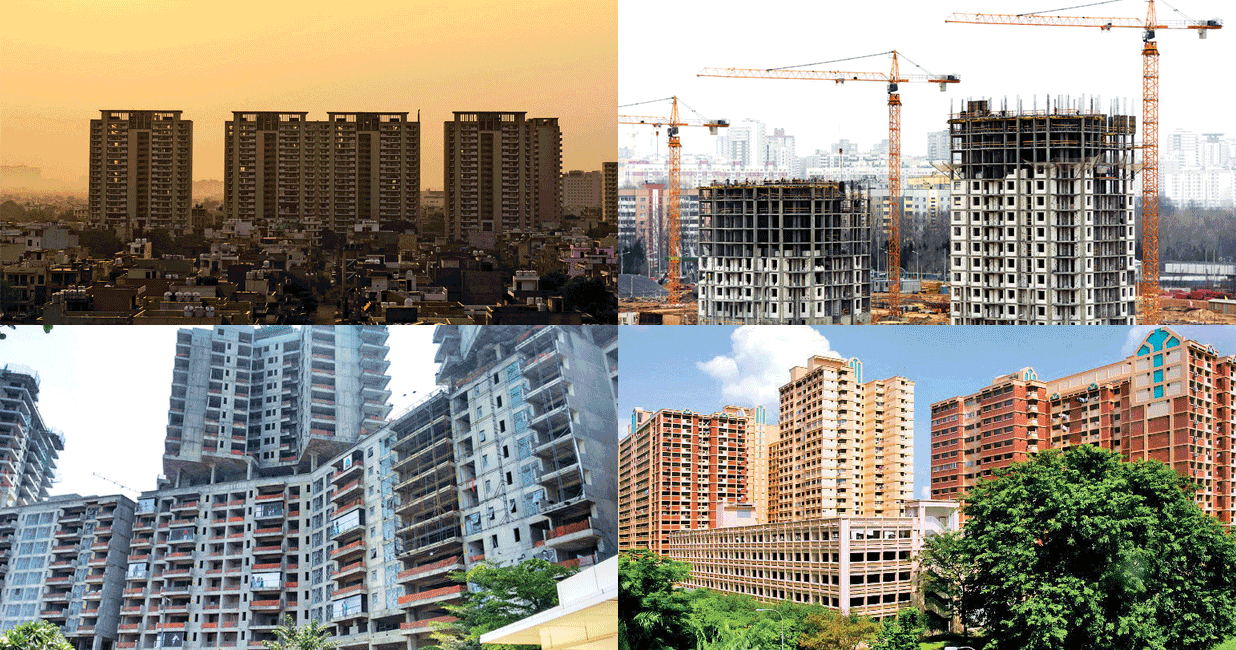
Housing for All by 2022 (HFA-22) is the flagship project of Prime Minister Narendra Modi. President Pranab Mukherjee, in his address to the joint session of Parliament on June 9, 2014, had announced that "by the time the nation completes 75 years of its independence, every family will have a pucca (permanent) house with water connection, toilet facility, 24×7 electricity supply and access". In order to achieve this objective, the central government launched a comprehensive scheme called Pradhan Mantri Awas Yojana (PMAY) – HFA-22. The scheme received cabinet approval in June 2015, and since then has been taking shape for faster execution.
Based on the recent activities of the government, industry experts believe the scheme is finally picking up pace and there may be a big jump in execution than what it was witnessed in the past. In this story, ICR has analysed the construction target of the government, likelihood of actual construction versus target and what is in store for the cement sector if the scheme is implemented on time. The story also analyses which states stand to benefit from this scheme and in turn which cement companies will be the beneficiaries.Increase in demand
Analysts expect incremental cement demand at 3.76 per cent per annum from the ‘Housing for All’ scheme. Based on the calculations in respect of total investment and number of housing units to be constructed under the scheme, cement players expect incremental cement demand to the extent of around 10 MT to be generated, translating into a growth of 3.76 per cent per annum. However, given the fact that cement demand growth of only 4 per cent to 5 per cent coming in from normal housing and infrastructure segments, the total cement demand growth is unlikely to touch double digits despite assumption of full scale implementation of ‘Housing for All’ scheme. Therefore, while the contribution from ‘Housing for All’ scheme is significant, it will not help the cement industry to achieve higher capacity utilisation by FY20.
To this, Pushpraj Singh, Chief Marketing Officer, JSW Cement, says, "On the back of ‘Housing For All’ scheme, we expect cement growth of about 7 to 8 per cent in the times to come." He added: "So if you see the CAGR of the industry, it has not been positive. It has been almost stabilised at whatever level it was for the last five years in South. If you look at the Eastern and the Northern regions, there has been significant growth. Combined, we expect about 6 to 7 per cent growth in the overall cement market in India."Technology
Since affordable housing require fast pace work completion, in this situation, Manju Yagnik, Vice Chairperson, Nahar Group, suggests precast construction as a cost-effective method for affordable housing. "It’s a fast and sustainable building technology for large housing projects that doesn’t compromise on quality," Yagnik says. Precast is a standard building system based on ready-made, factory-manufactured elements and intelligent connections. It provides how to style and construct an ample range of appropriate homes to fulfill the requirements of city dwellers in an exceedingly affordable timeframe and at an affordable price. Such new technologies will help boost the supply faster for affordable housing at a reasonable price. Ashok Mohanani, Chairman and Managing Director, Ekta World, believes that Indian property developers are adopting international strategies like pre-fabricated construction, dry-wall techniques, and slip-form construction for quick development. However, he thinks there’s a need to cut back the value of procurement of recent technological instruments and alternative products and materials. "Value engineering and rationalisation of the overhead costs can facilitate the sector vastly in bringing down the value of affordable housing units," he suggests. 32 million housing units on the card
The government had earlier constituted a technical group to ascertain actual urban housing shortfall in India. In a report published in 2012, the group estimated urban housing shortage at 18.8 million units. For the rural segment, the government recently outlined a scheme wherein it will build 13.2 million houses with the help of state governments and some contribution from the beneficiaries. This adds up to total housing requirement of around 32 million dwelling units (DU) by 2022. Meanwhile, total investment of $246 billion to achieve HFA-22 objectives, which means much higher private sector participation is required.What’s in for the cement sector?
Nirmal Bang, an equity research company based in Mumbai, assumed of
32 million units with an average area of Rs 400 per sq ft at an average construction cost of Rs 250 per sq ft. Nirmal Bang has estimated how much incremental cement demand HFA-22 can generate. The method they have used is based on the total investment and cement intensity of the project. Real estate developers that they connected believe that each housing unit will cost on an average Rs 1,250 per sq ft. Out of this, total construction cost is Rs 700 per sq ft and cement cost is
Rs 100 per sq ft. This tallies with general cement requirement of 20 kg per sq ft for construction of individual housing units. The key challenge in estimating the incremental cement demand and to understand how much this HFA- 22 construction will substitute individual house building in the country. Even if industry estimates that if only 25 per cent of houses are substituted, then total incremental cement requirement per annum will be 10 MT. This is a sizable addition to cement demand at 3.76 per cent.
However, ICICI Securities estimates differ from Nirmal Bang. As per ICICI Securities, even if one estimates only 20 per cent of houses to be constructed under PMAY get completed by 2022, assuming average size of the house 270 sq ft and 18 kg of cement requirement per square feet, it will give total cement requirement of approximately 27 MT by FY22.Companies to benefit
Based on the earlier success of housing construction, analysts believe that PMAY – rural has more potential in states like Uttar Pradesh, Bihar and West Bengal. Cement companies with higher exposure in the eastern and central regions (like UltraTech Cement, Shree Cement, Dalmia Cement and Birla Corporation) will benefit from the same. Under PMAY – urban scheme, states like Tamil Nadu, Madhya Pradesh, Andhra Pradesh and Maharashtra will stand to benefit. Companies with higher exposure to the southern region (like Dalmia Cement, Ramco Cements and India Cements) will benefit from the same.
It is expected that the share of infrastructure in overall cement demand would increase from the current 18-20 per cent to 22-24 per cent over the next five years, led by increased government spend. Over the last few years, weak macroeconomic environment along with several regulatory issues have impacted spending on infrastructure. However, increase in project announcement along with pick-up in execution suggests a sign of revival in the sector.
In addition, with general elections approaching in the next 18 months, it is expected that the project execution pace to improve further. Within infrastructure spends, industry expect roads and highways, railways, metros, airports, irrigation and urban infrastructure to drive higher growth. Analysts estimate a huge 160-190 MT potential cement demand from planned government infrastructure projects.
That said, India’s 17 states are expected to go for assembly election by FY20, which has likely consumed approximately 142 MT (around 50 per cent of cement demand) of cement in FY17. Five states in FY19 and nine states in FY20 are expected to go for state election.The disparity
Housing shortage in India is experienced by lower income group, which makes subsidy model redundant Housing schemes in the past have failed as the subsidy model doesn’t work, because the income level of homeless people is so low that they cannot afford to build a house even with the help of subsidy from the government. Based on studies conducted by the government, the housing need arises from the congestion in the house rather than homelessness.
Based on the government studies, around 80 per cent of total requirement comes from congestion in the house, which means the number of married couples in the house is more than the number of rooms available. This is a common phenomenon in urban areas, and because of the same, slum redevelopment projects take a huge time to take off as the density of population living in the area is high.
Moreover, the studies further highlight that 96 per cent of total requirement is from people coming under economic weaker section and lower income group categories. The definition of economic weaker section then was household with income below
Rs 5,000 per month and the same for lower income group was income between
Rs 5,000 to Rs 10,000 per month. This clearly shows that interest subvention scheme is not likely to address the housing problem as the income bracket of population facing housing shortage will have affordability issues.Progress of PMAY
As of now, 35 MoAs have been signed with 30 states and 5 union territories;
4,317 cities (472 Class I cities) have been selected in 35 states and union territories for inclusion under the scheme. Till now, the government has considered 7,474 projects for construction of 37 lakh houses for the economic weaker section in 35 states and union territories involving central assistance of Rs 2 lakh crore.
Meanwhile, of the Rs 57,000 crore central assistance, Rs 13,149 crore as a part of the first installment has been released to the concerned states against approved projects. As per the Ministry of Housing and Urban Affairs, at present only 3 lakh dwelling units have been constructed so far and another around 13 lakh housing units are under construction.
The industry has added cement capacities at 10.2 per cent CAGR over past decade; while demand clocked about 6.2 per cent CAGR. This has led to increase in surplus capacities from 34 MT (14 per cent of total capacity) in FY10 to 129 MT (31 per cent of capacity) in FY17. Utilisation levels also declined from peak of 98 per cent in FY07 to 69 per cent by FY17. Krupal Maniar, CFA, ICICI Securities, believes that up-cycle would be slow, gradual and elongated as we expect capacity addition at 3-4 per cent CAGR over next five to six years.
Increasing greenfield plant capex cost and rising entry barriers (like mine auction, regulatory clearances) are unlikely to push supply additions significantly. ICICI Securities expect cement demand to clock approximately 6 per cent CAGR (still lower than/in-line with GDP growth), resulting in gradual but steady improvement in utilisations over next five to six years. The Government focus on rural economy and higher infrastructure spends is likely to improve demand for the sector. Accordingly, Dharmesh Shah, Research Analyst, ICICI Securities, says "we expect utilisation to improve gradually by 500 bps to 74 per cent in FY20E."More M&A deals in the offing
The cement industry has seen some consolidation in recent years due to rising overcapacity, longer gestation periods (in securing various government/environment clearances, acquiring land), higher costs (elevated land costs) and issues relating to debt servicing. Some of the key deals have been UTCEM acquisition of JPA cement assets, Nirma’s acquisition of Lafarge cement business in India, and Birla Corp’s acquisition of Reliance Cement. The due diligence for ACC-ACEM merger is also on. Binani Cement and Murli Industries are under NCLT restructuring with Dalmia Bharat recently announcing the acquisition of Murli Industries.– RAHUL KAMAT