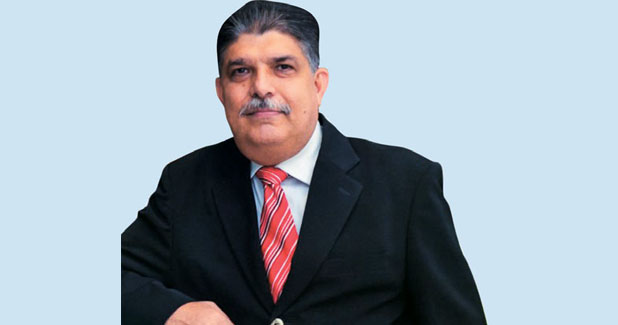
Rajnish Kapur, Business Head – Grey Cement, JK Cement
In a freewheeling interview, Rajnish Kapur, Business Head – Grey Cement, JK Cement, speaks on his company?s expansion plans and the state of the cement industry at large.
Give us some idea of the JK group and its foray into the cement business. What are your plans for expansion?
JK Cement is part of the multidisciplinary industrial conglomerate JK Organisation. We have over four decades of experience in cement manufacturing across the core categories of grey cement and white cement with value-added products like wall putty and waterproofing compounds, etc. Our enduring strength remains in our diverse product portfolio, high quality raw materials, consistently growing capacity, an extensive marketing and distribution network and the technical knowhow. JK Cement entered into the cement business by commencement of commercial production at the Nimbahera facility in 1975 with an annual capacity of 0.3 MTPA. With constant upgradation, the unit?s present capacity has touched 3.25 MTPA. It is equipped with a waste heat recovery system of 13.2 MW to reduce the electrical energy cost and utilise waste heat. The Mangrol facility?s commercial production commenced in 2001 with 0.75 MTPA capacity which has increased to 2.25 MTPA, along with a 25 MW captive power plant, a 10 MW waste heat recovery plant and a split grinding unit at Jharli with a capacity of 1.5 MTPA.
Near Muddapur village of Karnataka, we have a 3 MTPA plant which is based on Portland and slag cement. The Muddapur facility is equipped with the most advanced technology available in the global market, making it the most modern plant.
The Gotan facility at Rajasthan is a dual-process plant with the capability of manufacturing grey cement as well as white cement. The Gotan facility?s existing grey cement capacity stands at 0.5 MTPA. We were the first in India to build a white cement facility. The white cement plant was commissioned at Gotan in 1984, with an initial production capacity of 0.05 MTPA. Over the years, continuous process improvements and modifications have enhanced the plant?s production capacity to 0.6 MTPA. Our wall putty capacity was 30,000 tonnes per annum in 2005, which increased to 5 lakh tonnes in 2013. With the commissioning of the Katni unit, the capacity has surged to 7 lakh tonnes.
How has the consolidation phase in the cement industry progressed so far? Do you expect more consolidation to happen, or less, in the next 10 years?
I think in the year 2008 when I joined the cement industry, we saw the meltdown at the global level. Especially, I remember in a country like Spain, the cement consumption suddenly dropped to what it was 40 years back. But before that, the industry was doing very well from the global perspective. In India, the last couple of years have seen about 40 million tonnes of capacity changing hands. The reasons are many, but inability to service debt due to high infrastructure cost is one of the most prominent reasons. But mergers per se are not new to us. We saw the first consolidation taking place way back in 1936, where 10 existing cement companies came together under one umbrella in a historic merger and formed ACC. It is a matter of opportunity. Today, setting up a plant after acquisition of land has become extremely difficult. It makes more sense to acquire plants rather than build them. At present, there is huge surplus capacity over demand. In a wider sense, it helps the economy. The chances are that consolidation may make some players very strong, but it is taken care of by the Competition Commission laying down strict guidelines for acquisition. We, at JK, are watching the emerging opportunities and will take appropriate decisions when needed. As per my understanding, a reasonable amount of consolidation has already taken place, and while there may not be many big ticket acquisitions in the offing, standalone plants may still come up for sale.
Do you think there is a disconnect between the GDP numbers and the demand growth the cement industry is witnessing? At GDP growth of 7.6 per cent, the cement industry?s growth should have been more than 10 per cent…
The historic conversion ratio of cement industry growing at 2 to 2.5 per cent over GDP has seen a shift in the past decade or so. This may be attributable to a shift in the major drivers of cement demand growth; for example, there is a difference in the dependence of cement growth on infra today. Housing, being the biggest driver of growth, has seen a slowdown due to a number of unsold dwellings in the market. The large infra projects need a long gestation period and are now in the take-off phase. We, however, need to look at the Indian cement industry in context of the global scenario, wherein Indian growth is actually much higher than peers and developed economies. On a near-term analysis, with this year having good monsoons and the government infra push, we should see a positive impact. Over the long term, we should see road & highway projects, Smart Cities, ?Housing for All?, Metro projects, etc., driving growth.
Does JK Cement have any new market initiatives planned in the near future?
Customer orientation and service is our mission and we are constantly evaluating as to how we can improve our offerings to the customer. The first and foremost responsibility is to deliver a product that exceeds all quality parameters and we at JK Cement have the best quality monitoring systems in place. We are also taking a number of steps to improve our service to the customer. In terms of logistics, we are ensuring that we reach our network most efficiently. In the recent past, we have taken a number of steps to improve the capabilities of our own team, as well as our channel partners. Regular meetings with our channel partners are helping us understand the market needs correctly, and regular market visits by all in the hierarchy help us to be proactive in our service to the end customer. One area where we have made a paradigm shift is to separate the technical support activities for our grey cement and white cement divisions. With this, we are able to focus more diligently on the requirements of our respective customers. In continuation to this, we are also establishing concrete labs in different cities. We are also working on having a deeper penetration of our network. We have also planned various new initiatives in the near future, like we are working on a ?Go to Rural Market Model? to reach out to our rural customers. We have also recently launched a new influencer management scheme by which we hope to engage our influencers more meaningfully. Also, we will be adding various new value-added services for our customers and professionals looking at their needs, which will help them in building strong homes.
We have added a number of large infra players to our portfolio, and since the last year, JK Cement has been recognised as one of the major suppliers for big projects in the country. We have significantly increased our key account capability and this has also helped us get good brand visibility. Sustaining a good key account is not an easy task as we have to meet the expectations of various stakeholders in terms of product quality and supplies. Our product range is already approved by various agencies, which reflects the confidence of large buyers in our product quality. We also keep a close tab on the market to understand how our cement is performing in the hands of our customers. Our aim is to produce the best cement and provide the best service to our customers.
JK Cement has been ahead of others in power generation through Waste Heat Recovery (WHR); please give us some insight into how you have been doing it…
Our CMD, YP Singhania, is a great visionary. Living up to its reputation of pioneering many firsts in India, JK Cement became the first company to invest in installation of a WHR concept-based 10 MW power plant in India, in collaboration with TEC, Japan in 2008, and got carbon credit certificates under CDM, initiated by the World Bank, to reduce the carbon dioxide footprint. It was increased to 13.2 MW in the following years. As the plant capacity increased during the years due to upgradation in Nimbahera and new lines in Mangrol, we have today reached a total of 23.2 MW of WHR capability. In Muddapur, Karnataka, captive power plants were conceived along with the project and 2 x 25 MW coal based plants were installed.
Our current focus is to improve our capability to use AFR. Taking inspiration from the best companies in this field, we would like to improve our capabilities significantly. It makes good business sense, and it also helps the country.
How is the PAT scheme working for the industry, and more particularly, how is it working for JK Cement?
Perform Achieve and Trade is a scheme started by the Government of India under various international agreements to reduce the footprint of GHG (Green House Gases) by way of improving energy efficiency in energy intensive manufacturing sectors like steel, cement, etc. The Bureau of Energy Efficiency was set up under the Energy Ministry to look after this legally binding scheme. We have completed the 1st cycle of audit, and achieved our target. It is always easy to complete the first cycle. It is like an examination – getting up to 70 per cent of marks is fairly easy, but to increase the percentage from 80 to 85 is fairly difficult. We got the credit certificates for the first phase, but the 2nd cycle is going to be tough. We feel that the PAT scheme as such makes good business sense also; it?s not to be looked upon merely as a push from the government. In the second cycle, we are taking many small steps. Our focus is lowering electrical and thermal energy. We have planned investments accordingly – the major one being replacing drives with variable speed drives.
How has been the performance of JK Cement in the production of blended cements? Is JK planning to start production of composite cement? What do you think about the market for composite cements?
JK Super Cement is one of the premium grey cement brands in the country, available as Portland Pozzolana Cement (PPC). The product complies with quality standards specified by the Bureau of Indian Standards (BIS) and is much in demand, from both the retail and the institutional segments.
When I was at Bangladesh, we tried making a masonry cement while working with a Holcim plant. However, it was not a success because of improper use by the end customer. The regulatory system has to be in place and effective for application-based products. If the product is used for an incorrect purpose, then the results can be catastrophic.
We welcome the plan to introduce composite cements and we are evaluating the potential of this product. In Muddapur, we produce all three types of cement and can launch composite cement, if we find a demand for this product. We have started taking laboratory trials and evaluating all options.
We would like to know more on your dual-process plant, which can produce grey as well as white cement.
The white cement plant at Fujairah has been established with technical assistance of Taiheiyo Corporation, Japan. The company?s grey cement plant at Gotan in India is also of Taiheiyo technology and it can produce both grey and white cement. Similarly, the plant at Fujairah can produce both grey and white cement and the capacity is 0.6 MTPA of white cement or 1 MTPA of grey cement, or a combination of both. The changeover from white to grey or vice versa can be done in a short span of two to three days. However, presently the company is operating the plant at Fujairah only for production of white cement and has no immediate plans of producing grey cement, looking at the market conditions in the region.
Can you brief us on your CSR initiatives?
JK Group is known for its philanthropic initiatives in our country. The group has made many contributions to society by way of running schools, colleges, training facilities, ITIs, and building temples, etc. The JK temples in Kanpur and Nimbahera are much revered and are important religious places. We have built some of the best schools in the states in which we operate. LKSEC, Gotan (Rajasthan) is one such school where students from all parts of the country strive to get admission. We also have a university and a management college in Udaipur. At Nimbahera, we have constructed a new building for ITI this year, and it has received green building certification. We are running an RTC for the past few decades. Here, we not only train our own employees, but also those from other companies as well. In addition, we take a number of initiatives to improve the living conditions of our plant neighbourhood like vocational training, supply of water to villages, etc. We also encourage architects by conducting one of the most prestigious competitions for Indian architects and those from neighbouring countries. AYA is now in its 25th year, and we have honoured almost all the leading architects of India during the last 25 years.










 Concrete4 weeks ago
 Concrete2 weeks ago
 Concrete2 weeks ago
 Concrete4 weeks ago