The use of Asbestos Fibre is increasing globally, after a decline in the 1990s. A study shows that a substantial increase in consumption in about 12 countries particularly from the year 2000 to 2004. Use of Asbestos has always been a contentious subject to deal with, we have tried to give a fair picture on the subject.
Nature has provided us a wonderful material which is in use in the present form for more than 100 years. We are talking about Asbestos. It is a naturally occurring mineral that is commonly used as building materials. Asbestos consists of long, thin fibres which make it as a good thermal insulator. For a thousands of years, people were knowing this fire-resistant, strong yet flexible material. From the early 1900s and downwards, Asbestos has been largely used in the fields of construction, maritime, industrial and commercial products.
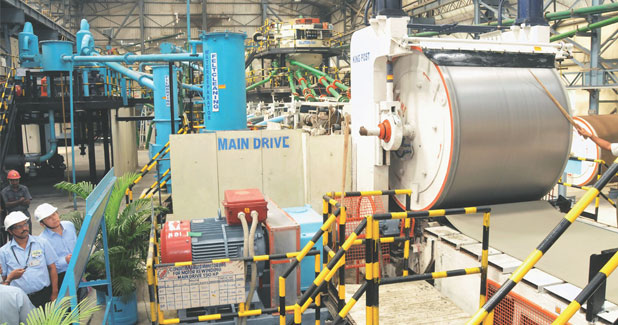
More about the material properties and it?s superiority has been stated in the interview given by John Nicodemus of ?The Fibre Cement Products Manufacturers? Association? and Jayachandran of HIL Ltd. The known use of Asbestos is not merely to provide reinforcement to the cement sheets but the same material due to it?s properties find its usage in heat and electrical insulating materials like gloves used in furnace, making rope for electrical and heat insulation, industrial gaskets, protective clothing for use in high temperature areas etc. Sheet panels and false ceiling tiles is another use of Asbestos fibre. But the major one has remained in making corrugated sheets. Asbestos is a very good additive with cement which adds strength to the material. Compared to other cement additives, Asbestos is cheap yet durable. The technology of producing sheets is pretty simple and quite old. Some improvements have happened over time but these are not major ones as stated by Jayachandran of HIL Ltd. For producing the sheets and other products there are well laid out specifications by Bureau of Indian Standards. The detailed manufacturing process is given else where in the issue.
Advantages of Asbestos
In terms of building roof shingles, they could last for about fifty to sixty years. Compared to plastic and wood, Asbestos is undoubtedly first in terms of longevity and cost together. More on the advantages you can read the interview of John in this issue.
Particularly in a country like India it will be just impossible to stop use of corrugated Asbestos cement sheets simply due to cost consideration and number of users coming from economically weaker class.
Disadvantages of Asbestos
Among the entire family of Asbestos fibres, Chrysotile or white Asbestos is widely used and supposed to be safe in it?s application as stated by both Jayachandran and John. The Amphibole or black variety variety of Asbestos has been prohibited, the world over. However World Health Organization and International Labour Organization do not agree with the statement. Views of both these organisations have been printed elsewhere for our readers.
Those who are directly exposed to Asbestos like construction workers and carpenters, can be afflicted with lung cancer and mesothelioma. Mesothelioma is defined as a rare cancer that affects the linings of the lungs or abdomen. Because the disease typically takes 20 to 40 years to manifest, workers can go through their careers without realizing they are getting sick. Due to its health risks, certain Asbestos products are banned in many countries, especially in Europe, but there is no ban in U.S and Canada. Asbestos in the bound form or combined form is not at all dangerous but loose Asbestos fibres are always dangerous. What is utmost important is letting loose Asbestos fibres in air. Asbestos in the loose form which ever variety is certainly dangerous because the chances of inhaling Asbestos are highest in loose form. In the past as stated by Jayachandran was extremely dangerous. If there is careless construction method concerning Asbestos, the Asbestos fibres can be lodged into the air. Though it might seemc that there?s nothing special about it, Asbestos fibres pose a great risk to one?s health.
The immediate competitor for the corrugated cement Asbestos sheets have been the metal sheets either Aluminium or Galvanized Iron. But these two products are miles away in the initial cost. There have been claims and counter claims on the advantages made by Asbestos Sheet producers and Metal sheet producers. We produce both comparisons and leave it to the judgment of the readers. Refere to Table 1 and Table 2.
Elimination of asbestos-related diseases
There have been many negative reports published about use of Asbestos, we tried to get some information from the website of World Health Organisation.
All forms of asbestos are carcinogenic to humans. Exposure to asbestos, including chrysotile, causes cancer of the lung, larynx and ovaries, and also mesothelioma (a cancer of the pleural and peritoneal linings). Asbestos exposure is also responsible for other diseases such as asbestosis (fibrosis of the lungs), and plaques, thickening and effusion in the pleura.
Currently, about 125 million people in the world are exposed to asbestos at the workplace. According to the most recent WHO estimates, more than 107,000 people die each year from asbestos-related lung cancer, mesothelioma and asbestosis resulting from exposure at work. Approximately half of the deaths from occupational cancer are estimated to be caused by asbestos. In addition, it is estimated that several thousand deaths annually can be attributed to exposure to asbestos in the home.
It has also been shown that co-exposure to tobacco smoke and asbestos fibres substantially increases the risk for lung cancer? and the heavier the smoking the greater the risk.
WHO response
The World Health Assembly Resolution 58.22 on cancer prevention urges Member States to pay special attention to cancers for which avoidable exposure is a factor, including exposure to chemicals at the workplace and in the environment. With Resolution 60.26, the World Health Assembly requested WHO to carry out a global campaign for the elimination of asbestos-related diseases "…bearing in mind a differentiated approach to regulating its various forms – in line with the relevant international legal instruments and the latest evidence for effective interventions…". …".. Cost-effective interventions for prevention of occupational lung diseases from exposure to asbestos are among the policy options for implementing the global action plan for the prevention and control of noncommunicable diseases (2013-2020), as endorsed by the Sixty-sixth World Health Assembly in resolution WHA66.10 in 2013.
Position on safety in the use of asbestos
ILO has taken similar stand as that of WHO. Two important clauses from ILO statement on Asbestos are reproduced here.
The Occupational Cancer Convention, 1974 (No. 139), provides for the measures to be taken for the control and prevention of occupational hazards caused by carcinogenic substances. Key provisions of Convention No. 139 concern:
- Periodically determining the carcinogenic substances and agents to which occupational exposure shall be prohibited or control;
- Making every effort to have carcinogenic substances and agents to which workers may be exposed in the course of their work replaced by non-carcinogenic substances or agents or by less harmful substances or agents;
- Reducing the number of workers exposed to carcinogenic substances or agents and the duration and degree of such exposure to the minimum
A Resolution concerning asbestos was adopted by the ILO Conference at its 95th Session in 2006. Noting that all forms of asbestos, including chrysotile, are classified as human carcinogens by the International Agency for Research on Cancer (IARC), and expressing its concern that workers continue to face serious risks from asbestos exposure, particularly in asbestos removal, demolition, building maintenance, ship breaking and waste handling activities, it calls for:
- The elimination of the future use of asbestos and the identification and proper management of asbestos in place as the most effective means to protect workers from asbestos exposure and to prevent future diseases and deaths.
- The Resolution also underlined that the ILO Convention on Safety in the Use of Asbestos, No. 162, should not be used to provide a justification for, or endorsement of, the continued use of asbestos.
Table 1: Extract of the claims made by "The Fibre Cement Products Manufacturers’ Association"
| S.No. |
Characteristics |
Asbestos Cement Sheets |
Galvanized Aluminium Sheets |
| 1 |
Life Span(Years) |
50 yrs (Min) Non-Corrosive |
10-15 yrs |
| 2 |
Fire Rating |
Fire Retardant and Non Combustible |
Tendency to twist and melt |
| 3 |
Thermal Insulation & Accoustic Rating |
Good |
Poor |
| 4 |
Energy Required in Production
(Kilowatthours(kwh)/SQ.M) |
16 |
69 |
| 5 |
Weather Effect |
None |
Corrosion at drilled holes and
where galvanizing is cracked |
| 6 |
Noise Level |
Low |
High |
| 7 |
Cost |
Low |
High |
Table 2: Life cycle cost comparison claimed by the manufacturer of metal sheets
| S.No. |
Item |
Aluminium
Plain |
GI
Plain |
Asbestos
Bare |
| 1 |
Thickness (mm) |
0.7 |
0.5 |
5 |
| 2 |
Qty(Kg) required per sq. mtrs
of area |
2.5 |
3.9 |
13.5 |
| 3 |
Price (Rs./ Kg.) |
220 |
42 |
15.4 |
| 4 |
Total Cost per Sq. mtr. |
550 |
165.5 |
207.9 |
| 5 |
Life Span
|
40 |
10 |
15 |
|
|
Net Cost per year per sq. mtrs |
13.8 |
16.5 |
13.9 |
| 6 |
Scrap Value after life span |
250 |
11.8 |
0 |
| 7 |
Net cost per year per sq. mtr
(Considering Scrap value) |
7.5 |
15 |
15
|