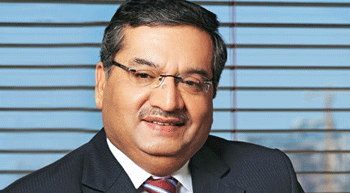
Vinay Wadhwa, Executive President – Marketing, Wonder Cement.
By having a two-pronged strategy, a proper effective network will push our brand and proper branding and other strategies will create a pull for our product, says Vinay Wadhwa, Executive President – Marketing, Wonder Cement, while sharing his thoughts on effective marketing in cement industry. Excerpts from the interview…
What is the thought process behind the preparation of your media plan?
When we formulated our campaign and media plan, we wanted to stand out from the clutter. We are focusing on perfect beginning which is an emotional bonding we wish to create with our consumers. When a consumer buys cement, he is looking for strength and durability. We would like to highlight these attributes through our other activities which we do on regular basis.
As a new brand, we don?t want to be just another brand. The two words, Perfect and Shuruaat, are of prime importance. When one starts any project, the first activity happening at the construction site will be procuring a bag of cement. Once a consumer selects Wonder Cement, he is making a perfect beginning. So we are trying to correlate every beginning with Wonder Cement as a perfect shuruuat. This is the thought process behind the entire campaign of Ek Perfect Shuruaat. So, these two words are the cornerstones of our campaign. We use most of the media which are relevant, like electronic, outdoor, print, hoarding/unipoles for the same.
What are the challenges that you foresee in the market and how have you factored them in your marketing strategy?
Cement industry?s growth is directly related to growth of the economy, the GDP. The industry is very competitive at this point in time and every brand has to really work hard to make its presence in the market, more so the new brands like ours. There are cyclical variations in the demand which is very important. During monsoons and severe cold conditions the demand dips. We try to anticipate the demand based on various parameters from the past trends and procure additional orders from the market to sustain through this lean period. There are certain projects which are very important, although these also get affected in the lean period, the degree of slowdown in those projects will be comparatively lower than the normal projects. The intensity of monsoon varies from state to state. So we try to focus more on states which are less affected during monsoon. Same is the case with winter season also, states such as Madhya Pradesh and Gujarat are relatively less affected where we can focus more during this season. Thus we are able to keep a balance during the lean period and minimise the effect of cyclical variations.
With rising input costs, price hike is inevitable. This will force consumers to shell out extra for your product. How do you tackle this scenario?
Costing is one part of on which, we have little control. Input/material cost is increases for everybody and we, of course, will try and put effort to bring down this impact to the minimum level. Similarly, in the case of pricing, cement is being sold with various factors of product differentiation and branding to create brand equity however, cement rates won?t vary much from brand to brand In. So we do not have much control on price. Demand-supply is another important factor. If the cost is rising and the demand is favourable, it may be possible set off some increase in cost in the pricing. But it may not always hold good. We have to find out ways to minimise the impact of cost increase, for example, make the overall distribution more effective to bring down the overall logistics cost.
Another important factor is that since we strongly believe in quality, and we have been able to create perception of the quality in the minds of the consumers. There does exist a correlation between pricing with quality and we have been fortunate to build up a good image for the product.
Which is a better strategy, distributing through few large dealers, or routing it via an extensive network of small dealer outlets?
Both have their own advantages. We need a healthy mix of both. Cement is distributed widely, which means, we are available in every tehsil markets and most of the villages. To ensure that our cement is available in tehsil level and village level, naturally, we require a vast dealer network. They ensure our brand presence in those markets. This is one approach. The other approach for metros and big cities is a combination of small and big dealers. Big dealers also have their own role, like they have more resources and have more presence in the market. So overall, we need to have a combination of both small dealers and big dealers. But our endeavour is to be present in most of the smaller markets, rural areas, and tehsil level. So naturally, smaller dealers do play an important role in the overall distribution. So it is a healthy mix of small and big dealers, depending upon the potential, location, and the type of market .In the overall analysis the dealer has to be effective in his area of operation.
How do you create brand differentiation and stand apart from the rest?
Our aim is to create Wonder as a niche brand. The strategy is to push the cement through a network of dealers. We also create a demand for our product through various advertisements and branding activities. We conduct meeting with masons on a regular basis, educate them about the quality, proper usage and storage of the cement. Regular meetings are also conducted with architects, leading builders, and other influencers in the market.
So, by having a two-pronged strategy, a proper effective network will push our brand and proper branding and other strategies will create a pull for our product. We try to achieve a push and pull for the product so that we are able to stand out in the market.
Apart from that, bulk of our cement is sold through trade network, the dealers. The dealers must have the confidence in our product, company and practices. So we are regularly taking the dealers to our factory so that they can see for themselves the kind of technology we are using, how the systems work and how the cement is dispatched. Once the dealer is convinced, it is easy for him to convince the consumer. This is one way to convince the man (the dealer) who is actually marketing our cement.
How do you reach out to different construction professionals?
We have segmented the market. First, is the individual house builder, for them we target the masons and dealers because individual house builder is in touch with these two influencers. If a dealer is effective and has a clout in his area, most of the household builders approach him for cement. The second segment is the contractors, for them we conduct separate regular meetings and educate them about the quality of the product. The third segment is big contractors who are involved with big projects. To convince them about the quality, we provide them with required technical support and convince them about the quality through our professional technical team. They go to various project sites, meet the contractors, understand their requirement and try to workout the required solution.
We also have technical vans with testing equipment, which move from project to project and site to site. At the site, our technical staff deputed on these vans demonstrates the quality of our product as it is equipped with basic testing facilities.
Quality perception of cement varies from customer to customer. How do you factor this in your marketing plans?
Perception is also built up on facts. Perception and actual situation normally do not vary much. So even when we do all these activities, if the consumer wishes to test our product at an independent laboratory, we facilitate the same as this convinces him as to the quality of the product. v Could you share with us the segment-wise break-up of sales?
Segmentation can be geographical and on end user basis In the end user segment, there are trade and non-trade. We sell 80 per cent through trade and 20 per cent through non-trade segment which is a combination of institutions, government projects etc.
Geographically almost 48 per cent of the total sales is in Rajasthan.
Other than price and quality, which factors influence buying decisions?
There is a mix of various factors that influence buying decisions. Apart from quality and price, advertisements, sales promotional activities, regular availability influence the buying decision. Another important factor is market presence through a vibrant network. Effective distribution of the product is very important so overall, a combination of factors such as pricing, quality, distribution and proper servicing will create a positive buying decision.
What are your current marketing plans / initiatives for promoting your products?
Currently, we are able to sell whatever we are producing and we have been able to create a niche in the market. The endeavour is to have an identity of our own. It is a long term process, but ultimately if we have our own identity, then we are more comfortable in the intense competition prevailing in the market. So the marketing plan is primarily to create a brand and an image for the product in the market. Branding of course is important. At the same time, the philosophy of our management on quality is of utmost importance to us. Our primary objective is to give our consumers a quality product at competitive price, we follow transparent policy in every activity backed by quality product and system, which is transparent and fair to everybody. Thus, we wish to create a positive image for the group.
We have been able to create the perception of quality in the minds of the consumers and fortunate to build up a good image for the product.









 Concrete3 weeks ago
 Concrete3 weeks ago
 Concrete4 weeks ago
 Concrete3 weeks ago