Yashovardhan Daga Executive Director, RBBR Infrastructure
Indian construction industry is now slowly embracing precast building technology. Improving socio-economic development has increased demand for affordable housing. Indian government is planning to provide subsidies for builders to meet the shortage of 25 million affordable apartment buildings. Precast is also popular for commercial projects. With growing number of infrastructure projects initiated Precast industry is set to boom in India. The technology has been proven to be a good solution for ensuring work safety and dealing with shortage of skilled labour in the building industry. ICR interacted with Yashovardhan Daga, to understand the growth potential of the sector.
How is precast market evolving in India?
Precast is mostly suitable to companies that take up huge building projects that could be constructed from repetitive simple units. For example, large building companies. However, the demand from such companies is so large that they have their own precast units. So large companies build precast structures for their own captive consumption. Small contractors on the other hand come to precast manufacturers only when they get desperate. They come to us when five months of the six month project are over and now they have to rapidly finish a large chunk of the project in the remaining one month. They might be facing labour shortages and precast is their only way out.
Builders do understand the merit of precast, but the economics do not permit them to setup their own precast units. However, they are getting inspired from success of other builders exploring precast structures and are slowly moving to this method of building. We intend to tap housing segment for sale of precast products.
Why are large infrastructure companies not owning their own precast unit?
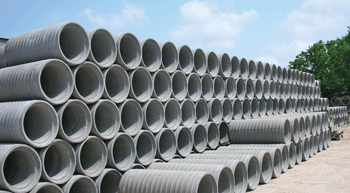
It is not necessary that all infrastructure building companies will opt for having a captive precast unit. For example, L&T is one of the largest infrastructure company in India, but they are not setting precast RCC pipe manufacturing units everywhere. Precast RCC pipe manufacturing is not their core business. Neither can one guarantee today how the infrastructure growth will be tomorrow. Today we have lots of road projects in hand, but five year down the line we may not have that many road building projects. So it will be better to outsource precast material, than to have your own unit.
How is the demand for concrete in India?
Concrete is a pretty standard product and there is always a certain amount of demand for this product in the market. However, the demand is low. We are not exactly in the concrete manufacturing business, but we keep interacting with equipment suppliers and we know that the demand is low. However, concrete market in India is large and unorganised and a lot of concrete manufacturing goes unreported.
How is availability of aggregates affecting the business? And what can be done to alleviate the issue?
We are facing aggregate shortage due to ban on mining. In India several mining operations are put to halt for environmental reasons. However, this is not a problem that cannot be solved. Concrete is manufactured in European countries too. European nations have some of the most strictest norms when it comes to environment. If aggregates and concrete can be manufactured there, then India too can find a way to manufacture it here.
One critical aspect here is that in India we do not have concretologists. If you look at the websites of international concrete suppliers, they give in-depth technical details of the material being supplied. Here we are rarely bothered about such details. Yes, we have shortage of aggregates, but then why are we not using granite as aggregate material, which is available in plenty. We are a bit hesitant when it comes to trying out a new technology.
What government initiatives can help precast industry?
Taxation must be rationalised for precast manufacturers. Just because we have a factory we are taxed extra. We often lose customers to competitors who are evading taxes. When a builder purchases a unit from us, they have to pay the VAT as well as Excise. This is an extra burden of around 15 per cent tax on the precast manufacturing industry. We are contributing to construction activity directly and should be treated as construction contractors while designing a tax policy that affects us.
What do you look at while selecting a vendor for suppling equipment?
While selecting a vendor, our first priority is to look at service quality. They must provide support in maintenance of the equipment. If we are churning out tonnes and tonnes of material on a daily basis, the machine is going to require maintenance too. So we want our equipment providers to support us when we need it. This is very important if we are trying a new product for the first time. We expect the vendors to support us for first two months at least. Second is price, but not at the cost of quality.
What about Chinese products? How is their quality?
I have not purchased any thing from china, but I have been visiting the Chinese market and their exploring equipment market. From what I have seen, there is nothing wrong with the quality of Chinese equipment. I saw that their customers are happy, both in and out of China. So, I feel that it is a myth that just because something is from China, its quality is bad.
Chinese manufacturers are perhaps falling short when it comes to marketing skills. We saw that a Chinese company may be selling 1 million units, but when we interact with their people we do not get satisfying answers to our queries. However, when we examine their equipment we do not see anything wrong with it. So I feel that it is just a language barrier.
We rarely develop indigenous products. Are we falling short on technological front?
I think that technology wise we are not lagging behind. A country that can build rockets can also build machinery for precast products. But we have to grow our appetite to take-on challenges. For example, there are only a few big precast manufacturers in India. But if one contacts them for a new product, then they have to contact their foreign partner for the know-how. We must learn to be come self sufficient and develop products indigenously.













 Concrete4 weeks ago
 Concrete2 weeks ago
 Concrete2 weeks ago
 Concrete4 weeks ago