Connect with us

Concrete

Putzmeister Breaks Concrete Pouring Record in the World

Published

on

Shares

Putzmeister`s machines are involved in the construction of metro rail projects, expansion and modernisation of international airports at Mumbai, Delhi, Kolkata and Bangalore; as well as building of diverse power plants, hydraulic projects, liquefied natural gas tanks, refineries, ports, roads, bridges, high-rises, and many such challenging projects.

Putzmeister Concrete Machines India is a 100 per cent subsidiary of Putzmeister GmbH, world?s No. 1 manufacturer of high capacity concrete machines. Putzmeister India manufactures an entire range of high-tech innovative concrete equipment, adapted to the Indian market specifications and the needs at its factory and head office in Verna, Goa. The company?s sales and service network is spread across India, continuously expanding further to cater to the growing infrastructure demands of the nation. As the pioneer of R&D in concrete pumping technology, Putzmeister is dedicated to offer the best and latest innovations in India.

Putzmeister?s machines are involved in the construction of metro rail projects, and expansion and modernisation of international airports at Mumbai, Delhi, Kolkata and Bengaluru; as well as building of diverse power plants, hydraulic projects, liquefied natural gas tanks, refineries, ports, roads, bridges, high-rises and many such challenging projects.

Continuous overnight concrete pour at NCC power project
Beginning of this year, Putzmeister completed a challenging pour at NCC power plant project at Krishnapatnam in Nellore district of Andhra Pradesh. Putzmeister?s boom pump-BSF 36.04H-ECI-withstood the continous concreting of the foundation, which was carried on overnight, completing this feat early morning the next day. The company is proud to be associated with clients who enable us to perform extraordinary tasks.

Putzmeister continues to provide the best innovations and quality in its concrete equipment. The world and our global partners know that Putzmeister is the one who sets standards ?every single time we pour?. At the same time, on the other side of the globe, Putzmeister was all set to create a new world record in Los Angeles, US.

Putzmeister sets new Guinness World Record for longest continuous pour in US
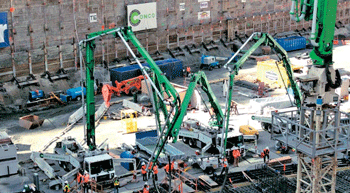
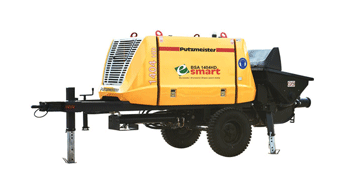
After a great successful concrete pour in India, the next day Putzmeister set a world record in Los Angeles, US. The massive pour took place with 12 Putzmeister truck-mounted concrete boom pumps ranging from 32 m to 47 m, two Putzmeister placing boom towers and two Putzmeister trailer-mounted pumps. These concrete pumps were strategically placed both inside and above the excavation. Total 19 pumps were utilised for this enormous 16,200 cm3 concrete pouring. It took 18.5 hours to complete the pour, which steered Putzmeister towards setting a new Guinness World Record for the largest continuous concrete pour on 15 February 2014 in Los Angeles.

The pour was to lay the foundation of the Wilshire Grand project, which will be the tallest structure west of the Mississippi when finished at 73 stories and 335 m in height. Turner and Conco, the general contractor of the project, devised a plan for the concrete pour, which was located 24-29 m below street level. For the past several months, crews have prepared the site by digging a 6 m-deep pit and lining it with 3,700 tonne of reinforcing steel. "We utilised Putzmeister equipment due to its durability and reliability," said Michael Marchesano, Turner?s general superintendent. "With a continuous pour of this magnitude, you need to be able to count on your equipment to keep doing its job, even under demanding conditions."

The pour included 227 ready mix trucks making more than 2,100 trips and pouring almost 39 mt of concrete during an 18 +-hour period.

"Each truck made 10-14 concrete drops, traveling through the night between eight different concrete plants within a 30 km radius," said Marchesano. "The first batch of concrete poured onto the site came from a plant in Vernon that poured the first concrete in Southern California ever."

"We were extremely happy with how all of the Putzmeister equipment performed," said Marchesano. "A pour this size requires extensive planning, precision, and dependable equipment. Everything went more smoothly than we could have imagined."

The concrete pour qualified as the largest continuous concrete pour in history and officially claimed a Guinness world record.

High-traffic, congested location
To minimise the impact on businesses and residents, the crew began the pour on a Saturday evening and concluded around noon the next day, working throughout the night.

Given that Los Angeles is the second most populous city in the US, the construction team anticipated logistical challenges when planning the large mat pour at the project?s downtown location. "Because the concrete must be poured within 90 mins of being mixed, trucks had to arrive on time," Marchesano explained. "In case of freeway jams, alternate routes were mapped."Not only was outside traffic a concern, but job site congestion also was a challenge. Equipment had to be carefully chosen to accommodate the site?s needs.

"Through its durability and diverse selection of pumps, Putzmeister helped us overcome the challenge of having a large amount of material that needed to be poured continuously in a dense urban area," said Marchesano. "Each piece of equipment had its role and was orchestrated to help make the pour run as smoothly and efficiently as possible."

Building up
Now that the foundation is in place, the crew will begin working on the attached parking structure and 73-story building that will make up the Wilshire Grand project. Both of the existing Putzmeister MX 34-4 Placing Boom Towers that were used for the concrete pour will remain in place while the crew builds up. Two additional Putzmeister placing booms will be constructed to help place concrete for the underground parking structure.The two Putzmeister trailer pumps used on the concrete pour will also be used to pump the concrete to the placing towers. The crew will be pumping more than 60,000 m3 of concrete vertically, including lightweight concrete and C55 mixes. With such well-planned and organised preparations, we are assertive of providing precise solutions to our clients in India.


Continue Reading
Click to comment

Leave a Reply

Your email address will not be published. Required fields are marked *

Concrete

PROMECON introduces infrared-based tertiary air measurement system for cement kilns

Published

on

By

Shares

The new solution promisescontinuous, real-time tertiary air flow measurement in cement plant operations.

PROMECON GmbH has launched the McON IR Compact, an infrared-based measuring system designed to deliver continuous, real-time tertiary air flow measurement in cement plant operations. The system addresses the longstanding process control challenge of accurate tertiary air monitoring under extreme kiln conditions. It uses patented infrared time-of-flight measurement technology that operates without calibration or maintenance intervention.

Precise tertiary air measurement is a critical requirement for stable rotary kiln operation. The McON IR Compact is engineered to function reliably at temperatures up to 1,200°C and in the presence of abrasive clinker dust. Its vector-based digital measurement architecture ensures that readings remain unaffected by swirl, dust deposits or drift. Due to these conditions conventional measurement systems in pyroprocess environments are often compromised.

The system is fully non-intrusive and requires no K-factors, recalibration or periodic readjustment, enabling years of uninterrupted operation. This design directly supports plant availability and reduces the maintenance overhead typically associated with process instrumentation in high-temperature zones.

PROMECON has deployed the McON IR Compact at multiple cement facilities, including Warta Cement in Poland. Plant operators report that the system has aided in identifying blockages, optimising purging cycles for gas burners, and supplying accurate flow data for AI-based process optimisation programmes. The practical outcomes include more stable kiln operation, improved process control, and earlier detection of process disturbances.

On the energy side, real-time tertiary air data enables reduction in induced draft fan load and helps flatten process oscillations across the pyroprocess. This translates to lower fuel and energy consumption, fewer unplanned shutdowns, and a measurable reduction in NOx peaks. This directly reflects on the downstream cost implications for plants operating SCR or SNCR systems for emissions compliance.

Continue Reading

Concrete

Adani Group To Set Up Cement Factory In Madhya Pradesh

Chief Minister Mohan Yadav inaugurates plant in Guna

Published

on

By

Shares


Adani Group (Adani) will set up a cement factory in Madhya Pradesh, the chief minister of the state announced after an inauguration ceremony in Guna. The chief minister, Mohan Yadav, described the occasion as a historic day for the state and said the project will strengthen industrial capacity. The event was presented as a milestone in efforts to broaden manufacturing and attract large-scale investment. Officials said the facility will add to regional production capability and support related industries.

State officials outlined that the plant will enhance supply chains for construction and infrastructure projects across the region. The company will bring technical expertise and logistical resources to the site, with government agencies coordinating approvals and land allocation. Local suppliers and service providers will benefit from increased demand, and training initiatives will be developed to build workforce readiness. Officials indicated that the project complements broader plans to modernise industrial clusters in the state.

The state administration said it has facilitated clearances and infrastructure support to accelerate implementation. Local officials have coordinated with the company to ensure connectivity and utilities are in place ahead of commissioning. The chief minister emphasised that collaboration between private investors and the government aims to create sustainable economic growth. Community outreach programmes will address local concerns and establish grievance mechanisms as construction proceeds.

Officials said the inauguration in Guna marks a new phase in the state industrial story and will serve as a reference for future investments. Administrators noted that close monitoring and periodic reviews will guide timely execution and adherence to environmental and safety norms. The government affirmed its commitment to facilitating responsible industrial expansion while ensuring benefits reach local communities. Stakeholders will continue discussions on supply chain integration and long term maintenance arrangements.

Continue Reading

Concrete

Railways Boost Cement Movement by 170 Per Cent and Eye Fly Ash

New container wagons cut costs and speed turnaround

Published

on

By

Shares


Indian Railways has recorded a 170 per cent rise in cement movement in the last four months after reforms launched in November to promote rail based bulk cement logistics. The Union Railway Minister, Ashwini Vaishnaw, reviewed the container sector reforms and their implementation and described the shift as improving plant to market efficiency. The reforms introduced customised bulk cement tank containers and a bulk cement terminal policy to support multimodal handling and door to door solutions.

The new system has simplified loading and unloading by enabling mechanised operations and by reducing package losses compared with bagged cement transport. Since cement can move directly from manufacturing centres to consumption centres in standardised tank containers compatible with Ready Mix Concrete machines, two stages of handling have been eliminated and material loss has been reduced. The standard shape of the containers facilitates faster turnaround and lowers logistics costs for suppliers and builders.

The improved freight turnaround is helping to lower the delivered cost of cement, which can ease pressure on housing costs for the poor and middle class and support affordable construction. The reform is said to be environment friendly as dust generation during material transfer has fallen and fuel consumption and emissions have reduced due to modal shift from road to rail. The Make in India tank containers are designed for seamless movement between train and trailer and to enable efficient door to door movement while cutting congestion on roads.

Building on the cement reforms, officials were urged to tap the fly ash transportation market to convert industrial waste into national wealth. The minister noted that nearly 300 million metric tonnes (mn t) of fly ash is produced in the country while only about 13 million t is transported by rail and asked officials to substantially increase Railways share to serve brick kilns, cement industries and construction sites. Wider utilisation of fly ash should reduce pollution, promote recycling and lower construction material costs while strengthening sustainable freight movement across infrastructure sectors.

Continue Reading

Video Thumbnail
â–

    SIGN-UP FOR OUR GENERAL NEWSLETTER


    Trending News

    SUBSCRIBE TO THE NEWSLETTER


    Don't miss out on valuable insights and opportunities to connect with like minded professionals.


      This will close in 0 seconds