Kiranmai Sanagavarapu, Director – Low Carbon Solutions, Fuller Technologies, explains why successful calcined clay projects must design for variability to deliver consistent operation.
Meeting rising cement demand while continuing to reduce the carbon intensity of cement production will require substantial reductions in clinker factor. The GCCA India Net-Zero Roadmap envisages the average clinker factor falling from 0.75 in 2020 to about 0.56 by 2070, with limestone calcined clay cement (LC3), alongside other blended cements, playing an important role in achieving this transition. For producers, calcined clay also offers greater diversification and control of supplementary cementitious material (SCM) supply because, unlike many other SCMs, it can be produced on site.
The Bureau of Mines records almost three billion tonnes of domestic china clay (kaolin) alone, spread across several states, led by Kerala (23 per cent), Rajasthan (19 per cent) and West Bengal (14 per cent).1 However, taking advantage of these resources is not simply a question of identifying a clay that works in the laboratory. Moving from promising laboratory results to reliable industrial production requires a much broader understanding of the raw material, the process and how both will behave under real operating conditions.
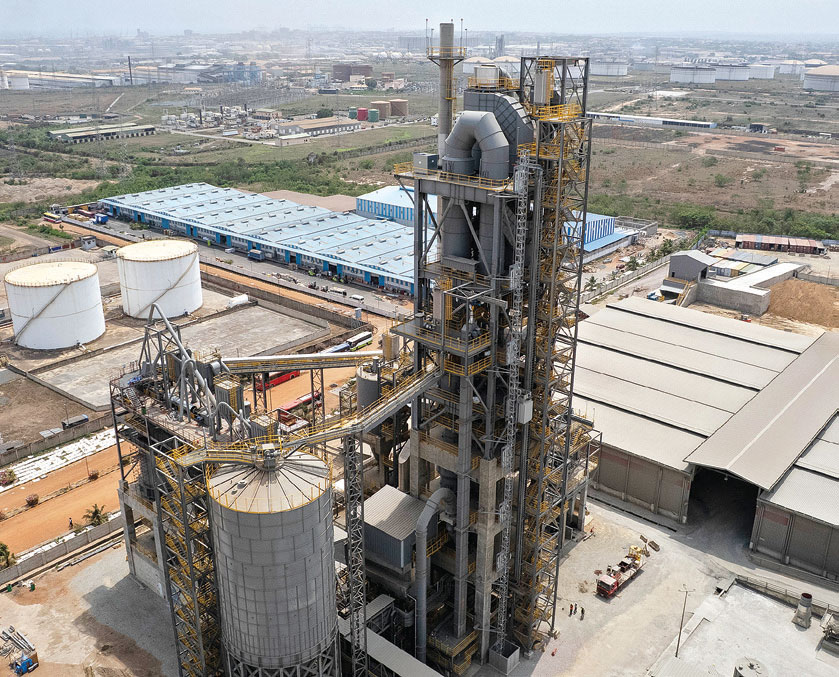
Pilot-scale LC3 production has already demonstrated the use of Indian raw materials,2 while LC3 has since moved into large-scale construction at Noida International Airport.3 Since 2023, there has also been a dedicated standard, IS 18189:2023, providing a technical framework for LC3. Internationally, Fuller Technologies has successfully commissioned commercial-scale flash calcination plants in France and Ghana, providing real-world experience translating laboratory and pilot results into the design, commissioning and operation of industrial calcined clay plants.
Design the system to the deposit
Kaolinite content is widely viewed as the critical consideration when evaluating a calcined clay project’s feasibility, but it should not be treated in isolation. Overall mineralogy, the presence of other clay minerals, quartz and other inert phases, iron and other impurities, particle-size distribution, moisture and handling characteristics can all influence how a clay behaves during processing. At the same time, the final cement’s performance and colour requirements must also be considered when defining the operating window. Characterising this variability establishes the expected feed envelope and can inform material selection and blending or homogenisation strategies, while pilot testing representative samples reveals how materials within that envelope respond to calcination.
Earlier Indian pilot work, for example, demonstrated that good cement performance could be achieved with relatively low-kaolinite clay (<40 per cent).4 The wider point is also demonstrated commercially at Vicat’s Xeuilley plant in France, which uses raw materials containing significant quantities of smectitic clays and notably high iron content. At Fuller Technologies’ Dania facility, raw-material characterisation, including XRD and XRF analysis, was combined with pilot calcination testing to understand the material’s mineralogical and chemical composition, its response to calcination and the resulting reactivity and colour. This provided the basis for establishing an operating window for commercial implementation.
Testing of Indian clay samples also illustrates the mineralogical variability that may need to be accommodated. Even where kaolinite contents are within a potentially useful range, the proportions of other clay minerals, inert crystalline phases
and amorphous material can differ substantially between samples.
Table 1. Representative mineralogical composition of two Indian clay samples
Mineralogical component Sample A Sample B
Kaolinite 44% 32–36%
Other clay minerals 11% 15–22%
Inert crystalline phase 24% 11%
Amorphous phase 20% 15–25%
Individual mineral phases and sample identities have been grouped or anonymised to maintain confidentiality.
Once the expected feed envelope is understood, the plant can be designed to achieve a specified production capacity across the design envelope, while maintaining consistent calcined clay quality as feed properties and operating conditions change. For example, feed moisture variability can increase both fuel consumption and gas flow, requiring sufficient gas-path or fan capacity to maintain throughput.
From design to operation
Commercial scale introduces another level of complexity. At CBI Ghana, the 1,200 tpd calcined clay plant had to integrate with the grinding plant as a single production system, requiring coordinated operating sequences across the complete line during ramp-up. Commissioning was therefore not only about achieving stable plant operation but also about establishing the relationship between process behaviour and product quality. Operators could monitor feed rate and moisture, gas temperatures, oxygen, pressure profile, and cyclone performance alongside reactivity and colour checks, allowing them to understand how process changes affect the finished calcined clay.
Successful calcination means consistently producing a material that meets the required product specification. Process data therefore needs to be considered alongside regular testing of calcined clay reactivity and colour, so that changes in product quality can be related to changes in feed and operating conditions.
Operator training is also critical. Flash calcination relies on rapid heating and short residence times, meaning the process responds quickly to changing conditions. For clays tested by Fuller, the useful activation range was about 750–850°C; however, the optimum varies with the clay. Insufficient thermal treatment can leave activation incomplete, while excessive heating can cause sintering and reduce reactivity. Gas-solids contact and residence-time distribution must also be controlled.
In addition to training, advanced process control, such as Fuller Technologies’ ECS/ProcessExpert® (PXP) system, provides an additional layer of support for operators in maintaining the required operating window as feed and process conditions vary.
Beyond the lab
The opportunity for calcined clay is increasingly clear. Realising that opportunity at commercial scale, however, relies on a combination of laboratory analysis and pilot testing, real-world experience in integrating calcination plants with existing operations, and the calcination and process-control technologies themselves. Ultimately, designing for variability and operating for consistency provides the route from a promising clay deposit to a reliable industrial SCM.
References
- Indian Bureau of Mines, Indian Minerals Yearbook 2022: Kaolin, Ball Clay, Clay (Others) and Shale, Ministry of Mines, Government of India, March 2024.
- Emmanuel, A.C., Haldar, P., Maity, S. and Bishnoi, S., Second pilot production of limestone calcined clay cement in India: The experience, The Indian Concrete Journal, 2016.
- Noida International Airport, Noida International Airport Becomes First Large-Scale Project to Build with Limestone Calcined Clay Cement, 26 September 2025.
- Bishnoi S., Maity S., Malik A., Joseph S., and Krishnan S., Pilot-scale manufacture of limestone calcined clay cement: The Indian experience, Indian Concrete Journal, 2014.
About the author:
Kiranmai Sanagavarapu, Director of Low Carbon Solutions, Fuller Technologies, developing commercially viable, plant-level decarbonisation pathways for the cement industry. Her work integrates technologies across fuels, clinker reduction and grinding, combining system-level thinking and techno-commercial analysis to deliver scalable emissions reduction strategies.
















 Concrete4 weeks ago
 Concrete4 weeks ago

 Concrete4 weeks ago

 Concrete4 weeks ago