Steel industry representatives pointed out that 94 per cent of the production was accounted for by six major companies in April
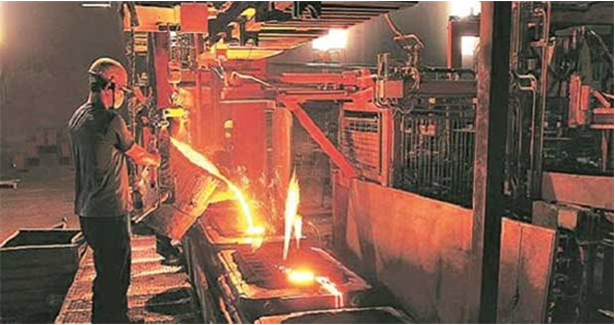
Capacity utilisation at steel and cement companies has improved significantly in May after a sharp drop in April. A revival in domestic demand to a limited extent, exports and easing of curbs, are driving major private sector steel companies to ramp up production, now hovering between 70 per cent and near full capacity levels. Some cement companies too have increased capacity utilisation to about 60 per cent. Steel and cement were the biggest shockers – recording a more than 80 per cent drop – in the core sector output in April. However, as Unlock 1.0 kicks in, domestic demand is expected to improve further.
Tata Steel managing director and chief executive officer, T V Narendran, said, the company was currently operating at 70 per cent production level and about 50 per cent was focused on exports.
"In the domestic segment, demand is currently led by rural markets, oil and gas, LPG and B2C segments like roofing and sheeting" he added.
JSW Steel has ramped up production to about 85 per cent. Seshagiri Rao, joint managing director and group CFO, JSW Steel, said that domestic steel demand for the industry in April was down by 90 per cent, so majority of sales was exports. In the month of May, we are seeing a demand recovery from 10 per cent in April to 25-30 per cent, Rao said.
Jindal Steel & Power (JSPL) managing director V R Sharma was expecting domestic demand to pick up further in June. In May, the company exported 65 per cent of its output but Sharma expects the share to come down to 50 per cent in June. JSPL is operating at full capacity.
"The MSMEs in the engineering segment have started operating. Domestic demand will improve further in June," he said.
Arcelor Mittal Nippon Steel India (AM/NS India) too is operating at full capacity after a production cut in April and early May.
Public sector steel major, Steel Authority of India Ltd, is operating at around 50 per cent production level. Anil Chaudhary, chairman, SAIL, said that domestic demand was picking up. "With relaxations to lockdown, domestic demand will improve further." Up to July, our export order book is full, he added.
Steel industry representatives pointed out that 94 per cent of the production was accounted for by six major companies in April which meant that secondary producers were either shut or had not been able restart. However, since then many of the secondary producers have resumed production.
For cement companies, easing of logistical hurdles and improved workers’ availability have helped move production levels in May and is expected to go up further in June in the wake of more relaxations to lockdown.
While cement production halted in March-April owing to the lockdown and the steps taken to control Covid-19, production commenced in May in some of the plants after receiving approvals from the respective state governments.
"A rebound is expected in May as production had commenced owing to the demand conditions and at some plants, the capacity utilisation is as high as 60 per cent now", H M Bangur, managing director at Shree Cement said. According to industry officials, individual house builders (IHB) segment, which drives 55 per cent of the annual demand, has been reviving after construction activities were permitted by various state governments.
"From March-April, we have understood that the pandemic is typically an urban phenomenon and the effect has been felt in the urban sector mostly. However, in rural areas, the demand is still driven by individual households and some government sponsored construction activities," an industry official said.
The primary reason being that labourers employed in rural IHB construction are namely locals while in urban centres, it is migrant workers who are speeding back home.
Moreover, government projects like road and irrigation projects which employ local labourers under the MNREGA scheme has also started driving demand.
A second sector official cited that in total 1,885 tenders, aggregating Rs. 46,500 core were floated in March 2020 of which, water and irrigation, building and housing and road projects account for 72 per cent of the total tenders. "It is likely that these construction activities will drive demand as well", the sector official said. However, analysts expect a recovery only in the second half.
Source: Financial Express
















 Concrete4 weeks ago
 Concrete2 weeks ago
 Concrete2 weeks ago
 Concrete4 weeks ago