Dr Kapil Kukreja, General Manager, and Dr Prateek Sharma, Group Project Manager, NCCBM, Ballabgarh, India, present the technical case for moving beyond direct refuse-derived fuel (RDF) firing in cement kilns.
Being identified as one of the most energy-intensive industrial sectors, cement plants utilise massive amount of fossil fuels for providing thermal energy to calciners facilitating clinker production. Coal and pet coke are the two most widely used fossil fuels in cement plants. These fossil fuels are however, getting depleted at a fast pace day-by-day. Combined with increasing fuel costs, greenhouse gas emissions, and environmental concerns, cement plants are motivated towards finding alternative fuels.
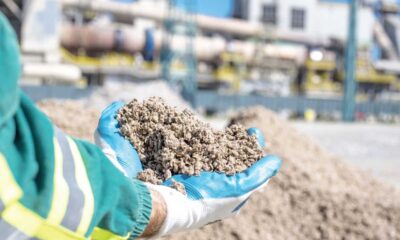
Refuse-derived fuel (RDF) emerges as a promising alternative fuel, which is composed of the combustible fraction of municipal solid waste majorly comprising of plastics, paper, cardboard and textiles. Utilising RDF for thermal applications introduces a scope for diverting waste from landfills while recovering useful energy. Across the globe, many cement plants have opted RDF utilisation in calciners and kilns.
However, direct utilisation of RDF often leads to various operational challenges which restricts its effectiveness and energy recovery potential. The high and variable moisture content in RDF serves as one of the major drawbacks. Excess moisture consumes a portion of the available thermal energy during evaporation, reducing overall combustion efficiency and lowering the effective heating value of the fuel. Higher moisture content in RDF can also repeatedly cause jamming in material handling system as well as potentially reduce shredder life. The highly heterogenous nature of RDF serves as another major challenge.
Variations in composition, particle size, and calorific value can lead to inconsistent combustion behaviour resulting in fluctuating heat release patterns. These fluctuations can affect process stability, temperature control, and clinker quality. Additionally, incomplete combustion of RDF particles can result in increased emissions, higher unburnt carbon content, and operational difficulties within the calciner system. Higher ash and inert content of RDF can dilute the clinker quality and reduce calciner efficiency.
Chlorides and alkalis present in RDF can lead to excess buildup and blockages in the kiln and calciner increasing the downtime of cement plants. Hence, issues with direct utilisation of RDF establishes the need for fuel conditioning and alternative utilisation approaches that can maximise the energy potential of RDF while minimising adverse impacts on plant operation. RDF gasification emerges as an efficient tool for converting solid RDF into syngas, which can be used as a fuel with improved characteristics.
Moreover, drying of RDF prior to its utilisation improves fuel combustion efficiency and potentially reduce emissions. Drying of RDF also serves as a very crucial step for preparing RDF for gasification. Reducing excess moisture from RDF ensures process stability and helps in maintaining gasifier temperatures. It also prevents reactor malfunctioning and improves the quality of resulting syngas. Further, syngas derived from RDF gasification can be used as a partial substitution of traditional fuels being used in cement calciners by achieving a suitable thermal substitution rate (TSR). Thus, the article describes two newly installed pilot scale setups at NCCBM Ballabgarh, for RDF drying and gasification. Both these setups have been financially supported by BEE.
Alternative fuel dryer setup
The alternative fuel dryer (AFD) installed at NCCBM as shown in Fig. 1, has the potential to increase reliability of RDF as an alternative fuel for thermal applications in cement plants. The multi-stage wire mesh conveying dryer utilises electrically heated air at 60-90°C for drying the RDF with <10 per cent moisture as output. The setup is suitable for 100-150 kg/hr drying capacity. Retention time for RDF inside the dryer is approximately 15 to 30 mins. Benefits of the setup include reduction in moisture content by 25 per cent to 30 per cent; utilisation of cooler stack air; improvement in fuel flowability; reduction of heat load in kilns and enhancement of kiln stability and thermal efficiency. Jamming prevention, extended shredder life and reduced downtime serve as added advantages of the AFD setup.
Downdraft gasifier assembly setup
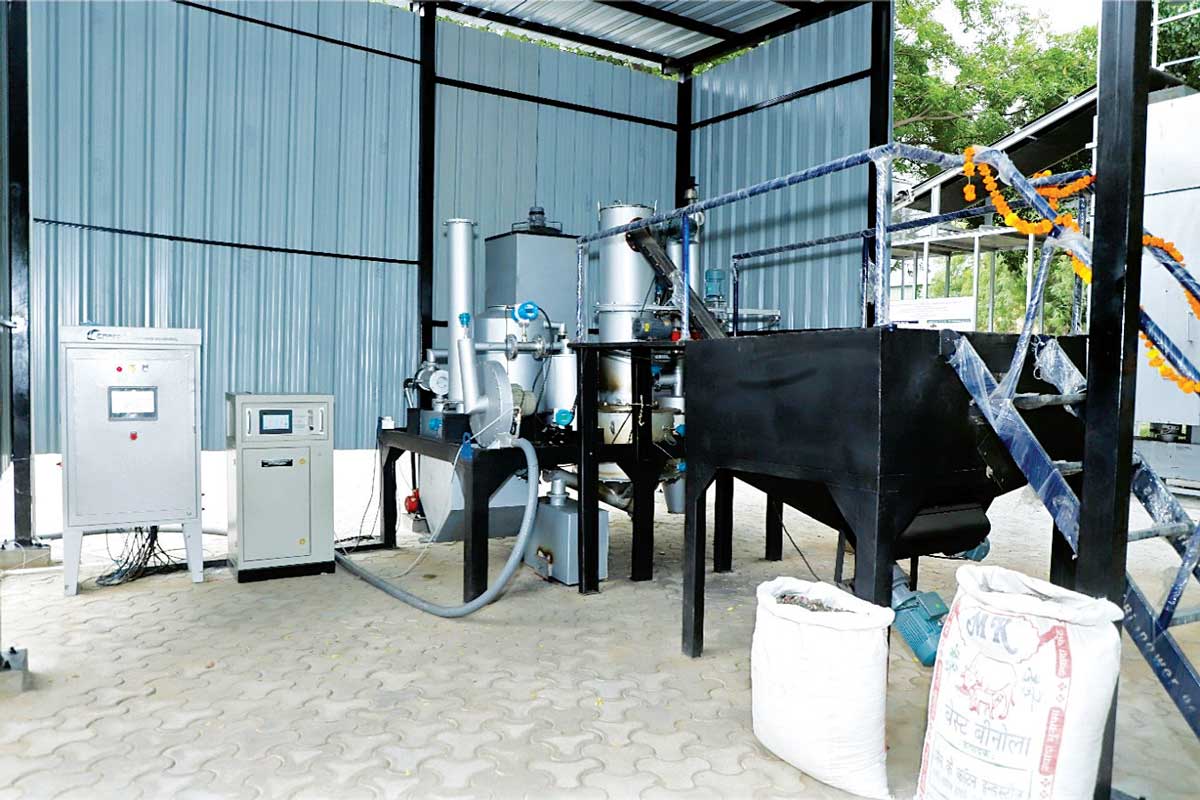
The downdraft gasifier assembly installed at NCCBM as shown in Fig. 2 is particularly attractive due to its relatively simple design and its ability to produce syngas with comparatively lower tar and particulate content. Having a 20 kg/hr RDF feeding capacity, the downdraft gasifier can be operated in continuous mode with the help of a screw conveyor arrangement used for feeding RDF at regular intervals. In the main reactor, RDF undergoes several reactions including pyrolysis, combustion and reduction followed by production of syngas using air as a gasifying agent.
Another screw conveyor placed below the main reactor is used for char and ash collection from bottom of the gasifier. A heavy-duty shredder of 100 kg/hr RDF processing capacity is used to prepare the raw material for gasification. The shredded RDF with particle size less than 50 mm is obtained at the bottom of the shredder commonly known as RDF fluff. The gasifier assembly can be operated in one or all of the three modes including hot air mode, hot gas mode and cold gas mode.
The hot gas mode produces raw syngas at higher temperature which can be directly used for thermal application in cement plants. The hot air mode is useful for providing ambient air at high temperature as a gasifying agent to the system. The cold gas mode deals with a series of different filters used for purifying the syngas resulting in cleaner fuel generation at a comparatively lower temperature. The cold gas mode is provided with a dedicated chloride cleaning system which enables the production of chlorine-free syngas.
An online syngas analyser, equipped with advanced dual beam dual wavelength NDIR sensors, connected to the downdraft gasifier assembly assists in providing real time composition and calorific value of the syngas being generated. The gasifier assembly is also connected with a SCADA based data logging system used for online monitoring and recording of data during continuous operation. Experimental studies with regards to syngas composition, calorific value, syngas yield, temperature of syngas and gasifier performance parameters are presently under investigation. A simulation model for integration of gasification process with actual cement plant calciner operation has also been developed using Aspen Plus simulation software.
Conclusion
As the cement industry continues its transition toward sustainable and resource-efficient operations, alternative fuel technologies play an increasingly important role. While direct firing of RDF offers a practical route for waste utilisation, challenges related to moisture content, fuel variability and combustion efficiency can limit its effectiveness. By integrating RDF drying and gasification with existing cement plant infrastructure, a more effective and efficient waste-to-energy potential can be accomplished through higher TSR.
Such integration enables the utilisation of locally available waste resources while reducing dependence on conventional fossil fuels. Drying of RDF significantly enhances fuel quality, while gasification provides an advanced pathway for converting waste-derived fuel into a cleaner and more controllable energy source. The two pilot scale setups of alternative fuel dryer and downdraft gasifier assembly installed at NCCBM are under active experiments to establish & optimise the technical parameters before deploying these technologies at plant level.
Further, co-gasification of RDF/biomass/coal using air/oxygen/steam as gasifying agent, optimisation of syngas quality for co-firing in kiln and green hydrogen production are some of the futuristic research areas of downdraft gasifier assembly.
About the authors
Dr Kapil Kukreja, General Manager, NCCBM, is a Scientist-E and certified project management expert with extensive experience in cement research, innovation, incubation, and institutional collaborations. An alumnus of IIT Delhi and BITS Pilani, he is also an author, poet, and adventure enthusiast.
Dr Prateek Sharma, Group Project Manager, NCCBM, is a PhD in Chemical Engineering with expertise in alternative fuels, gasification, waste heat recovery, energy efficiency, and artificial intelligence for the cement industry. He focuses on driving sustainable and technology-led advancements in cement manufacturing.


















 Concrete4 weeks ago
 Concrete3 weeks ago
 Concrete2 weeks ago
 Concrete4 weeks ago