Connect with us

Concrete

Co-processing systems deliver remarkably fast ROI

Published

on

Shares

Swapnil Jadhav, Director, SIDSA Environmental, explains how advanced waste pre-treatment technologies are helping cement plants convert challenging waste streams into high-quality alternative fuels, driving sustainability, efficiency and circular economy goals.

As cement manufacturers accelerate their decarbonisation journey, alternative fuels have emerged as a critical lever for reducing dependence on fossil fuels and lowering carbon emissions. Swapnil Jadhav, Director, SIDSA Environmental, discusses how advanced shredding, sorting, and waste pre-treatment technologies are transforming complex waste streams into consistent, kiln-ready fuels. He highlights the role of customised process solutions, real-time quality monitoring, and intelligent waste processing in enabling higher thermal substitution rates, stable kiln operations, and a more sustainable future for the cement industry.

Could you provide an overview of SIDSA Environmental’s role in waste treatment and process technologies?
We are a technology partner; we bridge the waste management and heavy industry sectors. Our expertise lies in designing turnkey process lines that transform complex waste streams into high-value, standardised fuels for cement kilns. Covering everything from waste conveying and sorting to advanced shredding, we provide cement plants with the solutions to effectively substitute fossil fuels, and we guarantee a reliable, safe energy supply.

What are the key advantages of using alternative fuels such as RDF in cement kilns?
The advantages are environmental, operational, and economic. The most critical is a drastic reduction in the carbon footprint by replacing CO2 emissions due to fossil fuels. Another key advantage lies in the kiln’s 1,450°C process that ensures complete, residue-free destruction of the hazardous compounds, which is not the case of traditional incinerators (even advanced ones). If this is not enough, minerals from RDF are incorporated directly into the clinker. Economically, it decouples a plant’s costs from volatile coal and gas markets. In fact, co-processing systems such as SID’s SMP deliver remarkably fast ROI. It also positions the cement plant as an essential public service, diverting non-recyclable waste from landfills and preventing methane emissions.

What innovations has your organisation introduced in W2E and recycling solutions?
Our innovations all focus on transforming complex waste into precisely defined products. With more than 50 years of experience, we’ve pioneered low-speed, high-torque shredding systems that minimise dust and contaminants (also critical for stable kiln operation). More recently, SID earned a reputation for flexible pre-treatment lines, engineered to process the most challenging, wet, and unsorted wastes where other systems cannot. We are also integrating sensor-based sorting and AI-driven analytics to auto-regulate fuel quality in real-time, guaranteeing always more consistent calorific value and particle size.

How does your shredding technology specifically support RDF production for cement?
Shredding is a critical first step. Our technology is engineered to deliver a homogeneous particle size from bulky, high-tensile materials, which is key to stable combustion. We often use a two-stage approach: a primary shredder for a first round of size reduction, followed by a fine shredder that calibrates the material precisely, typically below 30-80mm. Our integrated sorting systems are able to remove heavy inerts, protecting the shredders’ blades, as well as wet organics, thus significantly reducing the waste moisture before even drying it.

How does your machinery handle the challenges of hazardous and bulky waste?
Safety and durability are foundational at SID. Our systems incorporate ATEX-certified explosion prevention and are built with extreme wear-resistant materials. The low-speed, high-torque shredding principle of our shredders is inherently safer, generating minimal heat and dust. The entire process is enclosed under negative pressure with high-efficiency air filtration, guaranteeing zero fugitive emissions and creating a sealed, controlled environment for the operator. What truly sets SID solutions apart, however, is the synergy between each machine within our turnkey systems like the SMP. The machines are designed to work in concert, anticipating and neutralising potential hazards.

What future trends do you anticipate for alternative fuels in the cement industry?
We think tomorrow’s cement plants will require unprecedented precision in controlling particle size, moisture, and critical contaminants such as chlorine. Our response is to develop robust systems that make it possible. We are engineering pre-treatment lines that deliver always more refined, ‘calciner-ready’ fuel. One of our focuses is embedding real-time monitoring directly into the shredding line, giving operators a live digital readout of fuel consistency. The goal is precise mechanical separation: a clean, high-calorific fuel for the kiln. We deliver the homogeneous feedstock that advanced cement processes actually need to succeed.

How do your customised solutionsenhance a cement plant’s sustainability and efficiency?
A standard solution can be the enemy of efficiency. We begin with a deep audit of the client’s specific waste supply and kiln technology. By custom-engineering the line, the resulting fuel consistently meets ideal parameters, enabling higher thermal substitution rates and very stable kiln operation. That’s a lesson we’ve applied across more than 130 SMP references for hazardous waste co-processing in cement kilns over the last 28 years.


Concrete

Nuvoco Inaugurates Limla Cement Plant in Surat

Acquisition boosts Western India cement capacity

Published

on

By

Shares


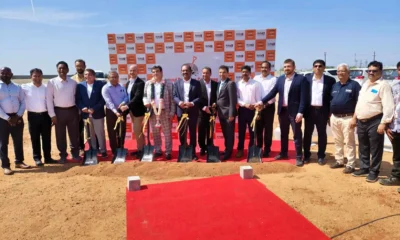
Nuvoco Vistas Corporation Limited inaugurated the Limla Cement Plant in Surat, Gujarat, marking a key milestone in its acquisition and revival of Vadraj Cement Limited.

The company completed the acquisition of Vadraj, which had been undergoing a corporate insolvency resolution process, by discharging a consideration of Rs 18 billion (bn) in June 2025. Vadraj’s asset base includes a clinker unit at Kutch and a grinding unit at Limla, along with high quality captive limestone reserves and a captive jetty at Kutch that enhance logistics efficiency.

Since taking over the assets, Nuvoco has undertaken revival, refurbishment and expansion across both sites, culminating in the opening of the Limla facility. The grinding unit at Limla achieved project completion ahead of schedule with the commissioning of two million tonnes per annum (mn t per annum) grinding capacity, further expanding the company’s scale and market reach.

Upon full operationalisation of the Vadraj assets, nearly 40 per cent of Nuvoco’s total cement capacity will be accounted for by plants in the North and West regions, supporting improved access to high growth markets. The plant is expected to support a phased volume ramp up in Gujarat and to serve adjoining markets in western Maharashtra while releasing northern capacities for other markets.

It will produce a complete portfolio of cement products including Ordinary Portland Cement, Portland Slag Cement, Portland Pozzolana Cement and Portland Composite Cement, and will offer the Duraguard range including the premium Duraguard Microfibre. The transaction is set to create synergies with Nuvoco’s existing manufacturing facilities at Nimbol and Chittorgarh, strengthening logistics optimisation and market access across key regions.

Nuvoco reported total income of Rs 113.62 billion (bn) in FY 2025-26 and stated it is on track to consolidate total cement capacity to 35 million tonnes per annum (mn t per annum) by FY2028. The company operates across cement, ready-mix concrete and modern building materials segments and highlighted a pan-India ready-mix presence alongside contributions to major infrastructure projects. Corporate communications contact details were provided by the company.

Continue Reading

Concrete

Nuvoco commissions Surat grinding unit

Nuvoco posts 20 per cent rise in Q1 PAT

Published

on

By

Shares


Nuvoco Vistas Corp. has announced its financial results for the quarter ended June 30, 2026, reporting growth in volumes, earnings and profitability while advancing its expansion plans in western India.
The company inaugurated a 2-million-tonnes-per-annum (MTPA) grinding unit at its Limla Cement Plant in Surat on July 11, 2026, ahead of schedule. The facility, part of the Vadraj Cement assets, is expected to strengthen Nuvoco’s presence in western India while freeing up capacity at its Rajasthan plants to cater to demand in northern markets.
Progress at the Kutch project remains on track, with phased commissioning scheduled to begin in the third quarter of FY27. The company has also commenced work on a bulk cement terminal at Viramgam, Sachana, Gujarat, featuring a dedicated railway siding. The terminal is expected to become operational by the second quarter of FY28 and will support distribution across Gujarat. These projects form part of Nuvoco’s capacity expansion programme, which is expected to increase its total cement capacity to 35 MTPA by FY28.
During Q1 FY27, the company recorded cement sales volumes of 5.3 million tonnes, up 5 per cent year-on-year. Consolidated total income rose 9 per cent to Rs 31.29 billion, while EBITDA increased 7 per cent to Rs 5.72 billion, marking the company’s highest-ever first-quarter EBITDA. Profit after tax grew 20 per cent year-on-year to Rs 1.60 billion.
Commenting on the results, Jayakumar Krishnaswamy, Managing Director, Nuvoco Vistas Corp., said the company delivered improved business performance despite macroeconomic and geopolitical challenges. He attributed the results to disciplined execution, cost optimisation and operational efficiencies, while highlighting the early commissioning of the Surat grinding unit as a key milestone in the company’s expansion strategy.
He added that the company remains focused on prudent procurement, supply chain efficiency and cost discipline while monitoring geopolitical developments that could affect industry supply chains and input costs.

Continue Reading

Concrete

Cement Sector Faces Sluggish Growth in First Half of FY27

April Price Hikes Unlikely To Offset Margin Decline

Published

on

By

Shares


Nuvama Institutional Equities has warned that India’s cement industry is expected to record subdued volume growth in the first half of fiscal year 2026-27 before a recovery in the second half. The brokerage assessed that price increases implemented in April 2026 will be insufficient to offset an overall decline in sector profitability. It attributed the outlook to weak demand and fresh capacity additions scheduled during fiscal years 2026-27 and 2027-28 that are likely to keep prices under pressure.

The report noted that demand was sluggish in April and May 2026 owing to global uncertainty, labour shortages, heatwaves, constraints in raw materials and unseasonal rainfall. Producers raised prices across regions in April to mitigate rising petcoke costs and higher packaging expenses, but the increases proved short lived. Nuvama reported that standard petcoke prices rose to USD153/t, around USD41/t higher than in the third quarter of fiscal year 2025-26.

Price correction followed weaker demand, limiting the net increase to about Rs 10-12 per bag by the end of the quarter. Imported petcoke prices have since fallen to USD132/t from a recent peak of USD168/t, although they remained roughly USD20/t higher quarter on quarter. The brokerage expected the higher input cost impact to begin reflecting from late quarter one of FY27 and to continue into early quarter two.

Nuvama also estimated that crude linked increases were likely to raise packaging costs by about Rs 120-150/t and to exert upward pressure on freight. It warned that soft demand combined with significant new supply coming on stream in FY27-28 would keep pricing under strain and constrain near term margin recovery. The report concluded that volume growth was likely to be sluggish in the first half of FY27 before recovering in the second half.

Continue Reading

Video Thumbnail

    SIGN-UP FOR OUR GENERAL NEWSLETTER


    Trending News