Connect with us

Concrete

How Upgrades Can Deliver Energy Savings Across the Cement Process

Published

on

Shares

Jacob Brinch-Nielsen, Vice President of Professional Services, FLSmidth Cement, brings together recommendations from experts across the flow sheet to demonstrate the role of upgrades in optimising the cement manufacturing process.

Improving Preheater Efficiency and Heat Retention
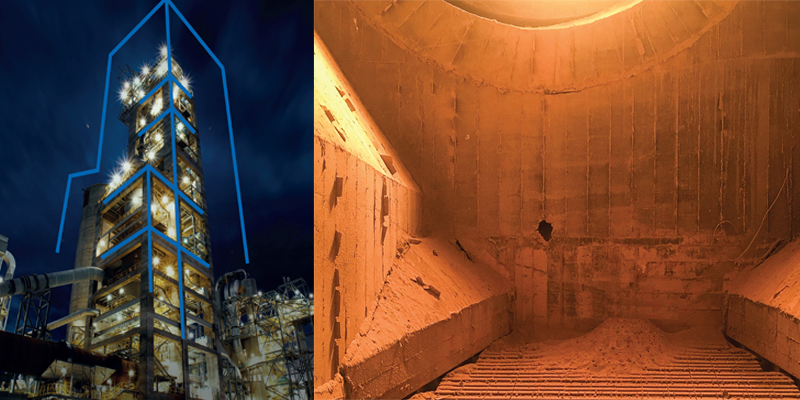
Preheaters play a critical role in cement plant energy efficiency, but outdated cyclone designs and corroded components can lead to excessive heat loss and higher fuel consumption. Plants that optimise preheater separation efficiency can reduce fuel use by up to 5 – 10 kcal/kg clinker while improving downstream performance. One area where upgrades can make a difference is in the central pipe elements. By switching to an advanced suspension design, plants can improve separation efficiency and extend wear life — offering both energy savings and operational benefits.
“The cast central pipe is installed in the preheater cyclones to improve separation and thermal efficiency,” explains Muthukumar Muthu, Senior Product Specialist, “Our patented design for the suspension of the cast pipe reduces corrosion (extending pipe life), while also making it easier to carry out maintenance work. Installation of one cast pipe in the lower cyclone stages can save customers 5 – 10 kcal/kg clinker, reducing power consumption in the ID fan drive by 4 to 8 per cent – a significant energy saving. Customers can choose whether to claim these benefits in cost savings or convert them to a 1 to 2 per cent increase in production. Either way, the cast pipe provides a quick ROI.”
The improvements to the cast central pipe elements reduce the stress across the element, and make it simpler to manufacture, which results in a more consistent quality, more durable product. This upgrade can be implemented during the annual maintenance shutdown with no disruption to operations.

Maximising Efficiency in Combustion
False air leaks and inefficient fuel combustion are two of the biggest sources of energy waste in cement kilns. Uncontrolled air ingress forces plants to burn more fuel to maintain operating temperatures, while the inefficient combustion of alternative fuels can create a volatile environment that reduces both efficiency and clinker quality. To address these issues, plants can implement sealing upgrades that prevent air leaks and burner modifications that optimise fuel-air mixing, ensuring more complete combustion and greater flexibility in alternative fuel use.
“We’ve introduced the new Spring Tensioned Graphite Seals to reduce false air entry and increase thermal efficiency – effectively lowering fuel consumption without affecting clinker quality,” says, Karthikeyan Arumugam, Senior Product Specialist.
In addition, advanced burner designs such as a JETFLEX® partial upgrade allow plants to retain the existing kiln burner pipe while improving fuel-air mixing, increasing alternative fuel utilisation and efficiency. This burner enables cement producers to use pulverised coal or petcoke, anthracite, oil, natural gas – or any mixture of these – as well as alternative fuels (such as plastic and wood chips, sewage sludge) with no difference in performance and minimal volatility in the kiln to support reliable and consistent production of high-quality clinker with low NOx emissions.

Cooling Efficiency as Easy as ABC Inlet
An inefficient or older generation cooler inlet leads to higher fuel consumption. Alternative fuels and petcoke produce dusty, sticky clinker that builds up easily, creating ‘snowmen’ in the cooler that disrupt the system, leading to inefficiencies and even unplanned shutdowns.
“The ABC Inlet upgrade continues to be one of our most successful cooler inlet upgrades because it resolves issues as a result alternative fuels usage and enables better heat recovery back to system,” explains Rene Hede, Cooler Product Specialist. “The ABC Inlet prevents snowmen formation with a patented in-grate design that pushes compressed air up through the grates, blasting agglomerations.”
In addition, the ABC Inlet’s rapid quenching process enables faster clinker cooling while maximising heat recovery to the pyro line, resulting in heat consumption savings of 10–30 kcal/kg of clinker. This also enhances clinker quality, providing greater flexibility in cement product formulation and allowing for clinker factor reductions that further improve grinding energy efficiency.

Part 2 of 3. Read Part 1 in the May issue of Indian Cement Review. Part 3 will be found in the July issue.

Concrete

30-Day Traffic Diversion In Place For CC Road Works In Madhapur

Diversions in place from May 16 for cement concrete road works

Published

on

By

Shares

The Cyberabad Traffic Police issued a traffic advisory as road works begin for the laying of a cement concrete (CC) road from Jaya Shankar Statue to RRR Restaurant at Parvathnagar in Madhapur limits. The advisory indicated that traffic diversions will be in place for 30 days from May 16 to ensure the smooth flow of vehicles and to minimise congestion on the affected stretch. The measure aims to balance uninterrupted construction activity with the movement needs of commuters.

Traffic moving from Toddy Compound towards Parvathnagar village will be diverted at Parvathnagar junction towards Sunnam Cheruvu and the 100 feet road. Local motorists and public transport operators have been advised to follow the diversionary route as directed by traffic personnel on duty. Alternate routes and signage have been planned to mitigate delays and to manage peak hour congestion.

Police officials said the diversion had been planned to facilitate uninterrupted road works while maintaining traffic movement in the area. Commuters were urged to plan their travel accordingly and to cooperate with traffic staff managing the stretch. Authorities indicated that enforcement of diversions would be active and that violations could attract penalties.

The 30 day schedule is intended to allow contractors to complete the laying and curing phases with minimal interruption to vehicular flow. Residents and businesses in adjacent localities have been advised to factor the diversion into deliveries and travel plans. The traffic police promised continuous monitoring of the works and the operational diversions and emphasised that temporary inconvenience was necessary for longer term improvement of the road network. Traffic personnel will be stationed at key junctions and additional signage and temporary markings will be displayed to guide motorists and pedestrians through the revised alignments while public transport services will follow the diversion where feasible and operators have been asked to adjust timetables to minimise disruption.

Continue Reading

Concrete

HeidelbergCement India Receives Consent For Khandwa Grinding Unit

Consent granted by Madhya Pradesh Pollution Control Board

Published

on

By

Shares

HeidelbergCement India (HeidelbergCement India) has received regulatory consent to establish a cement blending and grinding unit at Village Dongaliya, Tehsil Punasa, District Khandwa in Madhya Pradesh. The consent was granted by the Madhya Pradesh Pollution Control Board under the Water (Prevention & Control of Pollution) Act, 1974 and the Air (Prevention & Control of Pollution) Act, 1981 and is dated 17 May 2026. The company disclosed the development in a filing made under Regulation 30 of the SEBI (Listing Obligations and Disclosure Requirements) Regulations, 2015.

The project plan envisages procurement of long term availability of fly ash and the allotment of land on lease for setting up the unit. The proposed facility is described as a blending and grinding installation which will process cementitious materials sourced from nearby operations and suppliers. Company filings state the measures required to secure raw material logistics and statutory compliance before commencing construction.

The addition of a grinding unit in Khandwa is intended to strengthen regional supply and improve logistical efficiency by reducing haulage distances for finished product. The unit is expected to complement existing capacities in central India and to offer flexibility in product mix through blending operations. The reliance on fly ash as a supplementary cementitious material will necessitate long term supply agreements with thermal power producers and coordination with waste utilisation policies.

The disclosure to the regulator and to the stock exchanges follows standard corporate governance practice and aims to keep investors apprised of capital expenditure initiatives. The company indicated that subsequent permits and clearances would be sought in accordance with applicable environmental and land use rules. The project is presented as part of HeidelbergCement India’s broader strategy to optimise capacity distribution and to respond to regional demand dynamics.

Continue Reading

Concrete

PROMECON introduces infrared-based tertiary air measurement system for cement kilns

Published

on

By

Shares

The new solution promisescontinuous, real-time tertiary air flow measurement in cement plant operations.

PROMECON GmbH has launched the McON IR Compact, an infrared-based measuring system designed to deliver continuous, real-time tertiary air flow measurement in cement plant operations. The system addresses the longstanding process control challenge of accurate tertiary air monitoring under extreme kiln conditions. It uses patented infrared time-of-flight measurement technology that operates without calibration or maintenance intervention.

Precise tertiary air measurement is a critical requirement for stable rotary kiln operation. The McON IR Compact is engineered to function reliably at temperatures up to 1,200°C and in the presence of abrasive clinker dust. Its vector-based digital measurement architecture ensures that readings remain unaffected by swirl, dust deposits or drift. Due to these conditions conventional measurement systems in pyroprocess environments are often compromised.

The system is fully non-intrusive and requires no K-factors, recalibration or periodic readjustment, enabling years of uninterrupted operation. This design directly supports plant availability and reduces the maintenance overhead typically associated with process instrumentation in high-temperature zones.

PROMECON has deployed the McON IR Compact at multiple cement facilities, including Warta Cement in Poland. Plant operators report that the system has aided in identifying blockages, optimising purging cycles for gas burners, and supplying accurate flow data for AI-based process optimisation programmes. The practical outcomes include more stable kiln operation, improved process control, and earlier detection of process disturbances.

On the energy side, real-time tertiary air data enables reduction in induced draft fan load and helps flatten process oscillations across the pyroprocess. This translates to lower fuel and energy consumption, fewer unplanned shutdowns, and a measurable reduction in NOx peaks. This directly reflects on the downstream cost implications for plants operating SCR or SNCR systems for emissions compliance.

Continue Reading

Video Thumbnail

    SIGN-UP FOR OUR GENERAL NEWSLETTER


    Trending News

    SUBSCRIBE TO THE NEWSLETTER


    Don't miss out on valuable insights and opportunities to connect with like minded professionals.


      This will close in 0 seconds