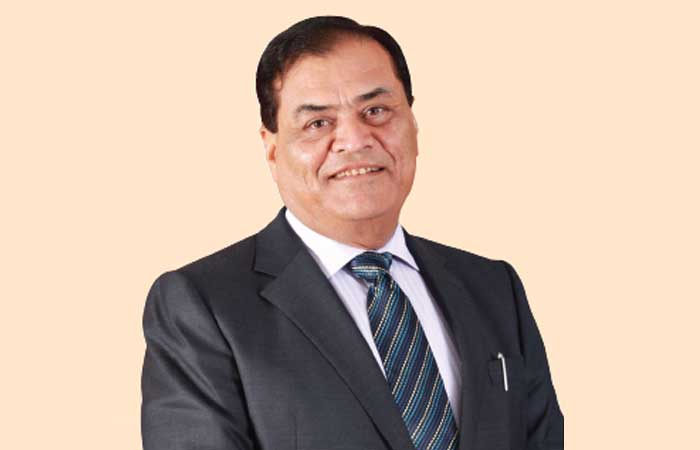
Mahendra Singhi, Member of Board of Governors and Strategic Advisor, Dalmia Cement (Bharat), shares insights into India’s Net Zero mission with Kanika Mathur.
India’s path to Net Zero is full of challenges. As a hard-to-abate industry, the cement sector needs to chart out strategies for achieving carbon neutrality. Discover how innovative approaches and policy support are shaping a sustainable future in this exclusive and insightful interview.
What is your view on the net zero mission, and how do we plan to achieve it?
The net zero mission is not merely a necessity for the cement sector or any specific industry but a global imperative. Every sector, whether service or manufacturing, must strive for net zero to address climate change and ensure a safe future for subsequent generations. The cement industry, in particular, has a significant role to play since it accounts for approximately 7-8 per cent of global CO2 emissions.
CO2 is the most prevalent greenhouse gas, and the cement industry’s contribution to these emissions is substantial. However, the good news is that the cement industry, especially in India, has been proactive. Over the years, it has explored and implemented strategies to lower carbon emissions. Initially, the focus was on low-carbon technologies. By adopting these technologies, the industry has already achieved significant reductions in CO2 emissions. Moreover, companies have begun integrating net-zero strategies into their business models, recognising that climate strategies are also sound business strategies. For example, the CDP (Carbon Disclosure Project) report recently highlighted the top 10 global cement companies prepared for a low-carbon transition, and five of these were Indian companies. This reflects a mindset shift towards sustainability, with Dalmia Cement leading the pack.
At Dalmia Cement, we believe in the philosophy that clean and green practices are both sustainable and profitable. Over the last decade, this philosophy has translated into a 33 per cent reduction in our CO2 emissions while simultaneously increasing revenue and profits. Such achievements demonstrate that net zero is not only achievable but also beneficial for business.
Alternative fuels and raw materials, digitalisation, technology, and Industry 4.0 are seen as crucial. Which plays the most significant role, or are they equally important?
Achieving net zero requires a multifaceted approach, and in the context of the cement industry, four key levers are critical. First, reducing the clinker content in cement production is essential. Clinker production is a major source of emissions due to the calcination of limestone. To mitigate this, we are focusing on producing blended cements such as PPC, PSC, PCC, and the newer L3 cement. Currently, India produces 73 per cent low-carbon blended cement. However, there is a need to eliminate the production of OPC (Ordinary Portland Cement), which emits around 900 kg of CO2 per tonne, compared to 400-500 kg for blended cements. Government policies, as well as support from the real estate and construction sectors, are essential for this transition.
Secondly, the use of alternative fuels and raw materials (AFR) offers a significant opportunity to reduce emissions. Transitioning to non-fossil fuels has shown promising results in regions like Europe and Japan, where AFR usage has reached 70-80 per cent, aided by strict regulations and quality waste management. In India, while progress is evident, AFR usage currently stands at around 10-15 per cent. Scaling this up will significantly contribute to emission reductions, as AFR accounts for approximately 20 per cent of total emissions.
Third, the transition to renewable energy sources is imperative. Transitioning to 100 per cent renewable energy through waste heat recovery systems, solar, wind, or hydro power is vital. Many companies have set ambitious targets for renewable energy adoption. However, supportive government regulations, such as banking facilities for renewable power, are necessary to accelerate this shift.
Finally, carbon capture technology (CCU/CCS) represents one of the most challenging yet impactful levers for achieving net zero. Capturing and either utilising or storing CO2 emissions can address roughly 50 per cent of emissions. While successful pilot projects are underway in Europe and the US, widespread adoption in India requires cost reductions and government support through incentives similar to the PLI scheme.
How can policymakers balance urban infrastructure development with carbon emission reduction?
As a developing country, India must prioritise growth to provide essential resources and amenities. However, this growth must be decoupled from emissions. Policymakers can achieve this by mandating the use of low-carbon technologies in new infrastructure projects and promoting blended cements over OPC through procurement policies. Additionally, supporting renewable energy adoption by providing banking facilities for renewable power and enhancing waste management practices to improve AFR quality are crucial steps. Introducing a polluter-pay policy can further offset the additional costs incurred by the cement industry. The Indian government’s commitment to maintaining a lower per-capita emission level compared to developed nations underscores its resolve to achieve sustainable growth.
How do you see the journey towards net zero unfolding?
The journey towards net zero is advancing steadily. In 2018, we at Dalmia Cement announced our carbon-negative and net zero roadmap during COP24. This commitment inspired other companies worldwide to adopt similar strategies. By COP26 in Glasgow, the Global Cement and Concrete Association committed to achieving net zero cement and concrete by 2050.
The global cement sector has been proactive, embracing new technologies and sustainability practices. Indian companies, too, are leading the way with innovative strategies and strong commitments. I am optimistic that within the next 10-25 years, the Indian cement industry will make significant strides towards achieving net zero, setting a benchmark for other industries globally.
















 Concrete4 weeks ago
 Concrete2 weeks ago
 Concrete2 weeks ago
 Concrete4 weeks ago