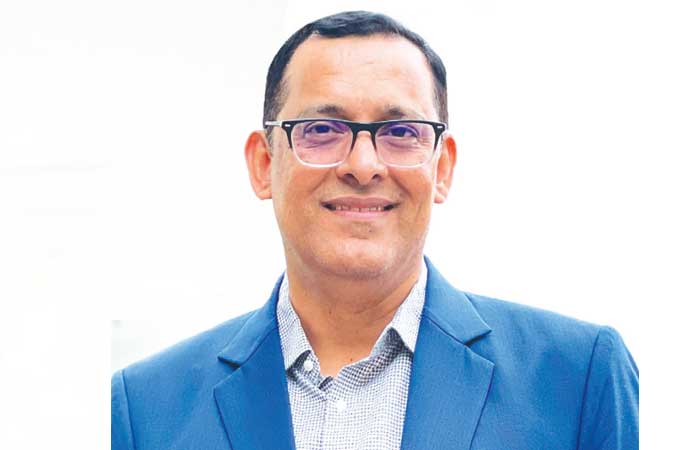
Some things are changing at FLSmidth Cement, but most remain the same, as the company’s Indian head, Manoj Taneja, explained to Indian Cement Review.
FLSmidth Cement is changing. Over recent years, the company’s pureplay strategy has separated its cement and mining businesses, and the cement business is now undergoing divestment: news that was met by some with uncertainty. However, according to Manoj Taneja, Head of India Cluster and Designated Partner in FLSmidth Cement India LLP, this has all been a “good move” that allows the cement business to “take control of our future”.
Taneja began his professional career as a service engineer at EEL India Ltd, a manufacturer of various material handling and bag packing systems acquired by FLSmidth in 2009. He has led the company’s Indian operations since 2022. “It is an exciting time at FLSmidth Cement. With pureplay and the divestment, we can now chart our own course. The most obvious example of this in our Indian business is consolidating our manufacturing footprint into a single facility near our corporate headquarters in Chennai. This allows us to focus exclusively on our cement clients, improving efficiency and responsiveness, simplifying logistics, and centralising our expertise into a single point of excellence. Chennai also offers good access to the rest of the country, making it easier for clients to visit our factory for inspections and performance testing.”
The corporate headquarters is also moving as the company seeks offices that better match its needs. “As we continue to embrace a flexible post-COVID working model, finding a workspace that supports this shift and provides our employees with a favourable working environment is essential,” Taneja explained. “We are staying in Chennai, however, and currently undertaking a site selection process that aims to limit the inconvenience caused to employees.”
A name you can rely on
Some things, however, remain constant. “We are still delivering the same industry-leading equipment and services as we have always done,” according to Taneja. Nowhere is this more obvious than the record-setting new clinker line at Shree Cement Ltd’s Nawalgahr plant in Rajasthan. Inaugurated in December 2023 with a guaranteed capacity of 11,500 tph, the plant is averaging daily clinker production of 13,695 tonnes. The line features a four-string preheater with low-NOX calciner, a 6m dia. x 88m long kiln, and the largest Cross Bar® Cooler ever delivered, with a grate area of over 325m2.
Shree Cement Ltd also recently signed their first group-level PlantLine™ service agreement in India, covering all current and future FLSmidth Cement automation solutions across seven plants. “PlantLine agreements aim to maintain the operational excellence of digital and automation solutions through a comprehensive, customisable range of services,” explained Tanega. “The Shree Cement agreement puts us just shy of 300 PlantLine agreements globally and shows the increasing significance of services that help improve and maintain plant performance.”
“One of the main benefits of our services is access to specialist (and potentially hard-to-acquire) skills and experience,” continued Taneja. “Our global network offers 24/7 access to support from a world-leading team of experts in all aspects of the cement-making process, plant, equipment, and automation systems, wherever you are in the world.”
Renewed focus on cement
Another outcome of the company’s pureplay transition is “keeping our cement clients front and centre of our activities; there is no competition with mining,” emphasised Taneja. “For example, here, in India, we recently ran nine client-focused webinars on diverse topics, all on the theme of enhancing equipment reliability. These sessions received an overwhelming response, attracting over 100 participants each, from all levels of client organisations, which indicates the widespread interest and engagement in the topics discussed.”
Webinars are a “great way to exchange and foster closer collaboration between us and our clients,” Taneja added. “However, we also understand the importance of face-to-face meetings and will attend several upcoming in-person conferences.”
This includes the upcoming 18th NCB International Conference and Exhibition in New Delhi, where FLSmidth Cement will present papers on various topics, including a paper on alternative fuels. “We are particularly excited about the impending commercial launch of our new FUELFLEX® Pyrolyzer, which uses hot meal from the lower preheater cyclones to dry and pyrolyze hard-to-burn refuse-derived fuels or biomass,” said Taneja. This innovative new equipment enables cement plants to achieve up to 100% fossil fuel replacement in the calciner, cutting CO2 emissions, diverting waste from landfills, and reducing fuel costs.
Other topics to be presented include a paper on the digital cement plant and another on supplementary cementitious materials, focusing on calcined clay. “We see growing interest in technologies that reduce the carbon intensity of cement,” explained Taneja. “Part of our core mission is to help the cement industry address and reduce its environmental impact. We are also fortunate to have some of the industry’s true sustainability leaders here in India, opening the way for collaborative innovation to solve these most pressing issues.”
A past to build the future on
“Change is a fact of life,” concluded Taneja. “This is particularly true in a dynamic and changing market such as the Indian cement industry. However, there are some things you can rely on throughout all the changes. One of those cornerstones is FLSmidth Cement. We remain committed to supplying equipment, services, and solutions that
improve the cement industry – just as we have always done.”
(Communication by the management of the company)














 Concrete1 month ago
 Concrete4 weeks ago
 Concrete3 weeks ago
 Concrete1 month ago