Connect with us

Concrete

Cement companies should avoid giving any negative message

Published

on

Shares

Branding has become the need of an hour today. You need to have the right pricing, right quality, and right message delivered while creating a successful brand. M Ravinder Reddy, Director ??Marketing, Vicat, believes that a lot of hard work is required behind creating a successful brand. He shares his company?? journey of creating cement as a brand.

How has been the journey of cement from commodity to brand?

I am quite satisfied with the journey of cement as a brand so far. If you consider the control days, the situation has changed significantly since 1982 when partial decontrol was introduced. Cement started selling as a brand since then. Initially it was in a radius of around 400 km around the plant. Then in the year 1989, cement became an independent commodity without any controls. It was then when the cement companies started advertisements for branding. The manufacturers went from one location to multiple locations.

Today if you see there is one mother brand and under it, there are a few more sub-brands. Today, cement is almost like any FMCG product. While creating a brand there is a lot of hard work that goes behind. Quality of the product and packing of the finished item is extremely important.

What are the three important attributes of cement as a brand?

  • Today?? customer is extremely sensitive and conscious about weights and measurement. He is aware of his rights. When we have moved from jute bags to laminated bags we must also make sure about what we are delivering to the customer. Today customer does not accept any compromise on quality.

  • The customer wants a consistent quality. Many times we give a quality product but it is not uniform in strength, colour, fineness, etc. There will be variation in the limestone quality but in the process, we must make sure of what comes out of the kiln that is in our hands.

  • The third important aspect is service associated with the product and delivery of the product.

  • When cement producers are trying to establish as a brand they will have to respond to all the three attributes stated above.

What do you think cement companies should avoid while establishing their product as a brand?

Cement companies should avoid giving any negative message. It will always go against the company. The producers should try to create a good image of the product and the company. As I said above, the customer today is very sensitive and fully aware of his rights. We should not try and hoodwink him; we should give him what we promise.

How important is the compressive strength of cement while creating a brand?

No doubt strength is an important property of cement. But today we not only talk of strength. We talk about setting time, water requirement, fly ash, or slag present. Properties that will impart durability to the structure that is being constructed. The industry is going away from strength as a property. Today?? advertisements are revolving around relations, durability, and sustainability.

Is it necessary to attach a personality to cement while creating a brand?

Yes, personality is important. When new cement is launched, we would engage a personality that can give confidence to the buyer. It is necessary for any new product but when the product is already established you can think of a different type of campaign.

I remember at Bharathi cement, we had hired the well-known Telugu actor Surya as a brand ambassador. We came to know before he took up our assignment, he had used our cement for his own construction and was a quite satisfied customer. This gives another dimension to the entire campaign.

Talking about cement as a product, what we produce today is backed by strong technological inputs and is comparable to a product in Europe or the US. When we launched our cement in Sri Lanka, our product was far superior to any local product. Apart from the consumer, we are also associating with engineers and masons who are part of the user chain. Their response to our product is equally important and valuable.

M Ravinder Reddy holds a MBA degree in Marketing and has over 34 years of experience in cement industry. While at Priya cement, he had introduced HDPE packing by replacing Jute packing. He joined Bharathi Cement as a Whole-time Director in September 2008, and he heads the company?? sales and marketing operations of Vicat India. In 2009, he successfully launched the ??harathi Cement??in premium segment. He is recipient of many national and international awards.In addition, he is an elected Chairman of Cement, Clinkers and Asbestos Cement products panel of CAPEXIL and also Vice President of South India Cement Manufacturer?? Association.


Continue Reading
Click to comment

Leave a Reply

Your email address will not be published. Required fields are marked *

Concrete

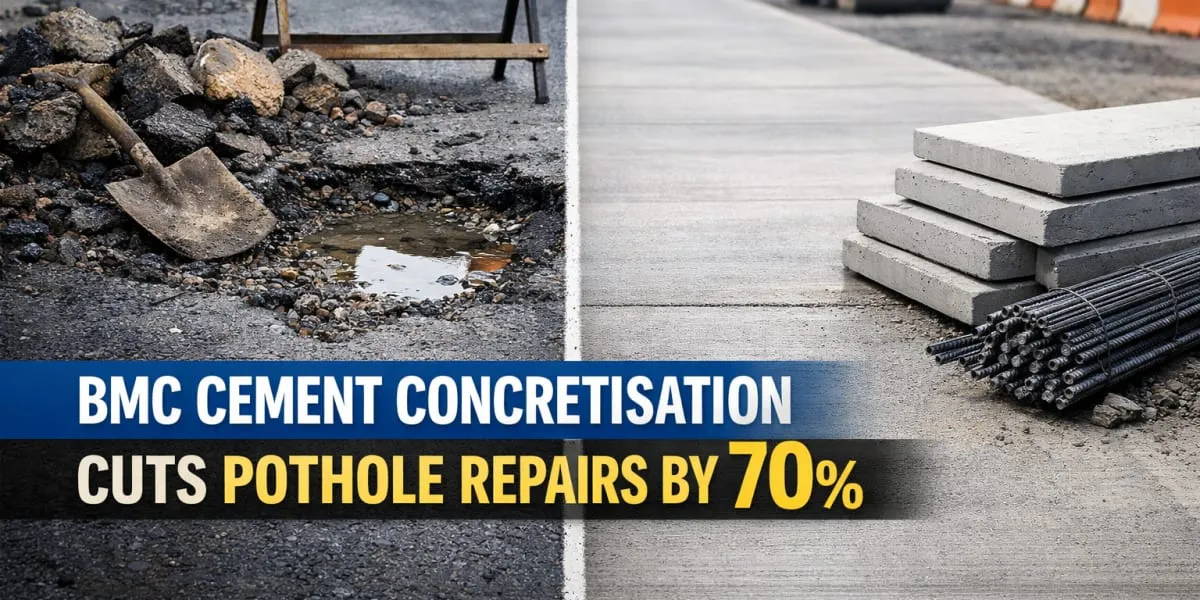
BMC Cement Concretisation Cuts Pothole Repairs By 70 Per Cent

Project worth Rs 170 billion (Rs 170 bn) aims to concretise 1,900 km by 2027

Published

on

By

Shares

The Brihanmumbai Municipal Corporation’s cement concretisation project, valued at Rs 170 billion (Rs 170 bn), has reduced expenditure on pothole repairs by 70 per cent over three years. Spending on repairs fell from Rs 2.02 billion in 2023–24 to Rs 1.56 billion in 2024–25 and then to Rs 890 million (Rs 890 mn) in 2025–26. The current tender is expected to be about Rs 440 million, representing a further 50 per cent reduction.

The project is being executed in two phases, with Phase I covering 307 km from October 2023 and Phase II covering 370 km from October 2024. The Indian Institute of Technology is auditing Phase II and will now also audit Phase I to ensure quality and accountability. Mumbai’s total road network spans approximately 2,050 km, of which about 1,200 km had been converted to cement concrete before 2022.

Since 2022 an additional 677 km were taken up for concretisation and nearly 71 per cent of that work, amounting to 481 km, has been completed. Municipal officials indicated that 10–15 per cent of the remaining work is expected to be completed by May 2026 and another 10 per cent by December 2026. The entire programme is scheduled for completion by May 2027, by which time nearly 1,900 km of Mumbai’s roads are expected to be fully concretised.

The administration has also developed a real time dashboard that displays detailed information about contracts, contractors and progress and citizens can access the latest updates online. The dashboard includes contact details for the civic officials and contractors responsible for particular roads to enhance transparency and accountability. The commissioner directed that ongoing works be completed by 31 May ahead of the monsoon to safeguard completion targets and minimise disruption.

Continue Reading

Concrete

Shree Cement Approves Rs 1,800 Crore Meghalaya Plant

Integrated unit to be completed by quarter ending March 2028

Published

on

By

Shares

Shree Cement has approved the establishment of an integrated cement plant in Meghalaya, signalling a targeted capacity expansion to serve regional demand. The board cleared a unit at Village Daistong in East Jaintia Hills District with a clinker capacity of zero point nine five million tonnes per annum (mn t) and a cement capacity of zero point nine nine million tonnes per annum (mn t). The project was approved on April four, 2026 and is designed as a new addition to the company’s production network where it currently has no existing plant.

The company has earmarked an estimated investment of Rs 1,800 crore (Rs 18 billion (bn)) for the project, which will be financed through a mix of internal accruals and debt. Management has indicated a balanced financing strategy to preserve cash flows while supporting long-term growth and operational investment. The financing approach is intended to avoid over reliance on external borrowing and to maintain financial discipline during the build out.

The plant is expected to improve logistics efficiency and compress distribution distances to emerging demand centres in the north-east, potentially lowering transportation costs and lead times. By locating production closer to demand the company aims to strengthen market access and respond more effectively to regional construction activity. The project forms part of a broader strategy to diversify the production base across geographies and reduce concentration risk.

Execution is planned over a multi-year window with completion targeted by the quarter ending March 2028 and the company will proceed with construction and requisite regulatory clearances. The integrated design is intended to enhance operational control and production efficiency once operational. The decision follows a regulatory filing dated April four, 2026 and the disclosed details have not been independently verified.

Continue Reading

Concrete

WCA Welcomes SiloConnect as associate corporate member

Published

on

By

Shares

The World Cement Association (WCA) has announced SiloConnect as its newest associate corporate member, expanding its network of technology providers supporting digitalisation in the cement industry. SiloConnect offers smart sensor technology that provides real-time visibility of cement inventory levels at customer silos, enabling producers to monitor stock remotely and plan deliveries more efficiently. The solution helps companies move from reactive to proactive logistics, improving delivery planning, operational efficiency and safety by reducing manual inspections. The technology is already used by major cement producers such as Holcim, Cemex and Heidelberg Materials and is deployed across more than 30 countries worldwide.

Continue Reading

Video Thumbnail
â–

    SIGN-UP FOR OUR GENERAL NEWSLETTER


    Trending News

    SUBSCRIBE TO THE NEWSLETTER


    Don't miss out on valuable insights and opportunities to connect with like minded professionals.


      This will close in 0 seconds