Connect with us

Process

AMCL-UBE tie-up: A win-win deal

Published

on

Shares

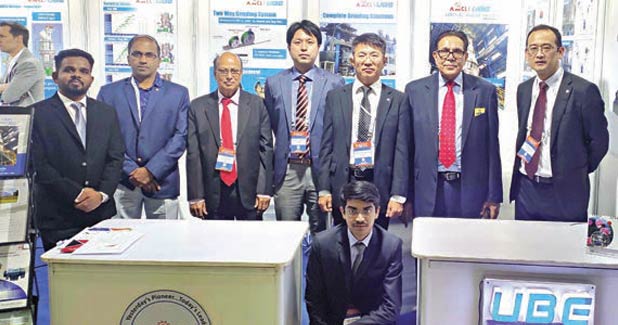
AMCL participated in the NCB event by putting up a stall where ICR had an opportunity to meet and talk to the Executive Director Rakesh Sharma and a team of UBE Machinery Corporation, Japan that included Yoshikatsu Fukuda, Overseas Sales Department; Tatsuya Hinauchi, Senior Manager – Design Section; and Hirofumi Kasai, Senior Manager, Mill System Engg Group.

Since you are part of NCB event, what are your overall impressions?
Yoshikatsu Fukuda:
This is a wonderful event, very well organised and we are happy to be here. We see a lot of energy around us, and are pleased with the overall management of the event.

How did you choose AMCL to partner with? Any specific reasons?
Tatsuya Hinauchi:
In May 2019, we decided to shake hands with AMCL. The first reason is that they are already in the business for over 20 years. They have similar products to offer to the cement industry, and they are well aware of the Japanese culture and discipline. They are able to fulfil our expectations in terms of engineering, and above all, AMCL has a good name in the market.

Do you think you are a bit late entrant in the full range of VRM product offering?
Yoshikatsu Fukuda:
Yes. We are little late to enter the Indian subcontinent. But Indian economy is developing, which will provide us an opportunity to grow.

What difficulties you are likely to face in the present scenario in India?
Yoshikatsu Fukuda:
Regarding the technology, that has not changed much. We shall be offering our products, which are comparable with any of the products in the market at an attractive cost. We shall have an exclusive service engineer to provide service to our customers. Along with him, there will be a trained team of local engineers. We would emphasise on the preventive maintenance rather than breakdown maintenance. A good satisfied customer takes your image forward.

What about the components used in your machines?
Hirofumi Kasai:
Our machines are not new to India. We already have 20 VRMs running in the country in different cement plants like JK Lakshmi, India Cements, Nuvoco, and Shri Digvijay Cement, to name a few. Except the bearings and may be the grinding table, we shall source all our components locally. The product is being upgraded constantly.

Tell us more about UBE Group and UBE Machinery.
Yoshikatsu Fukuda:
UBE is a big group originated in Japan and UBE Machinery is a part of UBE Group. We tied up with Loesche in 1954 and got separated in the year 1996. Since then, we produce and market our product in our own name. We also manufacture cranes, conveyors, injection machines and die casting machinery, etc. Half of our business comes from automotive sector and the other half comes from sectors like cement, coal, etc.

UBE Machinery is one of the leading manufacturers of vertical mills in the world. The vertical mills are known for their reliability, efficiency and economical operations. With this exclusive agreement, Indian cement industry will have a choice to select one of the most reliable mills to suit its requirements.We have one product exclusively designed for producing slag cement where you can grind slag and clinker together. But we also have a product where if you desire to grind slag and clinker separately you can do so.

A little about AMCL UBE tie up.
Rakesh Sharma:
AMCL was earlier a part of ACC group and was into manufacturing VRPM (Vertical Roller Pre-grinding Mills) in collaboration with Nihon Cement. Many VRPMs have been supplied to ACC, Ramco Cements, Sagar Cements, Kuwait Cement, etc. to get the benefits of energy conservation.

Once Holcim took over ACC, this unit was hived off to HNG group. We have been into the business of supplying VRPMs but the recent trend is to use full-fledged VRM, which is nothing but a separator being added to VRPM. UBE is an old and trusted player in the VRM business, and the machines supplied by them are mostly reliable and dependable. This is why we decided to tie up with UBE. They are into raw materials, coal, cement and slag grinding. UBE has a strong R&D team to back up their services. Energy efficiency is quite high in their machines. UBE VRMs can be used for any application in cement as well as in mineral industry.

How do you view the tie-up with UBE?
Rakesh Sharma:
Our thinking is for long term, and from that perspective, we have taken the right step at right time. It is more or less a forward integration for us. We, at India, are a developing country and the per capita of cement consumption is likely to grow at least to the world average level. There is enough scope to expand and we are going to have our share of business. We plan to offer cost-effective solutions to the industry and would aim to become a reliable resource for the cement industry. UBE Machinery Corporation, Japan has signed a licensing agreement with AMCL Machinery Limited on May 30, 2019 for design, manufacture and commission of vertical mills for cement plants and related applications on an exclusive basis for India, Nepal and Bangladesh. All the designs will be provided by UBE, and if any modifications required, will be carried out by their team. Our engineers are getting trained in Japan. We already have a full team for erection and commissioning. Slowly, we will expand our services network as well.

For the first time, we are going to have a test mill in India where the samples from the clients will be tested, which can include limestone, clinker, slag, fly ash, gypsum, etc. The necessary experimentation or simulation will be carried out before offering a product. For that matter, all the VRMs are customised since there is a lot of variation in the raw materials and the moisture content, etc.

UBE has decided to take Indian market very seriously. They are a low profile but a high content company. They do not talk much about their capabilities but believe in delivering reliable machines while always keeping the interest of customers in mind. In fact, the VRM revolution in India was started by UBE by supplying the vertical mill to Shri Digvijay Cement way back in 1984. We are getting good response from the customers from India, Nepal and Bangladesh, and we do hope to do well in coming years.


Continue Reading
Click to comment

Leave a Reply

Your email address will not be published. Required fields are marked *

Concrete

Steel: Shielded or Strengthened?

CW explores the impact of pro-steel policies on construction and infrastructure and identifies gaps that need to be addressed.

Published

on

By

Shares

Going forward, domestic steel mills are targeting capacity expansion
of nearly 40 per cent through till FY31, adding 80-85 mt, translating
into an investment pipeline of $ 45-50 billion. So, Jhunjhunwala points
out that continuing the safeguard duty will be vital to prevent a surge
in imports and protect domestic prices from external shocks. While in
FY26, the industry operating profit per tonne is expected to hold at
around $ 108, similar to last year, the industry’s earnings must
meaningfully improve from hereon to sustain large-scale investments.
Else, domestic mills could experience a significant spike in industry
leverage levels over the medium term, increasing their vulnerability to
external macroeconomic shocks.(~$ 60/tonne) over the past one month,
compressing the import parity discount to ~$ 23-25/tonne from previous
highs of ~$ 70-90/tonne, adds Jhunjhunwala. With this, he says, “the
industry can expect high resistance to further steel price increases.”

Domestic HRC prices have increased by ~Rs 5,000/tonne
“Aggressive
capacity additions (~15 mt commissioned in FY25, with 5 mt more by
FY26) have created a supply overhang, temporarily outpacing demand
growth of ~11-12 mt,” he says…

To read the full article Click Here

Continue Reading

Process

Price hikes, drop in input costs help cement industry to post positive margins: Care Ratings

Published

on

By

Shares

Region-wise,the southern region comprises 35% of the total cement capacity, followed by thenorthern, eastern, western and central region comprising 20%, 18%, 14% and 13%of the capacity, respectively.

The cement industry is expected to post positive margins on decent price hikes over the months, falling raw material prices and marked drop in overall production costs, said an analysis of Care Ratings.

Wholesale and retail prices of cement have increased 11.9% and 12.4%, respectively, in the current financial year. As whole prices have remained elevated in most of the markets in the months of FY20, against the corresponding period of the previous year.

Similarly, electricity and fuel cost have declined 11.9% during 9M FY20 due to drop in crude oil prices. Logistics costs, the biggest cost for cement industry, has also dropped 7.7% (selling and distribution) as the Railways extended the benefit of exemption from busy season surcharge. Moreover, the cost of raw materials, too, declined 5.1% given the price of limestone had fallen 11.3% in the same aforementioned period, the analysis said.

According to Care Ratings, though the overall sales revenue has increased only 1.3%, against 16% growth in the year-ago period, the overall expenditure has declined 3.2% which has benefited the industry largely given the moderation in sales.

Even though FY20 has been subdued in terms of production and demand, the fall in cost of production has still supported the cement industry by clocking in positive margins, the rating agency said.

Cement demand is closely linked to the overall economic growth, particularly the housing and infrastructure sector. The cement sector will be seeing a sharp growth in volumes mainly due to increasing demand from affordable housing and other government infrastructure projects like roads, metros, airports, irrigation.

The government’s newly introduced National Infrastructure Pipeline (NIP), with its target of becoming a $5-trillion economy by 2025, is a detailed road map focused on economic revival through infrastructure development.

The NIP covers a gamut of sectors; rural and urban infrastructure and entails investments of Rs.102 lakh crore to be undertaken by the central government, state governments and the private sector. Of the total projects of the NIP, 42% are under implementation while 19% are under development, 31% are at the conceptual stage and 8% are yet to be classified.

The sectors that will be of focus will be roads, railways, power (renewable and conventional), irrigation and urban infrastructure. These sectors together account for 79% of the proposed investments in six years to 2025. Given the government’s thrust on infrastructure creation, it is likely to benefit the cement industry going forward.

Similarly, the Pradhan Mantri Awaas Yojana, aimed at providing affordable housing, will be a strong driver to lift cement demand. Prices have started correcting Q4 FY20 onwards due to revival in demand of the commodity, the agency said in its analysis.

Industry’s sales revenue has grown at a CAGR of 7.3% during FY15-19 but has grown only 1.3% in the current financial year. Tepid demand throughout the country in the first half of the year has led to the contraction of sales revenue. Fall in the total expenditure of cement firms had aided in improving the operating profit and net profit margins of the industry (OPM was 15.2 during 9M FY19 and NPM was 3.1 during 9M FY19). Interest coverage ratio, too, has improved on an overall basis (ICR was 3.3 during 9M FY19).

According to Cement Manufacturers Association, India accounts for over 8% of the overall global installed capacity. Region-wise, the southern region comprises 35% of the total cement capacity, followed by the northern, eastern, western and central region comprising 20%, 18%, 14% and 13% of the capacity, respectively.

Installed capacity of domestic cement makers has increased at a CAGR of 4.9% during FY16-20. Manufacturers have been able to maintain a capacity utilisation rate above 65% in the past quinquennium. In the current financial year due to the prolonged rains in many parts of the country, the capacity utilisation rate has fallen from 70% during FY19 to 66% currently (YTD).

Source:moneycontrol.com

Continue Reading

Process

Wonder Cement shows journey of cement with new campaign

Published

on

By

Shares

The campaign also marks Wonder Cement being the first ever cement brand to enter the world of IGTV…

ETBrandEquity

Cement manufacturing company Wonder Cement, has announced the launch of a digital campaign ‘Har Raah Mein Wonder Hai’. The campaign has been designed specifically to run on platforms such as Instagram, Facebook and YouTube.

#HarRaahMeinWonderHai is a one-minute video, designed and conceptualised by its digital media partner Triature Digital Marketing and Technologies Pvt Ltd. The entire journey of the cement brand from leaving the factory, going through various weather conditions and witnessing the beauty of nature and wonders through the way until it reaches the destination i.e., to the consumer is very intriguing and the brand has tried to showcase the same with the film.

Sanjay Joshi, executive director, Wonder Cement, said, "Cement as a product poses a unique marketing challenge. Most consumers will build their homes once and therefore buy cement once in a lifetime. It is critical for a cement company to connect with their consumers emotionally. As a part of our communication strategy, it is our endeavor to reach out to a large audience of this country through digital. Wonder Cement always a pioneer in digital, with the launch of our IGTV campaign #HarRahMeinWonderHai, is the first brand in the cement category to venture into this space. Through this campaign, we have captured the emotional journey of a cement bag through its own perspective and depicted what it takes to lay the foundation of one’s dreams and turn them into reality."

The story begins with a family performing the bhoomi poojan of their new plot. It is the place where they are investing their life-long earnings; and planning to build a dream house for the family and children. The family believes in the tradition of having a ‘perfect shuruaat’ (perfect beginning) for their future dream house. The video later highlights the process of construction and in sequence it is emphasising the value of ‘Perfect Shuruaat’ through the eyes of a cement bag.

Tarun Singh Chauhan, management advisor and brand consultant, Wonder Cement, said, "Our objective with this campaign was to show that the cement produced at the Wonder Cement plant speaks for itself, its quality, trust and most of all perfection. The only way this was possible was to take the perspective of a cement bag and showing its journey of perfection from beginning till the end."

According to the company, the campaign also marks Wonder Cement being the first ever cement brand to enter the world of IGTV. No other brand in this category has created content specific to the platform.

Continue Reading

Trending News