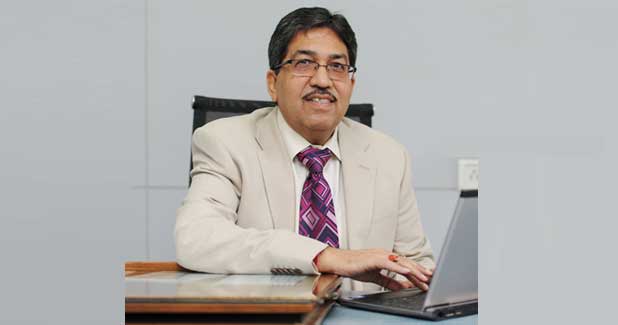
With over three decades of experience behind him in the sector, Dr Shailendra Chouksey, Whole-Time Director, JK Lakshmi Cement is often credited with having transformed the perception of cement as just another commodity to branded category. In this exclusive interaction with INDIAN CEMENT REVIEW in New Delhi, Dr Chouksey says that infrastructure creation will drive demand growth of cement by also providing a fillip to housing. Noting that the next phase of increase in capacity will come from greenfield plants, he informs that the industry is watching the development of inland waterways as a cost-effective mode of transport.
You have been saying that the cement sector is showing the green shoots of a revival after a prolonged period of subdued growth. How?
It is the growth in demand that we have witnessed in the last 12 months that has made me say that. While the figure of 14 per cent looks attractive, we have to remind ourselves that it is on the back of a base that was very muted. Taking that into account, even the growth of about 9 per cent – which the industry has witnessed close to after a gap of nearly six years – is quite healthy. And that’s something to cheer rather than be unduly pessimistic about. The other reason that makes us buoyant is that this demand has basically been fuelled by the initiatives of the government that are long-term in nature; so, there is an element of sustainability there. We would tend to believe that we are back in good times and this demand growth of 8-9 per cent is here to stay. It would eventually lead to a double-digit expansion because countries like China, Indonesia and others that have grown at a phenomenal pace in the past have demonstrated that infrastructure creation culminates in the demand for cement.
It is conventionally believed that the growth in cement sector is delivered by the housing segment. However, you just averred that the next phase of growth in the sector will be delivered by infrastructure development. That’s indeed a very interesting observation.
The reason why people tend to pin a lot of hopes on housing is that in India the segment still constitutes 60 per cent of the demand for cement. Any change there will have a much greater impact on growth, while infrastructure constitutes 20-25 per cent. Therefore, even if the infrastructure grows by 30-40 per cent, it can only translate into 7-8 per cent. Now a logical question would be that how can one expect a much steeper growth just on the back of infrastructure? But what we feel is that the moment our infrastructure expands, development of housing in areas surrounding such projects is bound to increase. Take the example of the metro railway in Delhi.
Wherever it has reached or whenever a new phase is planned, the housing activity there receives a spurt since the connectivity becomes a lot easier. Similarly, road infrastructure or any other project requiring cement, also provides a boost to housing.
In fact, at times it is very difficult to segregate the vanilla effect of infrastructure development and housing. There is a bit of intertwining there and we tend to believe that if the infrastructure is growing at 20-25 per cent, there is bound to be a cascading impact on the other segments that consume cement.
Which segments within the infra universe do you see as contributing to the cement industry’s growth over the next five years?
The road and highway projects will continue to be a major driver. But then we also feel that the metro rail fever is gradually spreading. And the best part is that it is being driven by the public through their representatives. Today, every member of parliament would like to establish a metro rail project in his constituency. There is hardly a state capital that is not talking about a metro project. The metro railway is a phenomenal cement consuming sector. And then again it has a ripple or downstream effect on the development of housing and commercial real estate, which in turn provides a spurt to a whole lot of construction activity. Going forward, metro rail projects would be another important area of cement consumption. Then we have already seen the Dedicated Freight Corridors (DFC) where work is underway and that will continue over the next three to four years. These are some of the important infrastructure projects that will drive the demand for cement. Along with these, there is an aspect that shouldn’t be missed and that is our GDP is growing and so is the purchasing power of the people. And that will result in individual housing construction.
What about the contribution from the smart cities programme of the government?
Well, one has to wait and watch. Initially, when the programme was announced, it was believed it would result in the development of greenfield cities. But gradually the government has realised that there is more to milked from the existing cities by making them smart. Therefore, though the construction might not happen at that pace that was anticipated, there would surely be ancillary developments around smart cities.
In India, the freight of cement has been done by road. With several waterways under development, do you see potential there?
Since it’s a whole new world that is opening up it would be too early on my part to comment on how it will eventually pan out. But at the end of the day, it is the money that talks. If cement manufacturers discover that it makes more economic sense to transport cement and other raw materials on waterways, they will most certainly make that shift. And that will not only be on account of the cost factor but also due to the increased regulation on the carriage of goods by road such as overloading, the high cost of toll that has pushed up freight rates, spike in fuel prices and the Indian Railways increasing freight charges.
Especially in the case of the railway, there is a certain minimum ticket size of freight and transporting less than that doesn’t really make economic sense for a cement manufacturer. Therefore, taking into account all these factors, we might have a good opportunity as far as the development of waterways is concerned. But one has to first test that out and then the network of waterways has to be well-spread out across the country. The operational stretch from Varanasi to Kolkata is in itself a very good beginning.
There is some debate on the 28 per cent GST levied on cement, which is the same as levied on luxury goods. What’s your take?
There is no debate as such. The question that is being asked of the cement industry time and again is what percentage are we looking at. We have said that it is not a question of what percentage the government retains. It is basically about recognising the fact that cement is a core commodity, and the world over the average taxation on cement doesn’t exceed 4 per cent. Therefore, why should India tax it at the exorbitant rate of 28 per cent? We know there are economic compulsions on part of the government and it cannot suddenly slash it down and lose all that revenue. But there has also to be a recognition that there can be a percentage where it can reduce taxation to a level where an increase in demand will compensate for any loss in revenue to the exchequer. If that happens, it’s a win-win situation for both the government and cement industry.
What is your outlook for the industry in 2019?
We feel that this is a very good time for the industry. We foresee no let-up in the demand. There is already a 30 per cent excess capacity that is lying idle. Therefore, we feel the industry will first consolidate operationally. At the present rate of growth in demand for cement, this excess capacity will get exhausted in about three years. But considering the fact that a new cement plant takes quite a while to come up, my own view is that there is not much to be milked out of brownfield projects. New capacity has to come from greenfield projects. I wouldn’t be surprised if over the next couple of years, one gets to hear several announcements of new capacity additions.
– MANISH PANT









 Concrete4 weeks ago
 Concrete2 weeks ago
 Concrete2 weeks ago
 Concrete4 weeks ago