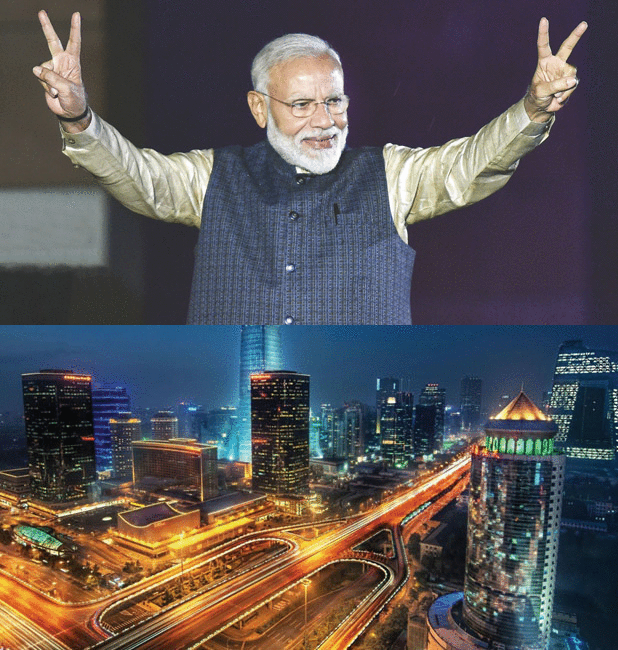
A second term for Narendra Modi-led Government means continuity of policy and opportunity to push tougher reforms, particularly – land and labour.
For Narendra Modi 2.0, the mandate of 2019 has brought a thicker stability cushion but a heavier load of expectations. The Elections results have been very convincing and indicate continuity in the regime. This is important because the government can continue to pursue its economic framework without any legislative hindrance as the majority is absolute. More importantly as there will be continuity there will be less time spent in formulating a new strategy.
The macro-economic situation however has been mixed by the end of FY19 and would need some direct intervention by the government in certain areas which require attention.
The Cement Manufacturers Association (CMA) would like to engage and work closely with the Government to find mutually beneficial solutions that will have a positive impact on the economy. Implementing government’s agenda on renewable energy by putting up 175 GW of renewable power would go a long way in transforming India to meet its national determined contributions for climate change. The Indian cement sector would like to actively participate in this initiative and looks forward to various policy interventions, which can support captive renewable power capacities.
The cement industry in India has been investing heavily to ensure that the industry in India remains at the cutting edge of technology and addresses global concerns like sustainability. Presently, the Indian cement sector has a surplus capacity of around 25 per cent and considering the same, the import of cement from countries like Pakistan and Bangladesh should be dissuaded."The Government is fully aware of various constraints being faced in the mining sector by the cement industry for which immediate interventions would be required to create ease-of-doing business. This would also support the "Make in India" initiative by maximising utilisation of India’s mineral wealth deeply in a sustainable manner," said Mahendra Singhi, President, Cement Manufacturers Association (CMA), and MD & CEO, Dalmia Cement (Bharat).
People of the world’s largest democracy have given their mandate to the government for another term, thus clearing the path for Narendra Modi. While we have witnessed the implementation of key reforms during the first NDA regime, strengthening of the overall economy is what is expected with the continuance of those reforms. "Looking back, we realise that the two words that perhaps rightly sum up the contribution of the government are continuity and stability," according to Ramesh Nair, CEO and Country Head, JLL India.
These measures would directly impact the real estate market. Segments including residential, office and retail have emerged stronger as a result of the developments so far, as per JLL. The government introduced the Real Estate (Regulation and Development) Act (RERA), a landmark reform in 2016. It also introduced the much-needed Goods and Services Tax (GST) in 2017. These have managed to bring in the much-needed efficiency and transparency in the system, albeit the industry witnessed teething issues during the initial phases of their implementation. Real estate industry expects in the second term of the BJP-led NDA Government.
Pradeep Aggarwal, Founder and Chairman, Signature Global India and Chairman, ASSOCHAM National Council on Real Estate, Housing and Urban Development, said "For the first time in many years, a government has shown inclination towards paying heed to the demands of the sector. GST and RERA are the two aspects that were ignored for quite a long time and by coming out with policies for it; as far GST is concerned, we feel that reduction in rates is lucrative for the buyers but input tax credit should be given to developers. The government has shown that it has good intentions to fulfill Modi’s vision Housing for All by 2020 and that it is not only a slogan."
Dr Niranjan Hiranandani, National President, NAREDCO, had this to say: "We believe the new government works further for the structural reforms and steps that will boost real estate business and strengthen consumer sentiment towards Indian real estate. The strong and steady government should bring about stability with remedial actions without much delay to revive the shock of last quarter economic growth. The stable government reflects the faith reinforced by the aspirational India, which enhances the confidence index domestic as well as globally. The Indian real estate industry is hopeful that the government will redress and resolve the prolonged issue of liquidity crisis that the sector is facing currently. Moreover, rationalising the taxes by subsuming stamp duty under GST will grant a big relief to the home buyers. We highly recommend the National Housing Policy to boost rental housing in order to fulfill the ambitious target of Housing for All by creating surpluses. Furthermore, under the decisive leadership of the Prime Minister, the nation will be able to unleash workforce opportunities in the sector that will help the nation to continue as the world’s fastest growing economy."
A report from CARE Ratings says,"The government has been the main driver of capex in the last two-three years and the steady pace of investment should continue. Continuity in investment in sectors namely roads and highways, urban Infrastructure, railways and renewable energy may be expected that will forge strong backward linkages with the rest of the economy."
"The focus must now be on reinvigorating private investment and here it would be necessary to review the clogs that are in the way of investment. Besides looking at further improving the ease of doing business the government must look at tying up other ends such as taxation, credit, regulation (where sectors have regulatory issues), environment etc. to ensure that there is a pick-up in investment. A relook at policies surrounding land acquisition is a priority as this would not only improve implementation rate of projects but would also help bring funds from private and foreign investors," adds the CARE Ratings’ report.
"The sector expects the new government to emphasise more on re-energising the reforms related to infrastructure investment, land acquisition reforms and speeding up the regulatory functions of the State. The sector had slowed down a bit since the sequential jolt of GST and demonetisation but the new GST regime for the sector was a big relief. We expect the government would take measures to expedite and streamline the environment clearances for the new projects, which is a two stage process and takes two to three years. A better clarity over the norms for infrastructure projects, which involve diversion of forest land for non-forestry purposes is recommended. The sector hopes better stability in the regulatory norms without too many changes," said Rohit Poddar, MD, Poddar Housing and Development and Joint Secretary, NAREDCO West.
The economy is going through a cyclical downturn. The GDP growth in the second half of 2018-19 had fallen to ~6.5 per cent – below the trend rate of growth of India (7 per cent). Consumption demand, which was the bulwark of the economy, has weakened and private investment is yet to show signs of a pickup.
CRISIL provided some agenda for the government.The agenda included: "To speed up employment generation, the government needs to focus on: a) policies that support manufacturing sectors with large employment-growth potential so that, despite slipping labour intensity, absolute employment continues to increase. Such sectors would include textiles, leather, and construction. b) Labour-intensive services such as health and education. This will not only create jobs as health, education and construction are highly labour intensive, but also raise India’s growth potential by making the workforce healthy and skilled/educated. c) Preparing the youth for new job opportunities and skilling for newer forms of jobs that are created due to rapid adoption of technology."
Sanjay Dutt, MD & CEO, Tata Realty and Infrastructure, and Tata Housing Development Company, had this to say: "The election result is good news for the real estate sector. We witnessed significant movement in the infrastructure and real estate sector along with the rise in GDP that resulted in job opportunities and confidence in the real estate sector. With the stability in the government, we expect investments to increase and private equity will play a larger role. The government is aware of the sector’s challenges and we expect some immediate relief and announcements."