India is witnessing an unprecedented growth in infrastructure and JSW Cement is consciously contributing to creating a self-reliant India by manufacturing the building blocks of the Indian development story with its world-class cement.
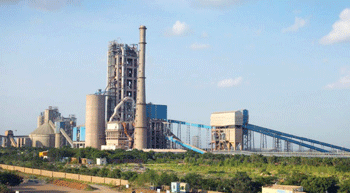
JSW Cement, the Rs 1,400-crore new entrant in the JSW Group, has adopted the route of utilising industrial by-products such as slag to make its eco-friendly cement to ensure a sustainable future for the country. As a group, the $11 billion conglomerate JSW is primarily known for steel as its core business. Slag, one of the by-products of steel industry, is a core ingredient for the manufacturing of Portland slag cement. JSW makes use of the slag to make its own Portland slag cement under the brand JSW Cement. The company has three manufacturing facilities: Vijayanagar in Karnataka, Nandyal in Andhra Pradesh, and Dolvi in Maharashtra. All plants put together have a cumulative capacity to produce 1,600 metric tonne of cement.
The corporate management
The corporate management team comprises a set of experienced professionals who are very focused in terms of making JSW Cement one of the leading cement brands in India. Pankaj Kulkarni, Director, Anil Kumar Pillai, Director and CEO, Hitendra Jariwala, VP – Sales and Marketing, Rahul Akkara, AVP – Brand, and Narendra Singh, CFO are the people who have the requisite experience and the pedigree to take JSW Cement to the next level.
Environment-friendly
By converting industrial by-products into a useful product, JSW has reduced the carbon footprint of the Group. JSW?s vision is to make cement from every tonne of slag that it generates. Not only does this ensure optimal utilisation of resources, but also saves the ecological risk of industrial by-product dumping.
Started in 2009, JSW Cement is a relatively late entrant into the industry. However, with a capacity to produce over 5.9 million tonnes per annum (mtpa), it is fast becoming a force to reckon with. Today, JSW has carved out a niche for its products by adhering to steadfast business values and sustainability norms. The company manufactures one of the most eco-friendly cements in India, and engineers its products for superior strength and durability.
Technology adoption
JSW Cement has pioneered the adoption of several contemporary technologies. Its flagship plant in Nandyal uses world-class technology (including the advanced combi finish mode roller press circuit and automated loading system) to manufacture cement. The company has won prestigious award for its energy-saving processes.
Product range
Portland slag cement (PSC) is the major product by JSW Cement, other ranges being ordinary Portland cement (OPC) and ground granulated blast furnace slag (GGBFS) cement. Slag-based cement offers a number of key advantages including increased strength, less corrosion, heat and water-resistance and longevity. ?In the last five years, we have been able to create a lot of dent in terms of products. One has to really understand that the product that we are selling in the market is really different from our competition,? says Rahul Akkara, AVP – Brand, JSW Cement.
Market reach
JSW Cement is sold in Andhra Pradesh, Karnataka, Tamil Nadu, Kerala, Maharashtra and Goa. A late entrant, compared to other existing players, JSW Cement is planning to gradually up its market share as Akkara says, ?We are looking for a 10 per cent growth year-on-year compared to what we have done in the previous financial year. But more importantly, as a new entrant in the industry, we are looking at spreading our distribution network and increasing production capacity to match the distribution and expansion area we cater to. Today, we are actively present in the seven markets of Andhra Pradesh, Karnataka, Telengana, Kerala, Maharashtra, Goa and Odisha.? According to him, there is a tremendous scope for PSC cement in these states as a vast area in these states fall under coastal line with presence of salinity. PSC cement has the property to resist corrosion from salinity. So PSC is ideal for these states. More than that, PSC cement has many other advantages to ensure the longevity of the structure. So, the strength of PSC cement of seven days or 28 days is far more than a PPC or OPC. ?We need to educate the consumer and this is where we are going to engage ourselves. As the awareness on PSC cement increases, the distribution will increase and that is how we are looking at achieving our target,? Akkara explains.
Expansion plans
JSW Cement plans to add two million tonnes of capacity at Vijayanagar, which already houses two plants. It is also envisioning setting up a greenfield cement plant with a capacity of 4.3 million-tonne at Gulbarga in Karnataka.
The company is also spreading its brand visibility across the country through various marketing initiatives. On the plans, Pankaj Kulkarni, Director, JSW Cement, elaborates, ?We are definitely looking at scaling up our operations based on product and brand acceptance by the consumer, influencers and trade.? He further adds, ?We are now embarking on a brand module and working towards making JSW Cement a preferred choice of the consumer in India. We have partnered with Ogilvy & Mather, one of the world?s best advertising agencies and launched our TV commercial, which would help us to garner a larger share of voice and increase recall for JSW Cement in the market.?
?The growth from 0.6 mmt to 6 mmt is a testimonial to our success.?- Pankaj Kulkarni, Director, JSW Cement
How is the current demand for your products and what are your marketing plans to boost your sales?
From a mere 0.6 mmt to 6 mmt in less than five years, JSW Cement has been on a roll, as we have been one of the fastest growing cement brands in the recent times. This has happened due to various reasons. We offer our customers superior quality cement; we have partnered with some of the best dealers and retailers across markets to sell our products. We bring to the table high level of business transparency in all our dealings. We are now embarking on a brand module and working towards making JSW Cement a preferred choice of the consumer in India.
What is your mantra for keeping your clients/customers coming back to you?
JSW cement offers its consumers superior quality PSC cement. The PSC cement today has many advantages over the regular OPC and PPC cement. We have been doing a lot of interactions and engagements with consumers and influencers on a sustained level. This engagement module works towards educating people on why they should buy PSC over other cement categories. The growth from a 0.6 mmt to 6 mmt is a testimonial to our success and acceptance of the product and the brand.
Do you have future expansion plans?
We definitely are looking at scaling up our operations based on product and brand acceptance by the consumer, influencers and trade.
Are you planning to launch any new product in near future?
We would currently like to focus on building the PSC category. Today JSW cement is the only company in India, which is focused on making PSC cement. We would like to build this space and gain market leadership in the PSC segment. We would also like to build the brand alongside and focus on creating the pull for our brand and PSC cement.
?We focus on PSC and want to take this forward.?
– Rahul Akkara, AVP – Brand, JSW Cement
How has been the growth of JSW Cement?
We have been able to create a lot of dent in terms of products. We are focusing on PSC cement and we want to take this forward in terms of market leadership. Compared to PPC, PSC is a far more superior product for the simple reason that PPC is essentially made of fly ash and PSC by slag. Slag being one of the core by-products of steel industry, has obviously much more longevity and strength as compared to fly ash and other compositions which are used in PPC and OPC.
What is the market share of PSC in India?
World over, 95 per cent of the cement used is PSC. However, in India, PSC is in its nascent stage with 7-10 per cent. One of the main advantages of PSC cement is that it is recommended and used in coastal line to resist the high salinity and corrosion due to salinity. PSC by its anti-corrosive and anti-sulphate properties prevents concrete from corrosion and rusting. We are here to make the product, which is not only ready for today?s challenges but also is geared to face the challenges of tomorrow. Today, because of the imbalance of ecosystems in terms of pollution and environmental changes, it is recommended by many people to use PSC over PPC and OPC. However, in India, JSW is taking the initiative to converting people from getting into PPC and OPC to rather use PSC owing to its various advantages over others.
What are the efforts that you are taking to educate such influencers?
We are looking ahead for a two-side approach. On one side, we are going to be tackling the end-consumers because they are also need to be informed about the product. Today, the decision making process of a consumer is not highly involved. The consumer is rather dependent on the contractor and the mason in terms of decision-making. We are looking at launching an ad film targeting the consumer segment, which talks about the advantages of PSC cement over a PPC and OPC. At the influencer segment, we are creating an event calendar where we will have different sets of meets with different influencers throughout the year. These are the various steps we will be taking and initiating in terms of giving awareness for JSW Cement.
How do you see the overall growth of cement demand in the sector?
There is a tremendous infrastructure boom happening across the country as well as world over; especially in countries like India, the infrastructure boom is going to be at a rapid pace. Today, with projects like Smart Cities, highways, expressways, airports, etc., there is a clear indication of an infrastructure boom in the next 10 years. In that sense, there is a huge potential for cement in India.
What is the percentage growth of PSC cement in India?
We are expecting a 10 per cent growth on our existing business. Also, we are going to invest in awareness programmes for PSC cement. We are the only key players who really focus on PSC cement for the simple reason that we would like to innovate and differentiate what the competition is doing. More importantly, for us our vision is to build with a category, create a great amount of awareness in PSC cement, primarily because it is a better product than PPC and OPC.














 Concrete4 weeks ago
 Concrete2 weeks ago
 Concrete2 weeks ago
 Concrete4 weeks ago