Connect with us

Economy & Market

We keep introducing new advanced pumps in the market and upgrading existing products

Published

on

Shares

Ranganath NK
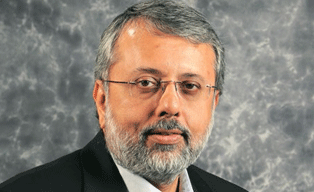
Managing Director, Grundfos Pumps India

Those who deal with industrial pumps ought to have heard the name Grundfos. Those who have used it would vouch for their reliability. Such is the status of this 60-year-old pump manufacturer. The company has defined its goals clearly. Though now China is a second home for Grundfos, the company is on its way to be the largest industry partner in India and Russia. It is aggressively introducing innovative products in the market that meet efficiency norms years before they are mandated. ICR interacted with Ranganath NK, Managing Director, Grundfos Pumps India, to take a closer look at the company. Excerpts from the interaction.

Tell us a bit about Grundfos India?
Grundos India is a wholly owned subsidiary of Grundfos A/S, Denmark. Set up in 1998, Grundfos India started with its commercial operations in 1999. Prior to that, Grundfos supplied to India through its warehouse in Dubai. Initially the company started with sales and service in India and later moved to local assembly and then to localising components in India. Of course, provided that the quality is maintained at the same level that we have at all other plants internationally.

Today, Grundfos India, headquartered in Chennai, is responsible for sales in India, Bangladesh, Bhutan and Maldives.

We have more than 250 employees working with 200 distributors and dealers with 20 offices across India. We have two production facilities, one adjoined the corporate office here in Chennai and another in the Special Economic Zone (SEZ) on the East Coast Road, Tamil Nadu.

So do you manufacture all components here in India?
No, not all. Initially we focused on building systems. The pumps were sourced from Dubai. When we started production of pump components, we started making about 20 per cent of the components. Now we are making about 40 per cent components locally. We don?t make steel or sheet metal components in India at all. It is not possible to manufacture them economically in India while adhering to high quality standards of Grundfos. Similarly for motors we are still dependent on imports from our international counterparts. We have so far not been able to identify a local supplier in India who can supply motors adhering to Grundfos standards and at an economical rate. It is much cheaper to get them manufactured abroad and import in India. We do casting work in India.Tamil Nadu.

How many units are assembled at Grundfos every year?
If we consider pumps of various sizes assembled in India, then it would be close to 50,000 units a year. But the number of units sold by us would be close to 1 to 1.5 lakh. We assemble only large size pumps (3 kW upwards), 62 per cent of which are used in the industrial sector.Tamil Nadu.

Has the recent slow down in industry affected you?
Though the growth was not negative, nor did we hit the bottom, we were influenced by the slowdown. Right from inception, for some 15 years now, we had maintained a CAGR of 30 per cent. But during the slowdown it was around 12 per cent.

Grundfos pumps have a very strong brand loyalty in the market. What is the secret?
There are a few key drivers for this brand attachment. One is our products are of high quality and run efficiently. Grundfos pumps are very reliable and have a life cycle of 10-15 years on an average. If you look at the life cycle cost of a pump, the cost of pump and its maintenance is negligible in comparison to the cost of energy consumed by it. Grundfos pumps offer 30-35 per cent savings in energy costs, so it makes sense to opt for these pumps. The pay back period of our pumps is less than a year to 18 months in most of the cases.

The pump to a plant is like the heart to the body. When a pump fails, it is like the plant having a heart attack. Maintenance people have to continuously monitor pump health to keep the processes running smoothly. A reliable pump that gives them less maintenance headaches will naturally be their favourite.

Plus we keep introducing new advanced pumps in the market and upgrading existing products. So our customers now expect the latest and best from us.

Does Grundfos have an R&D centre in India and if so what are the projects that you are working on?
Yes we have recently established an R&D unit here, which is mainly focused on embedded software development for pumps. We have also assembled a 5-6-member team recently to develop specific products catering to the Indian market. What is requested in local market may not sell in America. So these products are tailor made as per the specific needs of the local market.

Besides this, we are working on solar driven water pumps. We are developing very energy efficient pumps that reduce the requirement of solar panel size, making the whole system energy efficient and affordable.

You are also in manufacturing of motors and recently you have upgraded IE2 standards. Tell us more about this upgrade.
Grundfos has manufactured electrical motors since the beginning of the 1970s. These include a range of energy-efficient standard motors and motors with integrated frequency converters up to 22 kW that meet the current EU energy efficiency classification?s highest class.

Now the company will be switching from IE1 to IE2 motors as standard from August 01, 2014. To begin with, it will be implemented in the CR range of pumps and will be gradually extended to other products as well. In alignment with the global trend of shifting towards energy efficient motors, which was introduced in Europe in 2011, and in China this year, Grundfos is the first pump company in India to move to these energy efficiency IE2 motors.

Pumps consume about 10 per cent of global electricity. Without precisely the right motor, even the best pump will consistently waste energy. With Grundfos high efficiency pump and motor technology, it reduces the average pump?s energy consumption by up to 60 per cent.

Tell us about the Blueflux label pumps from Grundfos?
Blue indicates energy. These pumps are very energy efficient and have integrated electronic drives. They almost learn how to operate based on the usage pattern. The Grundfos Blueflux label ensures that the pump motor runs at the highest possible efficiency standard, IE3, under the EU Directive specifying ecodesign requirements for electric motors. Grundfos Blueflux technology represents the best from Grundfos within energy efficient motors and variable frequency drives (MG motors, MGE motors and CUE drives). Most pumps are needlessly inefficient. This is largely due to the motors driving the pumps. Most run continuously at their top speed regardless of actual requirements. The Grundfos Blueflux motor combined with a variable speed drive can decrease a pump?s energy consumption by up to 60 per cent, depending on the pump?s load profile.

Tell us about the green building initiatives taken by you?
While manufacturing products that help our clients save energy, we are also trying to contribute towards energy and water conservation by reducing our impact on the environment. I believe in walking the talk. So when it came to green buildings, we decided to set an example at home. Our headquarters in Chennai is India?s first gold-rated green building (LEED certification by USGBC in 2005) and is energy efficient with 100 per cent recycling of the sewage, rain water harvesting and with solar collectors and photovoltaics. Grundfos India?s factory also received the gold certification in 2011 from the Indian Green Building Council (IGBC). In August 2013, the Grundfos office building reapplied for certification, and that too against stricter norms. Our facility got the LEED EB Platinum rating.

Grundfos India has launched a forum through the social media site, Facebook, called ?Ek Boond Pani?. The name translates to ?a drop of water? in Hindi signifying the importance of each drop of water. Through this page, members share water conservation tips and facts to encourage this awareness to be driven home. Grundfos India is also working with students from elementary schools to universities to spread awareness on sustainability (energy and water conservation). We encourage school visits to its facility to showcase the Green Building concept.

Grundfos Group
An annual production of more than 16 million pump units makes Grundfos one of the world?s leading pump manufacturers. Circulator pumps for heating and air-conditioning as well as other centrifugal pumps for the industry, water supply, sewage and dosing are the main products. Today Grundfos is the world?s largest manufacturer of circulators, covering approximately 50 per cent of the world market of these pumps. In addition to pumps, Grundfos produces standard and submersible motors as well as electronics for monitoring and controlling pumps. Additional products are produced in the BioBooster and Lifelink divisions, which are part of the company?s new business activities.

The company was established in 1945 in Bjerringbro, a small town in Denmark. Grundfos DK the Sales Company, Grundfos A/S the Production Company and Grundfos Holding A/S are operated from this town. In addition, Grundfos has facilities in Aalestrup, Arslev, Brondby and and Farum.

The Grundfos Group is represented by more than 80 companies in more than 55 countries. The company has experienced more than 60 years of continual growth.

The pump to a plant is like the heart to the body. When a pump fails, it is like the plant having a heart attack. Maintenance people have to constantly monitor pump health to keep the processes running smoothly.

Ranganath NK
Ranganath NK joined Grundfos group in February 1998 and established Grundfos India as a company in March 1998. He oversees the operations of the company in India, Bangladesh, Bhutan and Maldives. Ranganath has more than 33 years of industry experience covering marketing, sales, design, project management, finance and human resources.

Prior to joining Grundfos, he was the Director of IAEC Industries. His first job was with Eicher Tractors in sales. Ranganath has been involved in technology transfer to India from other countries including Denmark. His focus has been and is water and energy conservation.

Ranganath was Chairman of Confederation of Indian Industry (CII), Tamil Nadu Council. He is also involved with the CII Councils for water, skill development and sustainability. He is a member of the Executive Council of Indian Green Building Council (IGBC).


Continue Reading
Click to comment

Leave a Reply

Your email address will not be published. Required fields are marked *

Concrete

PROMECON introduces infrared-based tertiary air measurement system for cement kilns

Published

on

By

Shares

The new solution promisescontinuous, real-time tertiary air flow measurement in cement plant operations.

PROMECON GmbH has launched the McON IR Compact, an infrared-based measuring system designed to deliver continuous, real-time tertiary air flow measurement in cement plant operations. The system addresses the longstanding process control challenge of accurate tertiary air monitoring under extreme kiln conditions. It uses patented infrared time-of-flight measurement technology that operates without calibration or maintenance intervention.

Precise tertiary air measurement is a critical requirement for stable rotary kiln operation. The McON IR Compact is engineered to function reliably at temperatures up to 1,200°C and in the presence of abrasive clinker dust. Its vector-based digital measurement architecture ensures that readings remain unaffected by swirl, dust deposits or drift. Due to these conditions conventional measurement systems in pyroprocess environments are often compromised.

The system is fully non-intrusive and requires no K-factors, recalibration or periodic readjustment, enabling years of uninterrupted operation. This design directly supports plant availability and reduces the maintenance overhead typically associated with process instrumentation in high-temperature zones.

PROMECON has deployed the McON IR Compact at multiple cement facilities, including Warta Cement in Poland. Plant operators report that the system has aided in identifying blockages, optimising purging cycles for gas burners, and supplying accurate flow data for AI-based process optimisation programmes. The practical outcomes include more stable kiln operation, improved process control, and earlier detection of process disturbances.

On the energy side, real-time tertiary air data enables reduction in induced draft fan load and helps flatten process oscillations across the pyroprocess. This translates to lower fuel and energy consumption, fewer unplanned shutdowns, and a measurable reduction in NOx peaks. This directly reflects on the downstream cost implications for plants operating SCR or SNCR systems for emissions compliance.

Continue Reading

Concrete

Filtration Technology is Critical for Efficient Logistics

Published

on

By

Shares

Niranjan Kirloskar, MD, Fleetguard Filters, makes the case that filtration technology, which has been long treated as a routine consumable, is in fact a strategic performance enabler across every stage of cement production and logistics.

India’s cement industry forms the core for infrastructure growth of the country. With an expected compound annual growth rate of six to eight per cent, India has secured its position as the second-largest cement producer globally. This growth is a result of the increasing demand across, resulting in capacity expansion. Consequently, cement manufacturers are now also focusing on running the factories as efficiently as possible to stay competitive and profitable.
While a large portion of focus still remains on production technologies and capacity utilisation, the hidden factor in profitability is the efficiency of cement logistics. The logistics alone account for nearly 30 per cent to 40 per cent of the total cost of cement, making efficiency in this segment a key lever for profitability and reliability.
In the midst of this complex and high-intensity ecosystem, filtration often remains one of the most underappreciated yet essential enablers of performance.

A demanding operational landscape
Cement production and logistics inherently operate in some of the harshest industrial environments. With processes such as quarrying, crushing, grinding, clinker production, and bulk material handling expose the machinery to constant high temperatures, heavy loads, and dust, often the silent destructive force for engines.
The ecosystem is abrasive, and often one with a high contamination index. These challenging conditions demand equipment such as the excavators, crushers, compressors, and transport vehicles to perform and perform efficiently. The continuous exposure to contamination across every aspect like air, fuel, lubrication, and even hydraulic systems causes long-term damage. Studies have also shown that 70 to 80 per cent of hydraulic system failures are directly linked to contamination, while primary cause of engine wear is inadequate air filtration.
For engines as heavy as these, even a minor contaminant has a cascading effect; reducing efficiency, performance and culminating to unplanned downtime. Particles as small as 5 to 10 microns, far smaller than a human hair (~70 microns), can cause significant damage to critical engine components. In an industry where margins are closely linked to operational efficiency, such disruptions can significantly affect both cost structures and delivery timelines.

Dust management: A persistent challenge
Dust is a natural by-product in cement operations. From drilling and blasting in the quarries to packing in plants, this fine particulate matter does occupy a large space in operations. Dust concentration levels in quarry and crushing zones often create extremely high particulate exposure for equipment. These fine particles, when enter the engines and critical systems, accelerates the wear and tear of the component, affecting directly the operational efficiency. Over time every block fall; engine performance declines, fuel consumption rises, and maintenance cycles shorten. In this case, effective air filtration is the natural first line of defence. Advanced filtration systems are designed to capture high volumes of particulate matter while maintaining consistent airflow, ensuring that engines and equipment operate under optimal conditions.
In high-dust applications, as in cement production, even the filtration systems are expected to sustain performance over extended periods without the need of frequent replacement. This becomes crucial in remote quarry locations where access to frequent maintenance may be limited.

Fluid cleanliness and system integrity
Beyond air filtration, fluid systems also play a crucial role for equipment reliability in cement operations. Fuel systems are required to remain free from contaminants for efficient working of combustion and injection protection. Additionally, lubrication systems also need to maintain the oil purity to reduce friction and prevent any premature wear of moving parts. The hydraulic systems, which are key to several heavy equipment operations, are especially sensitive to contamination.
If fine particles or water enters these systems, it can lead to reduced efficiency, erratic performance, and eventual failure of the system. Modern filtration systems are designed with high-efficiency media capable of removing extremely fine contaminants, with advanced fuel and oil filtration solutions filtering particles as small as two to five microns. Multi-stage filtration systems further ensure that fluid performance is maintained even under challenging operating conditions.
Another critical aspect of fuel systems is water separation. Removing moisture helps prevent corrosion, improves combustion efficiency and enhances overall engine reliability. Modern water separation technologies can achieve over 95 per cent efficiency in removing water from fuel systems.

Ensuring reliability across the value chain
Filtration plays a critical role across every stage of cement logistics:
• Quarry operations: Equipment operates in highly abrasive environments, requiring strong protection against dust ingress and hydraulic contamination.
• Processing units: Crushers, kilns, and grinding mills depend on clean lubrication and cooling systems to sustain continuous operations.
• Material handling systems: Pneumatic and mechanical systems rely on clean air and fluid systems for efficiency and reliability.
• Transportation networks: Bulk carriers and trucks must maintain engine health and fuel efficiency to ensure timely deliveries.
Across these operations, filtration plays a vital role; as it supports consistent equipment performance while reducing the risk of unexpected failures.
Effective filtration solutions can reduce unscheduled equipment failures by 30 to 50 per cent across heavy-duty operations.

Uptime as a strategic imperative
In cement manufacturing, uptime is currency. Downtime not only delays the production, but it also greatly impacts the supply commitments and logistics planning. With the right filtration systems, contaminants are kept at bay from entering the
critical systems, and they also significantly extend the service intervals.
Optimised filtration can extend service intervals by 20 to 40 per cent, reducing maintenance frequency while maintaining consistent performance across demanding operating conditions. Filtration systems designed for heavy-duty applications sustain efficiency throughout their lifecycle, ensuring reliable protection with minimal interruptions. This leads to improved equipment availability, lower maintenance costs, and more predictable operations, with well-maintained systems capable of achieving uptime levels of over 90 to 95 per cent in challenging cement environments.

Supporting emission and sustainability goals
With the rising environmental awareness, the cement industry too is aligning with the stricter norms and sustainability targets. In this scenario, the operational efficiency is directly linked to emission control.

Air and fuel systems that are clean enable
much more efficient combustion. They also reduce emissions from both the stationary equipment and transport fleets. Similarly, with a well-maintained fluid cleanliness, emission systems function better. Poor combustion due to contamination can increase emissions by 5 to 10 per cent, making clean systems critical for compliance.
Additionally, efficient and longer lasting filtration systems significantly reduce any waste generation and contribute to increased sustainable maintenance practices. Extended-life filtration solutions can reduce filter disposal and maintenance waste by 15 to 20 per cent. Smart and efficient filtration in this case plays an important role in meeting the both regulatory and environmental objectives within the industry.

Advancements in filtration technology
Over the years, there has been a significant evolution in the filtration technology to meet the modern industrial applications.
Key developments include:
• High-efficiency filtration media capable of capturing very fine particles without restricting flow
• Compact and integrated designs that combine multiple filtration functions
• Extended service life solutions that reduce replacement frequency and maintenance downtime
• Application-specific engineering tailored to different stages of cement operations
Modern multi-layer filtration media can improve dust-holding capacity by up to two to three times compared to conventional systems, while maintaining consistent performance. These advancements have transformed filtration from a basic maintenance component into a critical performance system.

Adapting to diverse operating conditions
The cement industry of India operates across diverse geographies. Spanning across regions with arid regions with higher dust levels, to the coastal areas with higher humidity, challenges of each region pose different threats to the engines. Modern filtration systems are thus tailored to address these unique challenges of each region.
Indian operating environments often range from 0°C to over 50°C, with some of the highest dust loads globally in mining zones.
Additionally, filtration technology can also be customised to variations which then align the system design with factors like dust load, temperature, and equipment usage patterns. Equipment utilisation levels in India are typically higher than global averages, making robust filtration even more critical. This approach ensures optimal performance and durability across different operational contexts.

Impact on total cost of ownership
Filtration has a direct and measurable impact on the total cost of ownership of equipment.
Effective filtration leads to:
• Lower wear and tear on critical components
• Reduced maintenance and repair costs
• Improved fuel efficiency
• Extended equipment life
• Higher operational uptime
Effective filtration can extend engine life by 20 to 30 per cent and reduce overall maintenance costs by 15 to 25 per cent over the equipment lifecycle. These benefits collectively enhance productivity and reduce lifecycle costs. Conversely, inadequate filtration can result in frequent breakdowns, increased maintenance expenditure, and reduced asset utilisation.

Building a more efficient cement ecosystem
With the rising demand across various sectors, the cement industry is expected to expand at an unprecedented rate. This growth is forcing the production to move towards a more efficient and resilient system of operations. This requires attention not only to production technologies but also to the supporting systems that enable consistent performance. Filtration must be viewed as a strategic investment rather than a routine consumable. By ensuring the cleanliness of air and fluids across systems, it supports reliability, efficiency, and sustainability.

The road ahead
The future of cement logistics will be shaped by increasing mechanisation, digital monitoring, and stricter environmental standards. The industry is also witnessing a shift towards predictive maintenance and condition monitoring, where filtration performance is increasingly integrated with real-time equipment diagnostics.
In this evolving landscape, the role of filtration will become even more critical. As equipment becomes more advanced and operating conditions more demanding, the need for precise contamination control will continue to grow. From quarry to construction site, filtration technology underpins the performance of every critical system. It enables equipment to operate efficiently, reduces operational risks, and supports the industry’s broader goals of growth and sustainability. In many ways, it is the unseen force that keeps the cement ecosystem moving, quietly ensuring that every link in the value chain performs as expected.

About the author
Niranjan Kirloskar, Managing Director, Fleetguard Filters, is focused on driving innovation, operational excellence, and long-term business growth through strategic and people-centric leadership. With a strong foundation in ethics and forward-thinking decision-making, he champions a culture of collaboration, accountability, and technological advancement.

Continue Reading

Concrete

Cement’s Next Fuel Shift

Published

on

By

Shares

Jignesh Kindaria highlights how Thermal Substitution Rate (TSR) is emerging as a critical lever for cost savings, decarbonisation and competitive advantage in the cement industry.

India is simultaneously grappling with two crises: a mounting waste emergency and an urgent need to decarbonise its most carbon-intensive industries. The cement sector, the second-largest in the world and the backbone of the nation’s infrastructure ambitions, sits at the centre of both. It consumes enormous quantities of fossil fuel, and it has the technical capacity to consume something else entirely: the waste our cities cannot get rid of.
According to CPCB and NITI Aayog projections, India generates approximately 62.4 million tonnes of municipal solid waste annually, with that figure expected to reach 165 million tonnes by 2030. Much of this waste is energy-rich and non-recyclable. At the same time, cement kilns operate at material temperatures of approximately 1,450 degrees Celsius, with gas temperatures reaching 2,000 degrees. This high-temperature environment is ideal for co-processing, ensuring the complete thermal destruction of organic compounds without generating toxic residues. The physics are in our favour. The infrastructure is not.
Pre-processing is not the support act for co-processing. It is the main event. Get the particle size wrong, get the moisture wrong, get the calorific value wrong and your kiln thermal stability will suffer the consequences.

The regulatory push is real
The Solid Waste Management (SWM) Rules 2026 mandate that cement plants progressively replace solid fossil fuels with Refuse-Derived Fuel (RDF), starting at a 5 per cent baseline and scaling to 15 per cent within six years. NITI Aayog’s 2026 Roadmap for Cement Sector Decarbonisation targets 20 to 25 per cent Thermal Substitution Rate (TSR) by 2030. Beyond compliance, every tonne of coal replaced by RDF generates measurable carbon reductions which is monetisable under India’s emerging Carbon Credit Trading Scheme (CCTS). TSR is no longer a sustainability metric. It is a financial lever.
Yet our own field assessments across multiple Indian cement plants reveal a sobering reality: the primary barrier to scaling AFR adoption is not waste availability. It is the fragmented and under-engineered pre-processing ecosystem that sits between the waste and the kiln.

Why Indian waste is a different engineering problem
Indian municipal solid waste is not the material that imported shredding equipment was designed for. Our waste streams frequently exceed 40 per cent to 50 per cent moisture content, particularly during monsoon cycles, saturated with abrasive inerts including sand, glass, and stone. Plants relying on imported OEM equipment face months of downtime awaiting proprietary spare parts. Machines built for segregated, low-moisture waste fail quickly and disrupt the entire pre-processing operation in Indian conditions.
The two most common failures we observe are what I call the biting teeth problem and the chewing teeth problem. Plants relying solely on a primary shredder reduce bulk waste to large fractions, but the output remains too coarse for stable kiln combustion. Others attempt to use a secondary shredder as a standalone unit without a primary stage to pre-size the feed, leading to catastrophic mechanical failure. When both stages are present but mismatched in throughput capacity, the system becomes a bottleneck. Achieving the 40 to 70 tonnes per hour required for meaningful coal displacement demands a precisely coordinated two-stage process.

Engineering a made-in-India answer
At Fornnax, our response to these challenges is grounded in one principle: Indian waste demands Indian engineering. Our systems are built around feedstock homogeneity, the holy grail of kiln stability. Consistent particle size and predictable calorific value are the foundation of stable kiln combustion. Without them, no TSR target is achievable at scale.
Our SR-MAX2500 Dual Shaft Primary Shredder (Hydraulic Drive) processes raw, baled, or loosely mixed MSW, C&I waste, bulky waste, and plastics, reducing them to approximately 150 mm fractions at throughputs of up to 40 tonnes per hour. The R-MAX 3300 Single Shaft Secondary Shredder (Hydraulic Drive), introduced in 2025, takes that primary output and produces RDF fractions in the 30 to 80 mm range at up to 30 tonnes per hour, specifically optimised for consistent kiln feeding. We have also introduced electric drive configurations under the SR-100 HD series, with capacities between 5 and 40 tonnes per hour, already operational at a leading Indian waste-processing facility.
Looking ahead, Fornnax is expanding its portfolio with the upcoming SR-MAX3600 Hydraulic Drive primary shredder at up to 70 tonnes per hour and the R-MAX2100 Hydraulic drive secondary shredder at up to 20 tonnes per hour, designed specifically for the large-scale throughput that higher TSR ambitions require.

The investment case is now
The 2070 Net-Zero target is not a distant goal for India’s cement sector. It starts today, with decisions being made on the plant floor.
The SWM Rules 2026 are already in effect, requiring cement plants to replace coal with RDF. Carbon credit markets are opening up, and coal prices are not going to get cheaper. Every tonne of coal a cement plant replaces with waste-derived fuel saves money on one side and generates carbon credit revenue on the other. Pre-processing infrastructure is no longer just a compliance requirement. It is a business investment with a measurable return.
The good news is that nothing is missing. The technology works. The waste is available in every Indian city. The government has provided the policy direction. The only thing standing between where the industry is today and where it needs to be is the commitment to build the right infrastructure.
The cement companies that move now will not just meet the regulations. They will be ahead of every competitor that waits.

About the author
Jignesh Kundaria is the Director and CEO of Fornnax Technology. Over an experience spanning more than two decades in the recycling industry, he has established himself as one of India’s foremost voices on waste-to-fuel technology and alternative fuel infrastructure.

Continue Reading

Video Thumbnail
â–

    SIGN-UP FOR OUR GENERAL NEWSLETTER


    Trending News

    SUBSCRIBE TO THE NEWSLETTER


    Don't miss out on valuable insights and opportunities to connect with like minded professionals.


      This will close in 0 seconds