Where fibre geometry meets filtration performance.
The Importance of Filter Bags
Filter bags used in the cement industry play a critical role in emission control, process continuity, and energy efficiency. In applications such as cement mills, separators, coal grinding systems, and pet-coke preparation units, filter media are expected to deliver both high particle capture efficiency and long service life. Therefore, filtration performance depends not only on polymer chemistry but also on the physical and geometrical characteristics of the fibres.
Homopolymer polyacrylonitrile (PAN) fibres are widely used in medium-temperature industrial gas filtration due to their continuous operating temperature of approximately 125°C, short-term temperature resistance up to 140°C, and excellent resistance to hydrolysis, acids, alkalis, and solvents. Owing to these properties, homopolymer PAN is commonly preferred in filter media used in power plants, cement and coal grinding processes, and various flue gas filtration systems.
Fibre Cross-Section Geometry Matters as M1uch as Fibre Chemistry
In industrial filtration, fibre selection is often based on polymer type. However, filtration performance is not determined solely by polymer chemistry. Two fibres manufactured from the same polymer may exhibit different filtration behaviour when they possess different cross-sectional geometries [1,2].
Different cross-sectional shapes such as round, kidney bean, and trilobal can influence external surface area, fibre-to-fibre contact, pore architecture, and airflow characteristics, thereby contributing to filtration performance [1,2].
Trilobal Homopolymer PAN: Enhanced Filtration Surface
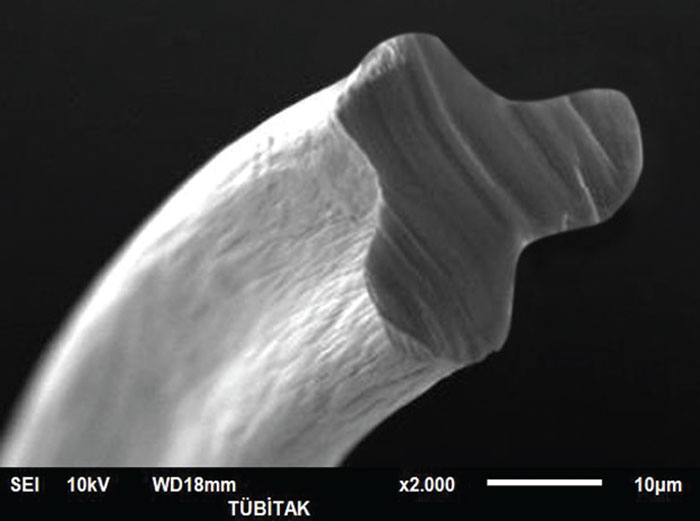
Produced by Aksa Akrilik, trilobal homopolymer acrylic fibre offers a greater external surface area than conventional round fibres of the same linear density due to its three-lobed cross-sectional geometry. This structure can increase the available surface area per fibre and enhance fibre-particle interactions. The literature suggests that such an effect may contribute positively to the capture of fine particles [1,2,3,4].
The increased surface area may also contribute to dust-cake formation and more stable filtration conditions, although the extent of this effect depends on the overall filter-media construction and operating conditions. For this reason, trilobal homopolymer PAN can be considered an attractive alternative for applications involving high concentrations of fine dust, such as coal and pet-coke preparation systems, cement mills, and separator filters [1,2].
Higher Specific Surface Area
One of the key advantages of trilobal fibres is their greater perimeter length compared with round fibres having the same polymer volume. The three-lobed structure increases the fibre-air interfacial area and expands the available external surface for particle interaction [3,4].
Particle capture mechanisms such as diffusion and interception can be influenced by fibre geometry and available surface area. Wang and Zhao demonstrated that shaped fibres, including trilobal fibres, can provide improved particle capture performance compared with round fibres under certain conditions [1]. Similarly, Yang et al. reported that engineered non-circular fibre geometries can improve particle collection efficiency and filtration quality factor [2].
Consequently, trilobal geometry offers an important morphological advantage that may complement the inherent chemical resistance of homopolymer acrylic fibre and support improved filtration performance [1,2].
Shape Factor: A Quantitative Measure of Geometric Advantage
One of the important parameters used to evaluate fibre cross-sectional geometry is the Shape Factor.
Where P represents cross-sectional perimeter and A represents cross-sectional area.
For perfectly circular fibre, the theoretical Shape Factor equals 1. As the geometry becomes more complex, the perimeter increases relative to the cross-sectional area, and the Shape Factor rises accordingly. Therefore, Shape Factor is widely used as a quantitative indicator of cross-sectional complexity and relative perimeter development [3,4].
A higher Shape Factor generally indicates a more developed cross-sectional perimeter and a larger potential fibre-particle interaction area. Owing to their extended perimeter, trilobal fibres typically exhibit higher Shape Factor values than round fibres. For this reason, Shape Factor analysis can be considered a useful engineering tool for evaluating the geometric characteristics of different fibres used in filter bags [1,3,4].
Fibre-to-Fibre Contact and Structural Stability Since filter bags are exposed to numerous
pulse-jet cleaning cycles throughout their service life, mechanical integrity is as important as
filtration performance. The three-lobed geometry of trilobal fibres may create additional contact regions between neighbouring fibres, potentially enhancing fibre-to-fibre interactions. As a result, trilobal cross-sections may contribute to the structural stability and dimensional integrity of homopolymer PAN-based filter felts. However, the extent of this effect can vary depending on felt construction, needling density, and operating conditions.
More Tortuous Flow Paths and Filtration Performance
Filtration performance is influenced not only by the characteristics of individual fibres but also by the pore structure formed by those fibres. Trilobal fibres may generate more complex local pore geometries and airflow pathways within the filter media [1,2].
More complex flow paths can increase the probability of particles encountering fibre surfaces within the filter structure. Wang and Zhao demonstrated that trilobal and other shaped fibres can alter local flow fields and influence particle capture performance [1]. As a result, trilobal geometry can be regarded as a promising cross-sectional design for industrial filtration applications involving high concentrations of fine particulate matter [1,2].
Conclusion and Acryterna® Solutions
Homopolymer PAN has long been recognized as a reliable filtration material for the cement industry due to its chemical resistance and hydrolytic stability. Trilobal fibre geometry may further enhance performance by providing increased external surface area, improved fibre-to-fibre interaction potential, and more complex flow pathways that can support particle capture mechanisms [1,2].
Aksa Akrilik’s homopolymer PAN-based Acryterna® AT200 and Acryterna® AT203 solutions offer the same polymer chemistry in different cross-sectional geometries. While AT200 features a kidney-bean cross-section designed to provide balanced filter-felt performance, AT203 utilizes a trilobal geometry that provides increased external surface area and enhanced fibre-particle interaction potential.
The available scientific literature indicates that trilobal and other engineered non-circular fibres possess morphological characteristics that may offer performance advantages in industrial filtration applications with high fine-dust loading, including cement mills, separator filters, coal grinding systems, and pet-coke processing operations. Nevertheless, final filtration performance depends on multiple factors, including filter design, felt construction, and operating conditions, and should therefore be validated through laboratory and field testing.
In summary, Acryterna® AT203 combines the chemical and hydrolytic resistance of homopolymer PAN with the enhanced external surface area and fibre-particle interaction potential provided by a trilobal cross-sectional geometry. Considering the geometric advantages reported in the literature, it represents a compelling option for industrial filtration applications where efficient fine-particle capture is of particular importance.
References
[1] Wang, K.; Zhao, H. (2015). The Influence of Fibre Geometry and Orientation Angle on Filtration Performance. Aerosol Science and Technology, 49(2), 75–85.
[2] Yang, H.; Zhu, H.; Fu, H. (2020). Numerical Calculation and Analysis of Filtration Performance of an Effective Novel Structural Fibre for PM2.5. PLOS ONE, 15(10), e0240941.
[3] Thomason, J.L. (2023). The Influence of Fibre Cross Section Shape and Fibre Surface Roughness on Composite Micromechanics. Micro, 3(1), 353–368.
[4] Militký, J.; Křemenáková, D.; Chovanová, A. Fibre Cross-Sectional Shape Indices.
About the author
Ayşe Karadağ Eren Aksa Akrilik Kimya Industry Solutions Product Manager


















 Concrete4 weeks ago
 Concrete4 weeks ago
 Concrete4 weeks ago
 Concrete3 weeks ago