Manoj Rustagi, Chief Sustainability Officer, JSW Cement, discusses how the adoption of ‘green’ practices in cement manufacturing could reshape the future of sustainable construction worldwide.
Cement is one of the most carbon-intensive materials in construction — but innovation is changing that. As sustainability becomes central to infrastructure, green cement is emerging as a viable low-carbon alternative. In this detailed interview with Manoj Rustagi, Chief Sustainability Officer, JSW Cement, we explore what makes cement ‘green’, its performance, and its future. From durability to cutting-edge technologies, here’s a look at the cement industry’s greener path forward.
What exactly is green cement, and how does it differ from traditional cement?
At this point in time, there is no standard for defining green cement. A very simple way to understand ‘Green Cement’ or ‘Low Carbon Cement’ is the one which emits much lower greenhouse gasses (GHG) compared to conventional cement (Ordinary Portland Cement – OPC) during its manufacturing process.
In India, there are many existing BIS Standards for different types of cement products. The most common are OPC; Portland Pozzolana Cement (PPC); Portland Slag Cement (PSC) and Composite Cement (CC). While OPC emits maximum GHG during its manufacturing (approx 800-850 kg CO2/MT of OPC), PSC emits least GHG (approx 300-350 kg CO2/MT of PSC). As PSC is having close to 60 per cent lower CO2 emission compared to OPC, it is the greenest cement available in the Indian market.
There is already work happening at the central government level to define green cement, like it has been recently done for green steel, and hopefully in the next one year or so the standard definition would be available.
What are the key environmental benefits of using green cement?
The primary environmental benefits of green or low-carbon cement are:
- Reduced CO2 emissions
- Lower energy and power consumption
- Conservation of limestone and fossil fuels
- Utilisation of industrial by-products
- (slag/fly ash)
Can green cement match the durability and strength of conventional cement?
PSC is much more durable than any other type of cement product. It has lower heat of hydration; the strength keeps on improving with time; and it has much higher resistance to chloride and sulphate attacks. Most of the concrete failures are because of chloride and sulphate attacks, which corrode the steel reinforcements and that is how cracks get initiated and propagated resulting in eventual concrete failures. For coastal applications, marine structures, seaports, and mass concreting, PSC is most suitable. Due to the intrinsic durability characteristics of PSC; it is a green and resilient cement product.
Usually everyone talks about lower GHG emissions, but it is equally important to build resilient building structures that can withstand natural calamities and have much longer lifespans. PSC is one cement type that is not only lowest in CO2 emissions but at the same time offers durability characteristics and properties (RCPT, RCMT, Mercury Intrusion, long term strength and flexural strength), which are unmatched.
What innovative technologies are being used to produce green cement?
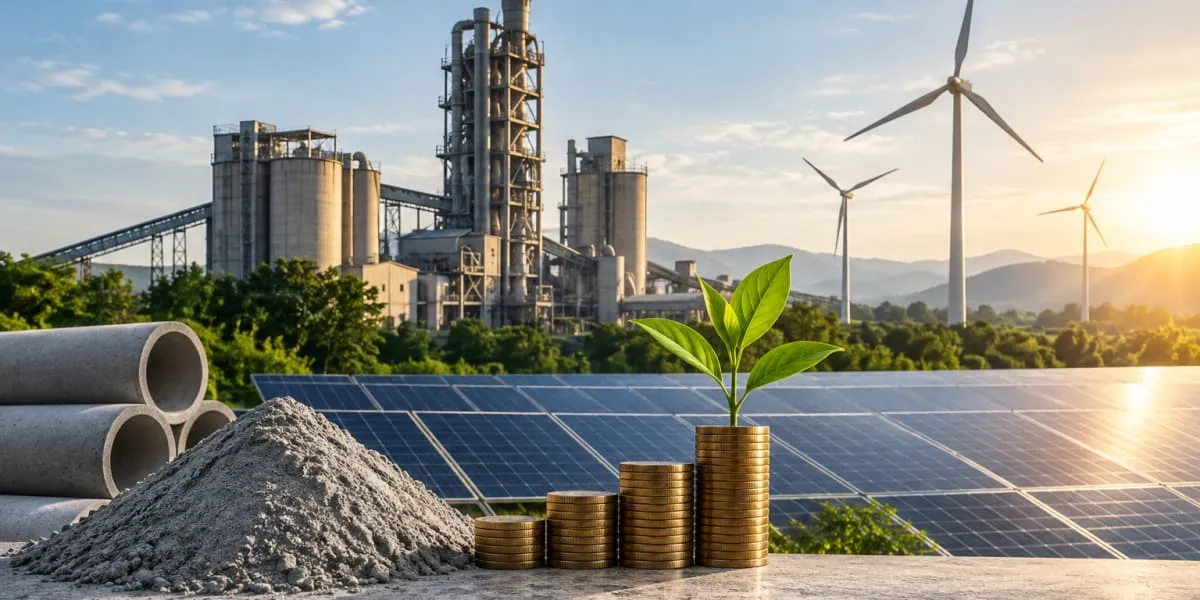
To further reduce the CO2 emissions in the manufacturing process; some of the innovative technologies which are commercially viable are:
- Alternative raw materials: Use of steel slag, red mud and other industrial by-products to substitute limestone
- Alternative fuels: Use of RDF/MSW, pharmaceutical wastes like biomass etc., to substitute coal/pet-coke
- Waste Heat Recovery (WHR): Power plants to generate electricity from waste heat
- Renewable energy: Solar and wind energy instead of state grid
How cost-effective is green cement compared to traditional options?
All of the above innovative technologies do not increase the cost of manufacturing. There are some future technologies like Carbon Capture, Utilisation and/or Storage (CCUS), which are not commercially viable and would increase the cost of cement. As such, the options available today for low-carbon cement (like PSC) are not expensive.
The Government of India has recently notified Indian Carbon Market (ICM), which also includes the cement sector. Hopefully, this would help progressive companies to further reduce their carbon footprint.
What challenges does the industry face in adopting green cement on a large scale?
There is absolutely no incentive/motivation for builders/contractors to use green cement products and therefore there is practically no demand. While the industry has taken many steps. In fact the Indian cement industry is believed to be most energy efficient globally and has approximately 10 per cent lower GHG emissions compared to global average. But due to lack of awareness and lack of performance based standards; the demand for low carbon cement or green cement has not picked up in India.
Are governments and regulators supporting the shift to green cement?
In India, in the last couple of years, there have been many policy interventions which have been initiated. One of them, namely the carbon market is under notification; others like Green Public Procurement, Green Cement taxonomy and National CCUS Mission are in the advanced stages and are expected to be implemented in the next couple
of years.
How do you see the future of green cement in global construction?
Globally the built environment accounts for 40 per cent CO2 emissions; and the maximum embodied emissions come from cement and concrete. There is a lot of innovation happening in cement, concrete and construction. Basically, how we build and what material we use. And this is to do with both carbon mitigation as well as adaptation as the built environment is so important for sustainable living. Precast and pre-engineered buildings/structures, 3D concrete printing, ultra high performance concrete, digital and AI/ML interventions in construction, admixtures/improved concrete packing; and circularity in cement manufacturing are some examples. Low-carbon cement or green cement eventually will lead to ‘Net Zero CO2 emission’ cement, which would enable a ‘Net-Zero’ built environment that is needed for long term sustainability.




















 Concrete4 weeks ago
 Concrete4 weeks ago
 Concrete4 weeks ago
 Concrete4 weeks ago