Connect with us

Concrete

Cement Demand Revives As Prices Decline In Q3 FY26

Nuvama reports improved volume growth after price correction

Published

on

Shares

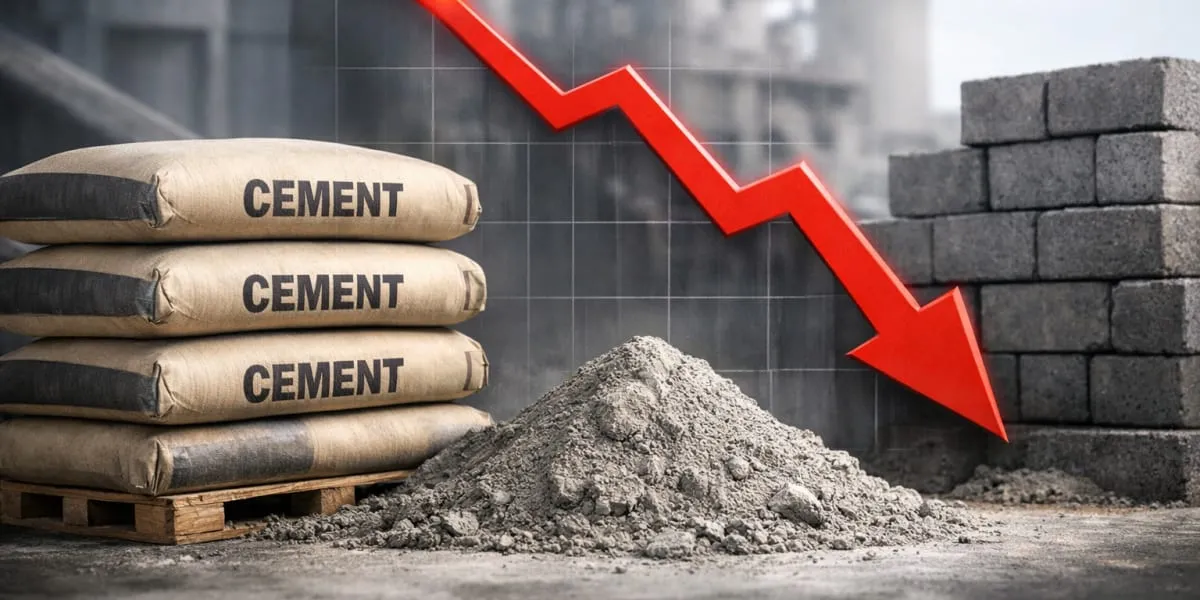
A report by Nuvama Financial Services (Nuvama) said cement sector demand revived in the third quarter of fiscal year twenty twenty six as prices declined, supporting volume growth across regions. The note indicated that sequential price correction helped replenish demand that had been subdued by elevated pricing earlier in the year. Nuvama quantified the price decline as a sequential correction that varied across states and segments, facilitating restocking by merchants and traders.

The report suggested that improved affordability after the price correction encouraged housing and infrastructure activity, with developers and contractors adjusting procurement plans. It added that regional dynamics varied, with some markets showing faster recovery while others remained reliant on seasonal construction cycles. Housing demand was driven by both affordable and mid segment projects, while infrastructure segment recovery was contingent on timely execution of public works.

Analysts at Nuvama assessed that the price moderation eased inventory pressures for manufacturers and distributors and supported margin stabilisation at several producers. Demand improvement was visible in both urban and rural segments, although the pace of recovery differed by state and trade channel. Producers were seen balancing price realisations with volume targets and managing input cost volatility through operational efficiencies.

The report recommended that investors monitor volumes and realisations closely as market equilibrium emerges in the coming quarters, noting that sustainability of recovery would depend on monsoon patterns and government infrastructure outlays. Overall, the assessment pointed to a cautiously optimistic outlook for the cement industry as price correction translated into tangible volume gains. Market participants were advised to track early signs of demand broadening beyond core construction hubs to assess the depth of the rebound.

Concrete

Cement Makers’ Margins To Fall Rs 50-75 Per Tonne Amid West Asia Conflict

Crisil Sees Margins Easing Despite Steady Demand

Published

on

By

Shares

Crisil said operating margins of Indian cement manufacturers are expected to decline by Rs 50-75 per tonne (t) this fiscal to Rs 925-950 per t due to higher input costs triggered by the West Asia conflict. The analysis covered 18 cement companies accounting for nearly 90 per cent of India’s domestic cement capacity and noted margins had improved sharply to around Rs 1,000 per t in fiscal 2026.

Crisil noted that the reduction would be driven mainly by higher power and fuel costs, which account for about 30 per cent of total costs, as petcoke and imported coal prices have surged amid geopolitical uncertainties. Freight costs, which account for about a quarter of total costs, are also expected to remain elevated because of higher diesel prices. The impact on profitability is likely to be more pronounced in the first half of the fiscal year before easing commodity prices moderate cost pressures later.

The rating agency said steady domestic demand and strong balance sheets should keep credit profiles stable despite the moderation in margins. Green energy currently accounts for 35-40 per cent of the sector’s total electricity consumption and is expected to partly cushion higher energy costs. Operating cash flows are likely to remain resilient, supported by projected 6-7 per cent growth in cement demand this fiscal.

Crisil highlighted that demand growth will be driven primarily by infrastructure spending, which meets about one-third of sector consumption, and by a nearly 18 per cent higher budgetary allocation for core ministries that should support project execution. Weaker rural housing demand amid pressure on agricultural incomes from a possible below-average monsoon may be offset by improved urban housing demand supported by favourable home-loan rates and a strong pipeline of Pradhan Mantri Awas Yojana-Urban projects. Ongoing capacity additions will keep capital expenditure elevated and may lift net debt to EBITDA to between 1.2 and 1.4 times from around 1.0 time last fiscal, though ratios are expected to remain healthy.

Continue Reading

Concrete

UltraTech Board Approves Rs 50 bn Fundraise Via NCDs

Company to issue half a million debentures for expansion plan

Published

on

By

Shares

UltraTech Cement’s board of directors has approved raising Rs 5,000 crore (Rs 50 bn) through non?convertible debentures issued in rupees.

The finance committee cleared a proposal to issue up to 500,000 fully paid, unsecured, listed, rated, redeemable, rupee?denominated, non?convertible, non?cumulative debentures of Rs 1 lakh each (Rs 0.1 mn each), aggregating to the Rs 5,000 crore programme.

As of June 2026 the firm reported net debt of Rs 15,875 crore (Rs 158.75 bn) and said its capacity expansion projects under execution are backed by capital expenditure of about Rs 17,000 crore (Rs 170 bn) over the next two to two?and?a?half years.

UltraTech spent Rs 9,500 crore (Rs 95 bn) on capital expenditure in financial year 2026 and in April the group crossed 200.1 mn tonnes per annum of domestic grey cement capacity and 205.5 mn tonnes per annum of global capacity.

The chief financial officer indicated the company would take consolidated capacity beyond 242 mn tonnes per annum, with grey cement capacity reaching 212.7 mn tonnes per annum by the end of financial year 2027. He noted the net debt?to?earnings before interest, taxes, depreciation and amortisation ratio stood at 0.87 times as of June 2026 and the company was confident of ending financial year 2027 with the ratio below one time.

In the first quarter of financial year 2026?27 UltraTech’s net profit attributable to owners rose 16.8 per cent year?on?year to Rs 2,599.3 crore (Rs 25.993 bn) and revenue from operations increased 15.9 per cent to Rs 24,648.20 crore (Rs 246.482 bn). The board approval is expected to complement internal cash flows as the company advances its expansion programme.

Continue Reading

Concrete

Homegrown Engineering: Closing the Global Technology Gap

Published

on

By

Shares

Jignesh Kundaria, Director and CEO, Fornnax Technology, explains how the persistent underperformance of AFR projects in Indian cement plants is an engineering philosophy problem and not a technology problem.

The adoption of alternative fuels and raw materials (AFR) in Indian cement plants has increased significantly in recent years. However, despite this progress, many facilities continue to face a common challenge: achieving consistent and reliable performance in day-to-day operations. Through extensive engagement with cement manufacturers and AFR stakeholders across India, including technical assessments and visits to various cement plants by Fornnax, a clear pattern has emerged. Many facilities deal with inconsistent feedstock quality, high moisture levels, contamination, fluctuating output quality and unexpected maintenance issues. These challenges are not isolated incidents. They reflect the complex realities of AFR operations.
The root cause is simple because there is no universal AFR process that works equally well for every facility. Waste composition varies across regions. Kiln configurations differ from plant to plant. Operational priorities, whether related to fuel substitution, production targets, or infrastructure limitations, are rarely the same. Yet many AFR projects still rely on standardised equipment and process layouts. As a result, solutions designed for one operating environment are often expected to perform equally well in another. This disconnects between standardised systems and local operating conditions can lead to underperformance, higher costs, and delayed project outcomes.

The cost of getting AFR wrong
AFR is no longer viewed solely as a sustainability initiative. It has become a strategic business priority for cement manufacturers. Rising fuel costs, stricter environmental regulations and growing pressure to reduce dependence on conventional fuels are accelerating AFR adoption across the industry. However, the success of an AFR project depends heavily on how effectively waste is processed before it reaches the kiln. Poor preprocessing can negatively impact kiln performance, fuel efficiency and emission control systems. Inconsistent fuel quality often forces operators to make frequent adjustments, reducing throughput and increasing energy consumption.
Equipment failures and unplanned downtime can disrupt production schedules and increase maintenance costs. When operational challenges persist, plants may lose confidence in AFR as a reliable solution and return to conventional fuels, undermining both sustainability goals and investment returns. The industry’s most successful operators have learned that AFR success is not determined by equipment alone. It requires the right combination of process design, material understanding, operational flexibility, and long-term support.

Engineering-led customisation
At Fornnax, we believe successful AFR implementation starts with understanding the challenge before selecting the solution. Rather than taking an equipment-first approach, we focus on engineering-led customisation that aligns with each plant’s unique operating conditions.
Understanding the material first: Every AFR project begins with a detailed assessment of the waste stream. Factors such as material composition, moisture content, contamination levels, seasonal variations and output requirements are carefully analysed. This understanding forms the foundation for process design, equipment selection, automation requirements, and operational flexibility.
Designing around real plant conditions: No two cement plants operate under identical conditions. Our process designs take into account actual waste characteristics, kiln requirements, available infrastructure, maintenance capabilities, and future expansion plans. Instead of forcing facilities into a standardised model, we develop solutions that fit their operating reality.
Creating integrated systems: A successful AFR plant is not simply a collection of machines. It is an integrated system where every component works together to maintain stable throughput and consistent fuel quality despite changing feedstock conditions. Drawing on insights gained from working with more than 70 cement facilities, we focus on identifying and eliminating potential bottlenecks during the design stage, when they are easier and more cost-effective to address.

Supporting performance beyond commissioning
As AFR operations mature, plant operators increasingly require more than equipment performance. They need responsive service support, spare parts availability, process optimisation guidance, performance monitoring and long-term reliability. Fornnax incorporates these lifecycle considerations into every project from the outset. Our goal is not simply to supply equipment, but to support sustained operational success. For us, innovation is not defined by complexity. It is measured by the ability to improve reliability, simplify operations, and deliver consistent results under real-world conditions.

Next phase of AFR growth
As AFR adoption continues to expand, the industry’s competitive advantage will increasingly belong to companies that combine technical expertise with a deep understanding of operational realities. This shift creates a significant opportunity for Indian engineering companies that understand local conditions, can adapt quickly, and are committed to long-term customer success, helping cement manufacturers achieve their targeted thermal substitution rate (TSR) while maintaining operational efficiency and process stability.

About the author
Jignesh Kundaria is the Director and CEO of Fornnax Technology. He has established himself as one of India’s foremost voices on waste-to-fuel technology and alternative fuel infrastructure. He has contributed to policy formulation in association with NITI Aayog across two critical areas: waste processing and tyre recycling, bringing an operator’s ground-level perspective to national-level conversations on industrial decarbonisation.

Continue Reading

Video Thumbnail

    SIGN-UP FOR OUR GENERAL NEWSLETTER


    Trending News

    SUBSCRIBE TO THE NEWSLETTER


    Don't miss out on valuable insights and opportunities to connect with like minded professionals.


      This will close in 0 seconds