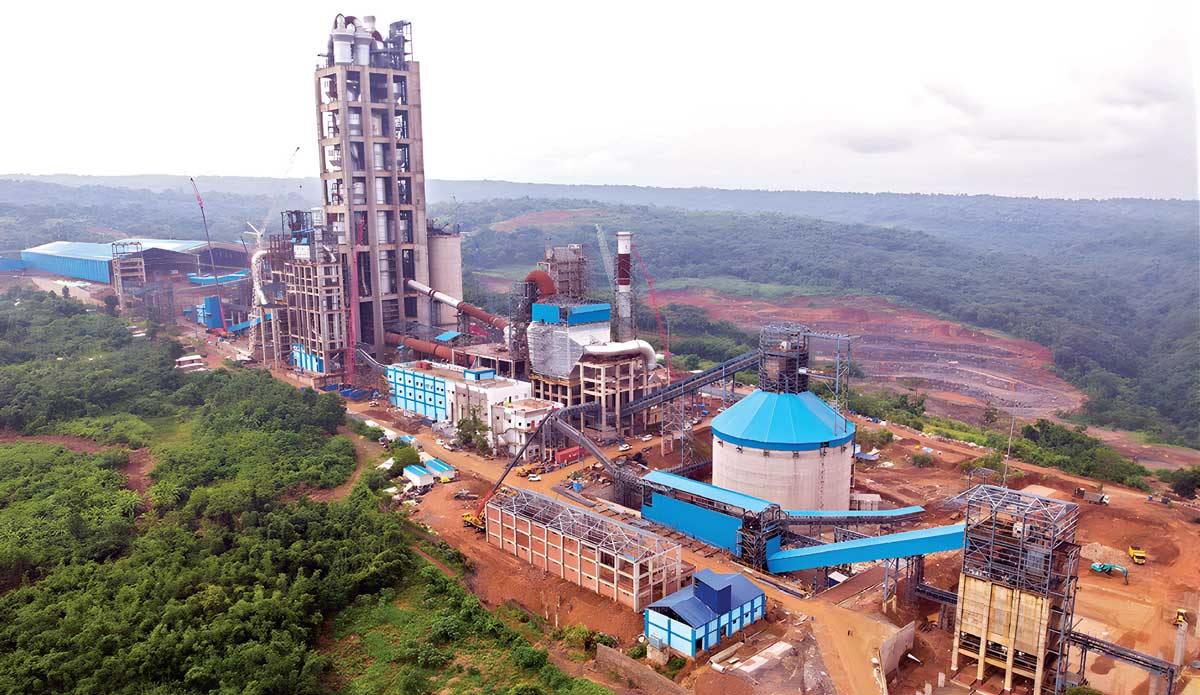
Humboldt Wedag India engineers a 9,500 TPD low-carbon clinker line for decarbonised cement production for Dalmia Cement.
Global decarbonisation targets and tightening environmental regulations are reshaping the cement industry. Leading producers are transitioning toward energy-efficient, low-emission technologies while maintaining high production capacity and operational reliability.
Dalmia Cement has committed to becoming a carbon-negative cement producer by 2040, supported by aggressive capacity expansion—from 49.5 MTPA to 75 MTPA by FY28 and 110–130 MTPA by 2031. Within this strategic roadmap, Project Green serves as a flagship initiative, combining scale with sustainability.
The project involves the installation of a 9,500 TPD clinker production line at Umrangso, designed with a strong focus on:
Best in class Thermal and Electrical energy consumption
High alternative fuel substitution rates
Reduced NOx and CO2 emissions
Integration with renewable energy systems
The focus while selecting plant and machinery was to have minimum thermal and electrical energy consumption and set a new benchmark in eco-friendly operations in terms of dust emission and meeting the standards of NOx emission. WHR was also envisaged along with the main plant and machinery in such a way that WHR is optimised by selecting energy-efficient technology in combination with maximum WHR potential.
The plant was commissioned in October 2025 after a gap of 24 months from the date of the start of civil construction work. The award of the main contract was effective from June 2023, and the start of construction was in September 2023.
Project technology and scope matrix
DCBL collaborated with Humboldt Wedag India (HWI) as a technology partner for capacity expansion project in the northeast region. The major equipment supplied by HWI includes an energy-efficient roller press system for raw material grinding, and a three-pier rotary kiln with a 9,500 tonnes per day (TPD) capacity. The pyro processing system integrates advanced technology from KHD, including a six-stage, double-string preheater with Low NOx-AF calciner designed for low NOx emissions, a high-capacity kiln of 9,500 TPD. The roller press system in finish mode has also been selected for raw material grinding, contributing to reliability, energy efficiency and quality.
KHD’s roller press technology is considered among the most energy-efficient grinding machines on the market. KHD’s pyro processing solutions, including the preheater, calciner, kiln and PyroJet burner, are engineered to provide optimal production capacity while limiting emissions and energy consumption. These advanced systems collectively enable high productivity, low carbon footprint, and reduced operational costs for cement plants.
Project overview and design philosophy
DCBL collaborated with Humboldt Wedag India as a technology partner for capacity expansion project. The primary objectives of Project Green include:
Development of a high-capacity, energy-efficient clinker line
Achievement of lower specific heat consumption
Reduction in specific power consumption
Maximisation of AFR substitution (35 per cent TSR potential)
Enabling WHR-based power generation
The design approach follows three core principles:
Efficiency first: Selection of proven high-efficiency equipment (roller press, HE-M pre-heater)
Fuel flexibility: System designed for wide AFR spectrum (biomass, RDF, industrial waste)
Future-readiness: Provision for chlorine bypass for higher TSR rates, de- carbonisation technology integration
Parameter Specification
System Capacity 2 × 350 TPH
Product Fineness 15% residue on 90 µ
Roller Press 2 × RP16-170/180
Installed Power 2 × 1600 kW
Dynamic Separator SKS LC 3750
Separator Air Volume 625,000 m³/hr
Bucket Elevator Capacity 1720 TPH
Parameter Specification
Clinker Capacity 9,500 TPD
Preheater 6-stage, Double String (90 HE 75)
Calciner Pyroclon Low NOx-AF
Calciner Dimensions Ø 7785 mm × 145 m
Rotary Kiln Ø 5.2 m × 82 m
Kiln Drive Power 1520 kW
Burner PyroJet Low NOx (522KO)
Technology highlight
When compared to other grinding options like ball mills and vertical roller mills (VRMs), the KHD roller press stands out as the most energy-efficient grinding system available in the cement industry. Key advantages of the KHD roller press include:
Energy efficiency: The roller press consumes significantly less power than both ball mills and VRMs, often saving 2-3 kWh/t of material compared to VRMs and much more relative to ball mills. Additionally, water spray is typically not used in the KHD roller press, eliminating the associated heat demand common with VRMs and thus increasing waste heat recovery potential.
Durability and maintenance: The roller press employs CHF lining on the roller surfaces, which greatly extends the component lifetime. The lifetime for these surfaces is longer than that of VRM components, reducing maintenance frequency and costs.
Layout design: The system incorporates a multifunctional V-separator and the latest generation dynamic SKS LC separator. These features enhance particle classification, improve grinding efficiency, and reduce dust nuisance through better engineering controls.
Operational benefits: The separation of grinding and classification in the system optimises energy use and throughput. Additionally, by avoiding water injection for bed stabilisation, the system reduces operational complexity and environmental impact.
Overall, the roller press grinding system achieves superior grinding efficiency, lower energy consumption, less wear, and better environmental performance compared to alternatives, making it a preferred choice for modern, sustainable cement production.
One of the notable features of the project is the KHD-designed latest generation low-pressure drop ’HE-M’ pre-heater cyclones, engineered for maximum gas–solid separation efficiency. Their optimised geometry ensures a low-pressure drop, directly improving the overall draft profile of the system.
By reducing system resistance, the preheater design lowers fan power consumption and enhances the stability of kiln draft and gas-flow distribution.
This efficiency translates into lower operating costs, reduced energy demand, and improved clinkerisation performance. The result is a preheater tower that reflects the hallmark of KHD’s engineering expertise — robust, reliable, and highly energy-efficient. PYRO-JET® Burner.
Technological changes are one of the ways of reducing greenhouse gas emissions and other general emissions from the cement industry. By using the Pyrojet burner, which is highly efficient in terms of low primary air quantity, low NOx emission, and reduced specific heat consumption. Three to five per cent less primary air consumption in comparison to other burners, which is equivalent to saving approximately 4 kcal/kg clinker.
One of the most imperative features of the PYRO-JET® burner is the flame characteristics. The PYRO-JET® burner generates short and stable flame, which results in less structural growth of C3S and C2S. Alite crystal size will therefore be smaller. Due to the smaller alite crystal size, the clinker becomes easy to grind. Also, due to short and stable flame, the formation of C3S is more in comparison to other burners, which results in higher early strength of the product and thus more fly ash can be added when manufacturing blended cement.
By minimising the primary air and transport air Pyro jet burners have reduced greenhouse gas emissions and other general emissions from the cement industry
AFR Utilisation
Pyroprocess system has been designed to integrate alternative fuels and raw materials (AFR) as part of its sustainability agenda. The system successfully co-processes both solid and liquid AFRs, achieving a Thermal Substitution Rate (TSR) of 35 per cent on a sustained basis.
Solid AFR mix of various kinds, including RDF, rice husk, palm fibre, with a combined NCV of ~2200-2300 kcal/kg, is used to replace conventional fossil fuels in the kiln partially.
The balanced use of solid and liquid AFR not only reduces dependence on non-renewable fuels but also lowers CO2 emissions and operating costs, reinforcing DCBL’s commitment to carbon neutral by 2040.
The operational results of the pyroprocess system, raw grinding system are presented in Tables 1 & 2. The primary objective of implementing raw grinding and pyroprocess was to achieve significant reductions in electrical energy consumption when compared to conventional alternatives. This objective has been successfully accomplished, as evidenced by the operational data. In addition to the energy savings, the recorded production outputs from all systems have consistently surpassed the originally guaranteed performance parameters. This demonstrates not only the reliability and efficiency of the installed systems but also validates the technological choice made for process optimisation and cost reduction.
Conclusion
Project Green represents a holistic transformation of clinker production, combining scale, efficiency and sustainability. The integration of advanced pyro processing systems, energy-efficient grinding, AFR utilisation and WHR makes it a benchmark for next-generation cement plants.
The DCBL–HWI collaboration highlights how engineering innovation can deliver:
Reduced environmental impact
Improved operational efficiency
Long-term sustainability
This project sets a replicable model for future cement plants aiming to transition toward carbon-neutral or carbon-negative production.
Raw Material Grinding System
The raw grinding circuit employs Roller Press (RP) technology in a finish grinding mode.
Pyro processing System
The pyro line represents the core of Project Green, designed for maximum thermal efficiency and operational flexibility.
















 Concrete4 weeks ago
 Concrete3 weeks ago
 Concrete2 weeks ago
 Concrete4 weeks ago