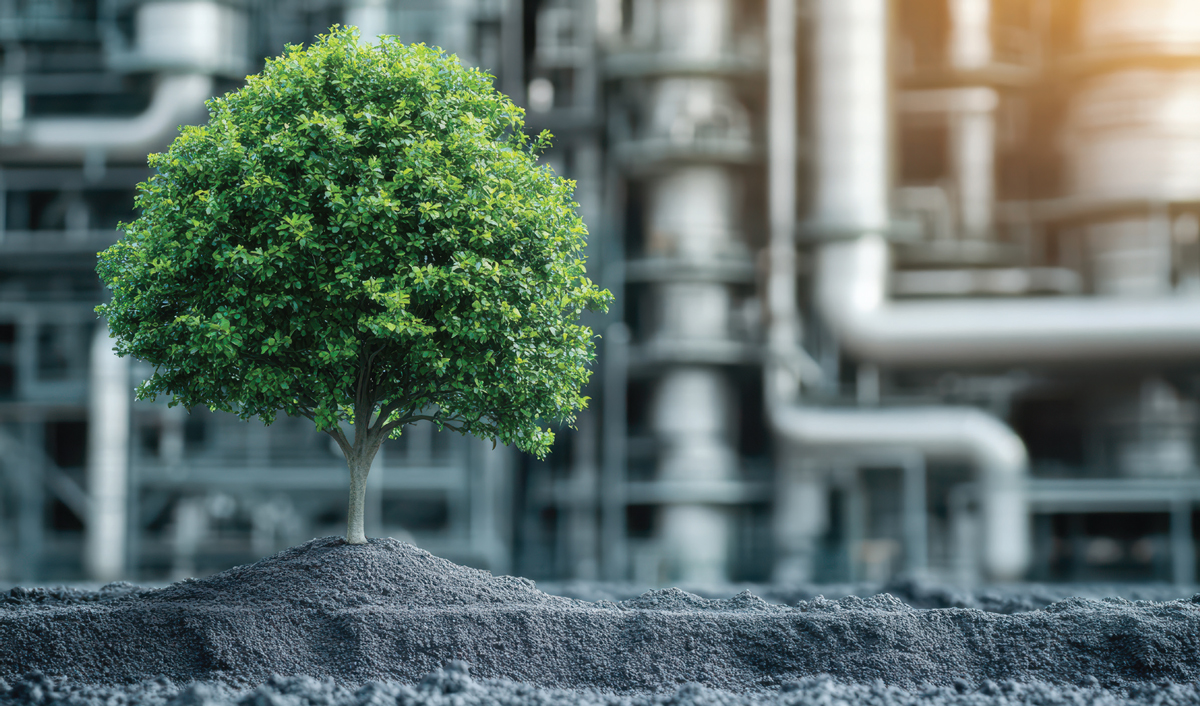
Raj Bagri, Founder, Kapture, outlines a pragmatic path to net-zero through the 3Cs of decarbonisation, linking innovation, circularity and real-world impact.
In the global race to a net-zero future, it’s easy for the conversation to become dominated by grand, abstract concepts, trillion-dollar investments, global treaties, and the immense scale of renewable energy projects. While these are vital, I believe that true, impactful change – the kind that moves the needle on real-world emissions, today lies in tackling the less glamorous sources of pollution. It’s about getting our hands dirty and utilising the machinery and materials that underpin modern infrastructure.
At Kapture, our mission is to address this challenge head-on, focusing on two of the world’s most polluting sources: diesel and concrete. This focus has distilled our approach to decarbonisation down to a powerful framework: the 3Cs – Cut, Cement, Carbon.
The first ‘C’ is about the immediate, non-negotiable need to Cut emissions at the source.
There is a lot of talk about electrification, the reality is that the global economy still runs on diesel. From construction sites and mining operations to emergency backup power and remote grid connections, the diesel generator is an omnipresent, reliable source of power. But it is also a relentless polluter, emitting not just carbon dioxide but harmful NOx, SOx and particulate matter that severely degrades air quality and human health.
The challenge is that replacing these generators overnight is not feasible. The cost is massive, the demand for off-grid reliability is absolute, and in many places, the infrastructure for mass electrification simply does not exist yet.
This is where true innovation is critical. Our core technology at Kapture is a simple, cost-effective carbon capture, utilisation and storage solution designed to be retrofitted onto existing diesel engines. We focus on low-cost CCUS technology that can strip the CO2 out of the exhaust stream before it enters the atmosphere. The beauty of this approach lies in its simplicity and modularity—it integrates with current infrastructure, offering an immediate and affordable solution to businesses that cannot yet afford a full transition to electric or hydrogen.
By focusing on the exhaust stream of diesel, we are addressing the hardest-to-abate mobile and stationary power sources, delivering a direct and quantifiable Cut in atmospheric emissions, today.
Cement and circularity
The second ‘C’ is Cement, or more broadly, the concrete industry. Concrete is the second most consumed substance on Earth after water, and its primary binding agent, cement, is responsible for approximately 8 per cent of global CO2 emissions.
To achieve net-zero, we can’t just stop using concrete, we must transform its production into a net-positive process. This is where Kapture’s material comes into play, the true breakthrough in Kapture’s model is its circularity. The CO2 embedded material captured from the diesel exhaust is not sequestered underground, it is converted into a benign, inert byproduct. This carbon-sequestered material can be embedded directly into the concrete-making process replacing filler or potentially used as a supplementary cementitious material (SCM).
This achieves a win-win for the built environment:
1. The captured byproduct partially replaces energy-intensive cement clinker in the concrete mix, directly lowering the overall carbon footprint of the final material
2. The carbon, once a pollutant, is now permanently mineralised and trapped within the concrete matrix, enhancing the material’s performance
This is more than carbon neutral – this is the path to carbon-negative material production for the concrete sector.
Meeting emission goals
The final ‘C’ is Carbon, representing the closed-loop approach we must take to tackle climate change. It is the strategic connection between disparate industrial problems to create a single, powerful solution.
At Kapture, we recognised that the challenge is not just capturing carbon but finding an economically viable, scalable, and permanent sink for it. For immediate impact, embedding CO2 emissions into concrete offers a faster, more distributed, and revenue-generating pathway to decarbonisation.
To wrap up, this is the ultimate promise of the 3Cs:
• We Cut diesel emissions
• We use the byproduct material to transform one of the world’s largest polluters (Cement)
• We close the loop on Carbon, moving it from a liability to an asset, accelerating the global transition toward real-world, industry-transforming net-zero goals
The transition to a sustainable economy will not be won by idealism alone. It will be won by entrepreneurs, engineers and scientists who are willing to tackle the hard to abate sectors, connect the dots between seemingly unrelated industries and deliver solutions that are not just green, but cheaper and better than the status quo.
ABOUT THE AUTHOR:
Raj Bagri, Founder, Kapture, is a climate tech entrepreneur with 15+ years of experience, leading innovative solutions to reduce diesel emissions and combat climate change.