The Indian cement industry, among the world’s largest, plays a pivotal role in national infrastructure and economic growth. Driven by robust demand, it continues to expand. ICR delves into the mergers and acquisitions currently underway with major cement players, in a bid to lead capacity expansion.
The Indian cement industry is one of the largest in the world, playing a crucial role in the nation’s infrastructure and economic development. Over the past few years, production has steadily increased, driven by robust demand from both urban and rural areas. Major infrastructure projects, housing developments, and government initiatives like ‘Housing for All’ and ‘Smart Cities’ have significantly boosted cement consumption.
The industry is characterised by a diverse range of players, from large multinational corporations to small local manufacturers, all contributing to a highly competitive market. Consumption trends indicate a strong preference for blended cements due to their environmental benefits and cost-effectiveness.
As the economy continues to grow, the demand for cement is expected to rise, supported by ongoing infrastructure development and urbanisation. This upward trajectory positions the Indian cement industry as a key driver of growth in the construction sector, with a focus on sustainable and innovative practices to meet future challenges.
According to the Infomerics Ratings report dated March 2023, the size of the global cement market reached US$ 363.4 billion in 2022, and it is expected to grow at a CAGR of 5.4 per cent during 2023 – 2028 to reach US$ 498.23 billion by 2028. The cement industry was expected to add 21.2 million tonnes per annum (mtpa) of manufacturing capacity in the year 2022-23. During the period, projects worth US$ 71.8 billion were expected to get commissioned. This would have been the fourth successive year, wherein the industry added more than 20 mtpa of manufacturing capacity. Between 2019-20 and 2021-22, the industry added a total of 81.1 mtpa of manufacturing capacity. The capacity utilisation of cement industries decreased from 66.2 per cent in 2018-19 to 60.3 per cent in 2021-22. There was contraction in demand and production during the pandemic.
India’s commitment to development
Infrastructure development in India is a major driver of cement demand. The government’s focus on initiatives like ‘Bharatmala’ and ‘Sagarmala’ for road and port development, along with rapid expansion in railways and airports, has significantly boosted the cement industry. Policies such as the ‘Pradhan Mantri Awas Yojana’ aim to provide affordable housing, further increasing cement consumption.
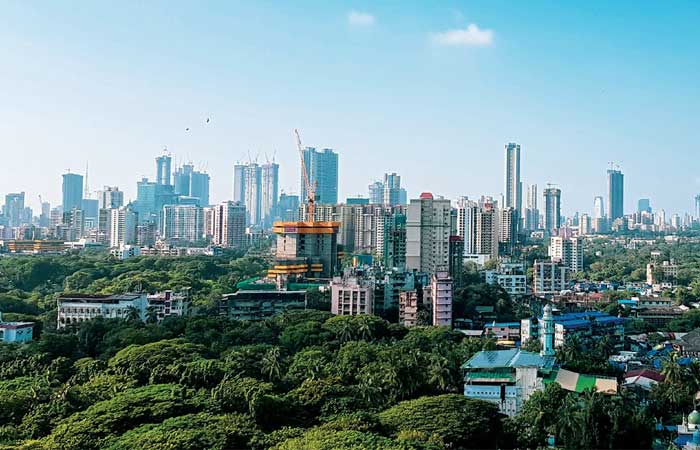
Urbanisation is accelerating in India, leading to a surge in real estate development. With a growing middle class and rising urban populations, demand for residential and commercial spaces is expanding rapidly. This urban growth is a key factor driving cement consumption, as cities expand and modernise their infrastructure to accommodate new residents and businesses.
According to Invest India, the government has committed an allocation of 3.3 per cent of GDP to the infrastructure sector in the fiscal year 2024, with particular focus on the transport and logistics segments. Roads and Highways account for the highest share, followed by Railways and Urban Public Transport. The government has set ambitious targets for the transport sector, including development of a 2 lakh-km national highway network by 2025 and expanding airports to 220. Additionally, plans include operationalising 23 waterways by 2030 and developing 35 Multi-Modal Logistics Parks (MMLPs). The total budgetary outlay for infrastructure-related ministries increased from around Rs.3.7 lakh cr in FY23 to Rs.5 lakh cr in FY24, offering investment prospects for the private sector across various transport sub-segments.
India’s cement industry also has strong export potential, with several manufacturers targeting international markets in Asia, Africa and the Middle East. The competitive pricing and quality of Indian cement make it attractive globally, contributing to increased export volumes. As global construction activities pick up, particularly in developing regions, Indian cement manufacturers are well-positioned to meet international demand, further supporting industry growth.
Anticipated growth spurt
Indian cement manufacturers are actively expanding their production capacities to meet growing domestic and international demand. Major players like UltraTech Cement, Adani Group and Shree Cement have announced significant investment plans to increase their manufacturing capabilities. This expansion is driven by factors such as robust infrastructure development, government initiatives, and rising urbanisation.
These companies are strategically enhancing capacity through both greenfield and brownfield projects, focusing on regions with high demand and logistical advantages. Innovations in technology and sustainability are also key priorities, as manufacturers aim to reduce environmental impact while increasing efficiency. This wave of capacity expansion positions the Indian cement industry to cater to future demand surges, maintaining its competitive edge in both domestic and global markets.
According to the Department for Promotion of Industry and Internal Trade (DPIIT), the Indian cement industry had an installed cement capacity of 600 million tonnes and production of 391 million tonnes of cement in 2022-23. The Crisil Market Intelligence report mentions that to cash in on rising demand from infrastructure and housing sectors, the cement industry is on course to add capacity by 150-160 million tonnes from FY25 to FY28. It also states that the industry has added capacity by 119 million tonnes (MT) per annum to reach a total of 595 MT.
The Indian cement industry is witnessing two major acquisitions in the current times. UltraTech, India’s largest cement player owned by the Aditya Birla Group, has announced that its board has approved picking up a 23 per cent non-controlling stake in India Cements in a deal valued at around Rs.1,885 crore.
While the conglomerate Adani Group has grown its capacity from almost nothing to a total of 75 mtpa in three years, positioning itself as the second-largest player in the industry. The latest growth move is the buyout of Hyderabad-based Penna Cement Industries for Rs.10,420 crore. Currently, Penna Cement has a total capacity of 10 mtpa and another 4 mtpa is under construction. Once the deal is closed, the total capacity of the Adani Group’s cement business will expand to 85 mtpa. The group aims to achieve a production capacity of 140 mtpa by 2028, while market leader UltraTech Cement has set its sights on reaching a capacity of 200 mtpa.
“This landmark acquisition is a significant step forward in Ambuja Cements’ accelerating growth journey,” said Ajay Kapur, CEO and Whole Time Director, Ambuja Cements. “By acquiring PCIL, Ambuja is poised to expand its market presence in south India and reinforce its position as a pan-India leader in the cement industry. PCIL’s strategic location and sufficient limestone reserves provide an opportunity to increase cement capacity through debottlenecking and additional investment. Importantly, the bulk cement terminals (BCTs) will prove to be a gamechanger by giving access to the eastern and southern parts of peninsular India, apart from an entry to Sri Lanka, through the sea route. Our aim is to make PCIL highly competitive on cost and productivity and improve its operating performance.”
Other cement organisations in India also have major manufacturing capacity expansion plans. Shree Cement in February 2024 announced plans for capacity development in Uttar Pradesh (UP) which outlines the development of two cement factories: one in Etah and another in Prayagraj. Both projects are expected to cost approximately `2,000 crore and increase UP’s capacity to produce cement by almost 7 mtpa over the course of the following 24 months. One of Shree Cement’s current projects is a 3.5 mtpa facility in Etah, which is expected to start up in the upcoming year. Prayagraj is planning another 3.5 mtpa facility at the same time. Nearly 17 acres of land in Etah have already been purchased by Shree Cement, and building is under construction.
“New investments made in cement production facilities automatically come with the latest technological advancements that can enhance efficiency, minimise environmental impacts, and improve the quality of cement. This leads to construction practices that are more durable and sustainable. JSW, for instance, has initiated research on the integration of supplementary cementitious materials (SCMs) like fly ash, slag, calcined clay and more. These materials not only improve the durability and strength of cement but also contribute towards reduction of carbon footprint of the cement industry. In order to meet energy demands sustainably, we must look at better industry practices such as usage of waste heat recovery systems, high-efficiency coolers and preheaters, and transition towards clean energy sources like solar or wind power,” states Jigyasa Kishore, Vice President – Enterprise Sales and Solutions, Moglix.
JK Cement in June 2024 announced the commissioning of a new grinding unit at its Prayagraj plant in Uttar Pradesh. The Prayagraj plant is a 2 mtpa clinker grinding unit project, which will increase the overall capacity of the organisation from the present 22 to 24 mtpa. This strategic move allows the company to efficiently cater to the burgeoning demand for cement across east Uttar Pradesh.
Dr Raghavpat Singhania, Managing Director, JK Cement, said, “We are thrilled to launch the new grinding unit at Prayagraj, which marks a significant milestone in our expansion strategy. As India accelerates its infrastructure development to sustain robust economic growth, we are continually scaling our capacities to cater to escalating demands from the infrastructure, housing and construction sectors. Our commitment to quality, innovation, and contributing to socio-economic development remains unwavering. We anticipate that these endeavours will not only foster our growth but also actively contribute to the overall development of the region and the nation.”
Dalmia Bharat’s cement manufacturing capacity as of May 2024 stood at 45.6 million tonnes. In the coming year, they plan to add 2.4 million tonnes in Assam and 0.5 million tonnes in Bihar. They are also in the process of acquiring cement assets from Jaiprakash Associates, which will add 9.4 million tonnes to their capacity and mark their entry into the Central region. They are currently focusing on completing ongoing projects and integrating assets like Jaypee Cement. Recently, they invested
`240 crore to expand their plant in Ariyalur, Tamil Nadu, and will add another million tonnes in Kadapa.
Commenting on the company’s expansion plans, Puneet Dalmia, Managing Director and CEO, Dalmia Bharat, said, “We continue to focus on strategic capital expenditure, maximising on the region and growth prospects and further enhancing our market position in the South. Driven by robust infrastructure development, housing and investments, we anticipate cement demand to rise. This increased capacity will facilitate the growing demand in the Southern region.”
Manufacturers are targeting specific regions that offer strategic advantages, such as proximity to raw materials, growing markets, and improved infrastructure connectivity. This regional focus helps in tapping into localised demand and reducing logistical complexities.
Kiran Patil, Managing Director, Wonder Cement, says, “We aim to increase our capacity within the next five years by establishing new plants in strategic locations across the region. These plans align well with the government’s industrial and infrastructure policies, such as the National Infrastructure Pipeline (NIP) and the push for affordable housing. These initiatives are driving demand for construction materials, and we are committed to supporting
these efforts by ensuring a steady supply of high-quality cement.”
“At Wonder Cement, we are committed to significantly expanding our production capacity to meet the growing demands of the Indian market and to contribute to the nation’s infrastructure development. Our expansion strategy is carefully aligned with the government’s industrial and infrastructure policies to ensure that our growth supports national priorities,” he adds.
The capacity expansions are set to increase the competitiveness of the Indian cement industry, with enhanced supply chains and improved market reach. This growth not only meets domestic needs but also strengthens the potential for exports, as Indian cement becomes more competitive in terms of quality and pricing on the global stage.
Overall, the expansion of manufacturing capacity by Indian cement organisations is a critical response to the dynamic market conditions, ensuring that the industry is well-prepared to support India’s developmental aspirations and maintain its competitive positioning internationally.
Rise in cement exports
India’s cement industry gained momentum with the government’s big infrastructure push for development projects. Amid global uncertainties caused by the recessionary situation in the US and EU economies, the global demand for cement has been subdued, and accordingly the cement export from India significantly decreased in half of a decade.
As per Directorate General of Commercial Intelligence and Statistics (DGCI&S), India exports Portland cement, aluminous cement, slag cement, super sulphate cement and hydraulics cements to other countries. India exports most of its concrete cement to Bangladesh, Sri Lanka and the UAE. Currently, India comes after Spain, Germany, Italy and China in the list of global cement exporters.
According to a report by SeAir Exim Solutions, India’s cement exports declined from 33,73,000 metric tonnes in 2015-16 to 11,66,000 metric tonnes in 2021-22. Cement shipments have significantly decreased in recent years. Overall, India’s cement export future depends on balancing domestic demand, global economic conditions and the industry’s ability to seize growth prospects.
The current Indian cement export scenario (2023-24) is as follows:
Cement Export Data Details
Total cement export from India 211K
Global Rank 1
Cement exporters in India 6498
Number of Indian buyers 16,150
The Infomerics Ratings report states that the cement import by India also significantly declined from 17,69,000 tonnes in 2017-18 to 7,52,000 tonnes in 2019-20 due to the pandemic. With the recovery in domestic demand, imports by India gained traction from 7,52,000 tonnes in 2019-20 to 8,16,000 tonnes in 2021-22. In 2021-22, India imported cement largely from UAE (395.1 thousand tonnes), Bangladesh (130.7 thousand tonnes), Bhutan (196.4 thousand tonnes) and Oman (41.2 thousand tonnes).
Risks and challenges
Expanding cement manufacturing capacities in India presents several risks and challenges:
- Regulatory and environmental compliance: Navigating stringent environmental regulations can be complex and costly. Manufacturers must ensure compliance with pollution control norms, which can delay projects and increase operational costs.
- Raw material availability: Securing consistent and cost-effective supplies of limestone and other raw materials is crucial. Fluctuations in availability or price can impact production and profitability.
- Logistical challenges: Efficient transportation and distribution of cement are critical. Infrastructure bottlenecks and high logistics costs can affect supply chain efficiency and market reach.
- Market saturation and competition: Rapid capacity expansion can lead to oversupply in the market, pressuring prices and margins. Intense competition among manufacturers further complicates market dynamics.
- Economic and policy uncertainty: Fluctuations in economic conditions and changes in government policies related to construction and infrastructure can affect demand, influencing investment returns and strategic planning.
Addressing these challenges requires careful planning, strategic investment, and a focus on sustainability to ensure long-term growth and competitiveness in the industry.
Conclusion
The Indian cement industry stands at a pivotal point, driven by robust infrastructure development, urbanisation, and strategic government initiatives. As manufacturers expand their capacities through significant investments in both greenfield and brownfield projects, they are positioning themselves to meet growing domestic and international demand. However, this growth trajectory is not without challenges, including regulatory hurdles, raw material availability, logistical issues and market competition.
To navigate these complexities, companies are focusing on sustainability, innovation, and strategic regional investments, ensuring they remain competitive and responsive to dynamic market conditions. As the industry continues to evolve, its ability to adapt and capitalise on emerging opportunities will be crucial in maintaining its role as a key driver of India’s economic development and infrastructure growth. With a commitment to quality and environmental responsibility, the Indian cement industry is well-equipped to support the nation’s aspirations and achieve long-term success on the global stage.
















 Concrete4 weeks ago
 Concrete2 weeks ago
 Concrete2 weeks ago
 Concrete4 weeks ago