Kapil Kukreja, Group Manager; Dr D K Panda, Joint Director; and Bharat Bhushan, Project Engineer, National Council for Cement and Building Materials (NCB), Ballabgarh, India, present their findings in an article that delves into the methodology used to tackle the identified issue and discusses the R&D project taken up by NCB that resulted in the creation of an innovative design capable of effectively managing diverse alternative fuels and their combinations.
At COP26, India made a significant commitment by pledging to embrace a low-carbon growth path and to shift half of its energy consumption away from fossil fuels and towards non-fossil alternatives by the close of this decade. Moreover, India has set the ambitious goal of achieving carbon neutrality by the year 2070. To achieve the target of carbon neutrality, alternative fuels (AFs), including biomass, refuse-derived fuel (RDF), used tires, plastic waste and hazardous waste, which have the potential to replace conventional fossil fuels such as coal, pet coke, etc. These AF are seen as promising solutions in line with India’s mission to reach carbon neutrality.
Nonetheless, with the adoption of these AF, challenges were encountered in handling of AF and their mix, encompassing environmental, product quality, logistical issues, health and safety concerns, as well as the intricacies of the processes and operations involved. However, one of the main challenges faced while handling AF used in cement plants is the jamming of the transfer chute.
Chute transfers are vital for material handling but can often become weak links in the chain. These components are used in conveying systems to transfer bulk materials between feeders, screens, and from one conveyor to another or for discharge into burners/pre-calciner. Chute design requires careful attention, as handling AFs with variations in material characteristics or operational requirements can lead to productivity losses and operational disruptions due to jamming or unpredictable chute behaviour.
Problem with chutes
A survey was conducted in the Indian cement industry in the year of 2019-20 to assess the issues related with handling of AFs and their mix. Out of 100 questionnaires distributed, 61 responses were received, providing valuable insights. The survey highlighted that 78.7 per cent of respondents faced transfer chute issues when handling AFs, primarily jamming. The main reasons included using conventional chute designs unsuitable for heterogeneous AFs,
lack of knowledge about material flow and properties, and the unexpected introduction of new materials not considered during chute design. These issues led to significant maintenance efforts and operational disruptions.
One significant cause of chute jamming is the reliance on traditional chute design methods, which have been widely employed in the Indian cement industry for handling uniform materials like limestone, coal, bauxite, and iron ore. These methods fall short when dealing with heterogeneous AFs due to the varying properties of these materials throughout the year, depending on their source, mix content, and other factors. Additionally, a lack of understanding of material flow and physical properties, such as shape, size, angle of repose and angle of inclination, contributes to chute issues.
Another key factor identified in the survey is the unexpected introduction of new materials that were not considered during chute design. Anticipating all potential AF types during design is challenging because cement plants select materials based on factors like cost, suitability for their raw mix, fossil fuel prices, and availability. Therefore, it was challenge to design a transfer chute which can handle various AF and their mix without any jamming issues.
Solution
Based on the survey result, NCB took the problem related to jamming of transfer chute while utilising AFs and their mix in Indian Cement Industry as an R&D project. The project commenced with the site visit of cement plants, discussion with plant personnel and determination of material properties, providing essential foundational data. Utilising this data, key input parameters were carefully selected to run the Discrete Element Modelling (DEM) simulations.
To ensure the DEM model’s accuracy, it underwent calibration through the development of CAD calibration models. These models aligned the DEM model with real-world conditions. Following calibration, the existing transfer chute design was simulated using DEM. Accordingly, 14 simulations of AFs were conducted using the DEM, and the subsequent outcomes were thoroughly examined to pinpoint significant concerns associated with the traditional chute design. This analysis served as the basis for developing an improved transfer
chute model. The enhanced design was subsequently subjected to DEM simulation to assess its
performance. The various designs were evaluated and necessary modifications were made to address any identified issues to improve the performance of the transfer chute.
Fig 1: Simulation Results for Industrial Waste
Additionally, adjustments to the DEM parameters were carried out to fine-tune the model’s accuracy. The ultimate goal of this comprehensive process was to arrive at the final design of a transfer chute suitable for handling AF and their mix without jamming. The final parameters obtained after fine tuning and making adjustment to the chute design in simulation are as follows:
• Chute Valley Angle: 70°
• Chute Width (Minimum): 4.3 to 4.5 times the lump size
• Chute Hood Height at the material entrance: Minimum 0.6 times the Belt Width
• Cross-sectional area of transfer chute: Minimum 10 to 11 times of cross-sectional area of the material stream inside the chute.
• Selected Liners: UHMWPE
Based on the above parameters obtained after simulation, an experimental setup comprising four transfer chutes and belt conveyors was established on NCB’s Ballabgarh premises to conduct experimental study on the different samples of AF collected from different cement plants and sites. Thereafter, 19 AF and their mix were collected from different cement plants across India. The materials were experimented on different mass flow rates of 3, 5, 8, 10 and 15 tph and with moisture content levels spanning from 0.18 to 45 per cent. Remarkably, even after a total of 261 hours of operation on the experimental setup, no instances of jamming were observed in the transfer chute.
Even when faced with a jamming scenario, the innovative flexible arrangement introduced in the transfer chute design (patent filed by NCB) proven to be highly effective at swiftly addressing blockages caused by solid AF. It helps in clearing these blockages in just six minutes, representing a significant improvement compared to the conventional method, which typically necessitates a lengthy 85 to 105 minutes to remove and resume operations. This innovative approach optimises the chute cleaning process, ensuring uninterrupted operations.
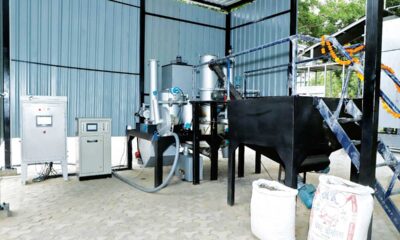
Figures 2, 3 and 4 shows the general arrangement of the of the experimental setup and glimpses of experiments:
Conclusion
In the cement industry, conventional transfer chute designs have posed challenges when handling a range of diverse alternative fuels. To address this issue, a new transfer chute design capable of handling various AFs and their mixtures has been developed by the NCB. This innovative design can handle various AFs and their mixes and also significantly reduces chute jamming and cleaning time to 6-8 minutes. The NCB led the development of this versatile transfer chute design, which promises to enhance material handling in cement plants. The project’s outcomes led by NCB are valuable for system design improvements and process optimisation, streamlining cement plant operations.
ABOUT THE AUTHOR:
Dr Kapil Kukreja, Group Manager (CME), NCB has over 19 years of work experience in the field of System Design, Project Engineering and Management. He has previously worked with organisations like ACC, Holtec Consulting, JK White Cement etc.
Bharat Bhushan, Project Engineer (CME), NCB has a one-year experience as Project Engineer in the field of System Design, Project Engineering & Management.
Dr Dhirendra Kumar Panda, Joint Director, NCB has over 36 years of experience in the areas of Geology, Raw Materials and Mining and administrative experience as a Team Leader, Programme Leader and Head of the Centre.





















 Concrete4 weeks ago
 Concrete3 weeks ago
 Concrete2 weeks ago
 Concrete4 weeks ago