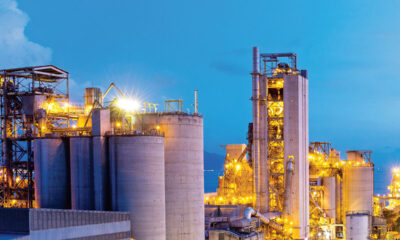
Manish Chordia, Regional Sales Manager-Cement (South Asia and Africa), ABB India Limited, discusses the importance of automation in cement plants to achieve efficient production with minimal environmental impact.
How do your solutions help cement plants to adjust to changing fuels and raw materials?
Delivering high quality products, while keeping production costs low and plant efficiency high, is an ongoing challenge for all process industries. Cement manufacturers face these challenges daily and the drive for improved efficiency cannot undercut the stability of production processes. ABB AbilityTM Expert Optimiser (EO) helps in alternative fuel management and raw material handling. EO can control, mix and monitor rates of alternative fuels to ensure consistent burning, while also ensuring that the kiln does not become unstable due to changes in fuel calorific value.
Stable and correctly proportioned raw material is essential for energy-efficient clinker production. Cement blended at the right proportions is essential to ensure that specifications are met and a quality product is delivered to end-customers. Implementing EO can positively impact both raw material and the cement blending processes. Incorporating optimisation and analytics technologies, the software enables a plant to automatically make the best operational decisions accurately and consistently. ABB AbilityTM EO standardises the optimisation strategy to minimise both shift-to-shift variations and human workload. This frees up operators to focus on more pressing tasks. EO for cement combines Advanced Process Control (APC) technologies with ABB’s extensive industry expertise, stabilising the process and maximising profitability to manage critical plant components, including kiln, alternative fuels, mills, and blending. It constantly pushes the boundaries of what is possible in a plant to maximise yield and throughput whilst minimising operating costs such as fuel and electricity.
Tell us more about your Advanced Process Control (APC) solution and its functionality.
ABB’s APC technology helps to improve fuel management, mill optimisation and material blending in cement manufacturing. The suite comprises a set of tools, both online and offline, that allow the deployment of advanced controllers and analytic models. This provides monitoring, predictive analytics, and closed loop control capabilities at the device, edge, and cloud to ensure real-time operational efficiencies. It also helps process and energy industries to optimise operations by using emergent technologies – such as the cloud, data analytics, visualisation, and advanced modelling algorithms, as part of the disruptive change offered by the Internet of Things (IoT). It extracts knowledge from existing data in the plant and uses that for detailed analysis to arrive at the best course of action to improve
specific processes.
How does automation help cement plants achieve accuracy and efficiency in production?
Efforts to reduce energy demands, by using higher efficiency equipment and substituting fuels and raw materials, are important to lower production costs. These changes introduce constraints that must be managed to secure the required quality and productivity of the plant. The ABB plant-wide automation strategy searches for the optimal operation point while maximising product quality and productivity, at the lowest energy consumption and least environmental impact. This is achieved through a combination of variable speed drives (VSD), advanced process control, energy monitoring and reporting.
Electrical energy savings of up to 70 per cent can be achieved by using VSD over a fixed-speed motor and damper. The multi-drive solution provides the optimised drive solution for the grate cooler. The control and optimisation of the kiln will reduce thermal fuel consumption by up to 8 per cent. When this is combined with the automated collection, organisation and distribution of production, quality and energy reports, fast decisions and interaction to reach the goals of energy management are achieved.
There can be no flaws or failures in cement composition or entire structures could disintegrate. Advanced measuring, information and optimisation systems are needed as never before to monitor and correct any deviations in quality standards – from quarry to dispatch. ABB’s tailored products, digital applications and services improve processes and help you achieve optimum production standards. Automation systems minimise material and energy use in complex processes.
Instead of controlling independent equipment and systems supplied by different suppliers over separate control systems, it is a great advantage to integrate and control automation islands centrally. ABB integrates these processes and adds value to the companies they work with. The processes covered in the scope of the ABB AbilityTM platform are considered to be a fully compatible integration with energy efficiency, production increase and optimisation, reduced downtime, business and asset management, ERP systems in factories by utilisation of Level 3 software. ABB produces its software unique for the sector by utilising the Minerals Library, which ABB has developed specifically for the cement sector. This library is composed of object-based software control and energy management applications productively and in an entirely parameterised manner at the same time. Thus, customers have the opportunity to operate and continue their production process and asset management in the most efficient way.
What is the data support provided by your solutions to the cement manufacturers?
In recent years, rapid advancements in big data and digital technologies have begun a revolution in industrial processes, commonly known as Industry 4.0. This revolution is defined by the application of disruptive technologies such as the IoT, augmented reality (AR) and artificial intelligence (AI) to industrial settings to optimise process performance, reduce operating costs, and enable safer and more secure production. One of the key elements for cement customers is to have an information management system that allows transparency across operations. ABB Ability™ Knowledge Manager information management system provides analytical insight to identify best practice and improve overall operations at plant and corporate level. Enhancing transparency across a plant or fleet of plants, Knowledge Manager is also available via a mobile app for smartphones or tablets, enabling plant and company managers to view operational performance at any time and from anywhere. Knowledge Manager software ensures executives can access instantly to the key performance indicators (KPI) of many cement factories. By utilisation of this software, they may see how much energy their factory transiently consumes, how much transient production they accomplish, which alternative fuels or minerals they use, and their profitability at any instant.
What are the major challenges in executing your solutions?
As ABB, we can provide solutions from quarry to dispatch to the cement industry which means automation, instrumentation, electrification, digitalisation, project management and engineering, infrastructure, and service. Additionally, ABB can also support cement manufacturers in the journey of decarbonisation with the help of co-operations with the likes of Coolbrook and Captimise. ABB’s experienced engineering team can react to changes in projects, offering expertise and take action quickly to produce solutions. In addition, despite the fact that electrification and automation systems are the final point during commissioning works, ABB can provide added value to the customers by trying to go one step ahead of the construction and mechanical works.
Other main challenges are the readiness of the companies for the decarbonisation journey considering both technical and financial ways. As ABB, we are ready to support them beginning with pre-feasibility studies.
Tell us about the innovations by your organisation that the cement industry can look forward to?
The most important feature differentiating ABB is customer satisfaction for its products and systems, ABB’s steadfast devotion in adherence to quality and global ethical principles, engineering strength and know-how, and powerful supply chain. By providing service and support for the projects and systems designed by ABB even after many years, we differentiate ourselves from other companies. We are investing in new technologies that reduce the use of fossil fuel consumption and reduce unscheduled stoppages as well as collaborative partnerships to reduce emissions in the cement industry. Collaboration with Coolbrook’s RotoDynamic technology, which replaces fossil fuels with renewable electricity, with Captimise to join forces to support the cement industry in planning CCS projects by providing technology agnostic FEED studies and a small sized trail facility to allow testing of the selected Carbon Capture technology will help the cement customers during their journey to achieve Net Zero target.