Concrete
Moving Towards Carbon Neutrality

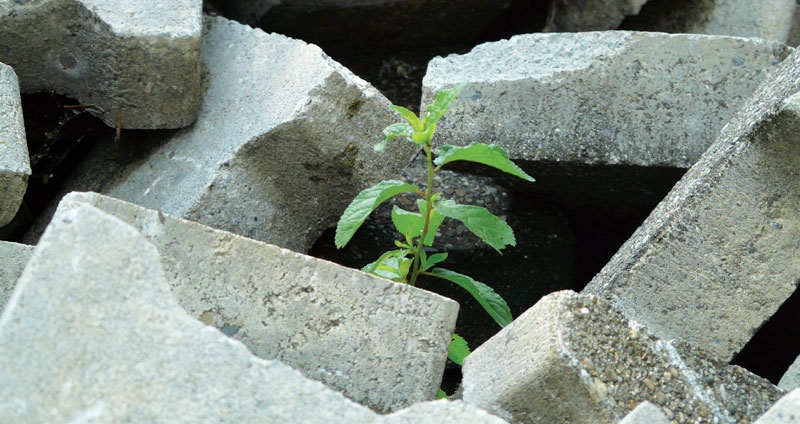
The role of the cement industry in reducing the carbon footprint of a country cannot be underscored enough. As India strives to strengthen its position globally in cement manufacturing and tries to hike up production to meet domestic demands, our efforts at balancing emission and environment plays a vital role. ICR looks at the various factors and possible outcomes of environmental endeavours in cement production.
The primary driver to global climatic change is carbon and Greenhouse Gas emission from various industries of the world. To save the planet from the harmful effects of this emission, the world collaboratively needs to take strides in the direction of achieving a Net Zero environment.
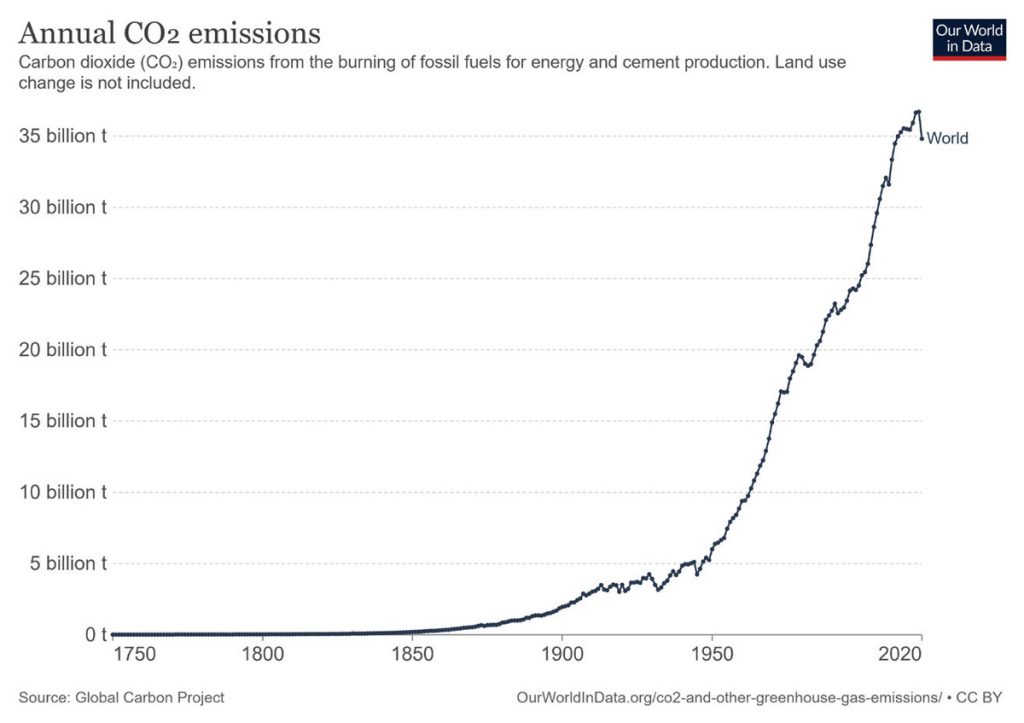
According to the Global Carbon Project, the annual CO2 emission globally as of 2020 was 34.81 billion tonne (refer to Fig 1). Prior to the industrial revolution, these emissions were very low. With growing industrialisation this kept increasing in value. In 1990, the carbon emission quadrupled reaching a value of over 22 billion tonne per annum globally and continued growing rapidly.
To tackle the issue of carbon emission across the globe, it is important to understand where it is coming from. From industry to country, breaking down the problem into smaller sections is likely to bring a solution at large.
In a treemap published in 2017, Global Carbon Project indicated the countries and how much carbon they are emitting. As per the analysis, owing to having the largest population on the planet, Asia emits 53 per cent of the total carbon emission globally. China is the largest contributor the same followed by India and then other Asian countries.
Concrete is the most consumed man-made material in existence. Cement, the key ingredient of concrete, also leaves a massive carbon footprint behind it. It contributes to emitting 8 per cent of carbon emission of the total world’s emission. According to a news report published by the BBC Network in December 2018, the cement industry emitted more carbon in the environment than aviation fuel which stood at 2.5 per cent then and wasn’t far behind the carbon emission from global agriculture business at 12 per cent.
India is a growing and developing nation with an expected 250 million people to be added to its urban population across the region. This has led to the cropping up of many infrastructural projects which in turn shall increase the production of cement. India is also part of the Paris Agreement and has aligned itself with its goal of achieving Net Zero by 2070 as announced in the Glasgow Climate Summit.
The challenge that shall present is to maintain the goal of achieving a better for the nation as well as meeting the demands of a growing and developing nation. As mentioned in a report published by World Business Council for Sustainable Development (WBCSD), by adopting state-of-the-art technological interventions, innovative production techniques and climate-resilient resource optimisation measures, cement manufacturers in India are integrating sustainability within their growth aspirations. The sector has already surpassed the targets of the Perform Achieve and Trade (PAT) Scheme by 80 per cent and is now being recognised globally as one of the most energy-efficient and sustainable markets for cement.
“Being an energy intensive industry, we are also focusing upon alternative and renewable energy sources for long-term sustainable business growth for cement production” says Dr Hitesh Sukhwal, Sr. Manager (Head Environment), North – West region, Udaipur Cement Works.
“Presently, our focus is to improve efficiency of zero carbon electricity generation technology such as waste heat recovery power through process optimisation and by adopting technological innovations in WHR power systems. We are also increasing our capacity for WHR based power as well as Solar power in the near future. Right now, we are sourcing nearly 50 per cent of our power requirement from clean and renewable energy sources i.e., zero carbon electricity generation technology,” he adds.
Transition to Net Zero
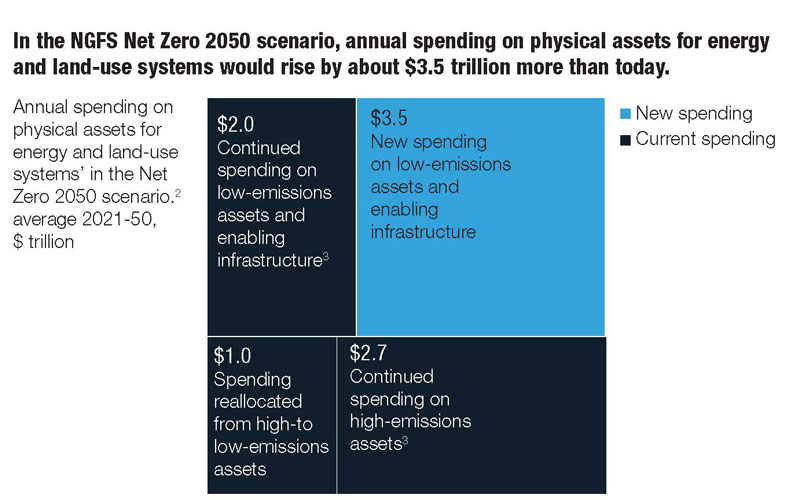
According to an article published by McKinsey & Company in April 2022, as the world will move towards a Net Zero scenario in 2050, capital spending on equipment and infrastructure with relatively low emissions intensity would average $6.5 trillion a year—more than two-thirds of the $9.2 trillion in annual capital spending during that time. During the Net Zero transition, energy systems of the world and its machinery will be re-engineered to utilise renewable fuels instead of fossil fuels.
McKinsey’s analysis of the Network for Greening the Financial System (NGFS) Net Zero 2050 scenario suggests that the annual spending on low-emissions assets and the infrastructure to enable them would rise to about $3.5 trillion than today.
Innovation needs to be accelerated, not only to accommodate renewable fuels, but also to transport the energy produced by them from creator to user. In the long haul, larger sunny terrains must be able to send the produced solar energy to lesser sunny terrains for renewable energy consumption.

Green the Future of Cement
Green cement is essentially the cement produced by various manufacturing techniques that reduce carbon emission by either using supplementary cementitious materials, waste heat recovery, substituting fossil fuels with other renewable sources and using various other methods to reduce the impact of carbon on the environment.
As the need of energy in the cement industry is paramount, the solution to its emission issues lies in finding renewable electricity that can produce clean, safe, affordable, and infinite energy. Across the globe and in India, companies are in the process of changing their manufacturing techniques to transition to clean energy and reduce their carbon footprint.
The future also holds cement that supports zero carbon emission. According to news reports from May, academicians from the University of Cambridge have invented the world’s first ever process to produce zero-emission cement and have secured a patent for the same.
This innovative process crafted by academicians – Dr Cyrille Dunant, Dr Pippa Horton and Professor Julian Allwood – is aimed to limit the need for green hydrogen in the cement sector. It uses waste concrete from the demolition of old buildings. This concrete is crushed, allowing the stones and sand constituents to be separated from the mixture of cement powder and water that bind them together. This recycled cement powder can then be used in the place of lime-flux in secondary steelmaking.
The inspiration for this process struck when these researchers noticed that the chemistry of used cement is virtually identical to that of the lime-flux used in conventional steel recycling processes. The new cement could therefore be made in a recycling loop that eliminates the emissions of cement production, saves raw materials, and reduces the emissions required in making lime-flux.
Capturing the emitted carbon cement plants can be a solution the world should be looking at. This would protect the environment from getting saturated with carbon dioxide while storing it in a form that won’t cause any harm.
Throwing light on this subject and technology, Maarten van Roon, CCO, Carbon8, says, “We help enable circularity for hard-to-abate industrial sectors by combining captured carbon from their operations with industrial residues, from the very same operations, to manufacture new materials for the construction industry.”
“In cement production specifically, cement bypass dust (CBD) and cement kiln dust (CKD) are produced as a by-product. CBD and CKD are reactive to CO2 because of the compounds they contain, making them a potential carbon sink. Our technology solution captures CO2 directly from the cement plant and permanently stores it in products, by valorising those residues. The product that ACT currently manufactures is CircaBuild, a carbon-negative alternative to natural aggregate,” he adds.
Carbon neutrality is the key concern for nations across the globe. India, being the second-largest producer of cement in the world, has the power to impact global climate change and environmental health. A shift in consumer preference in India would significantly affect the global climate change
war. The Government of India, with various policies, regulations and mandates on using green cement can drive this change and build an infrastructurally and environmentally strong nation in the years to come.
–Kanika Mathur








Concrete
NDMC Rolls Out Intensive Sanitation Drive Across Lutyens Delhi
Municipal body intensifies cleaning and monitoring across the capital
Concrete
UltraTech Appoints Jayant Dua As MD-Designate For 2027
Executive named to succeed current managing director in 2027
Concrete
Merlin Prime Spaces Acquires 13,185 Sq M Land Parcel In Pune
Rs 273 crore purchase broadens the developer’s Pune presence


NDMC Rolls Out Intensive Sanitation Drive Across Lutyens Delhi

UltraTech Appoints Jayant Dua As MD-Designate For 2027

Merlin Prime Spaces Acquires 13,185 Sq M Land Parcel In Pune

Adani Cement and Naredco Partner to Promote Sustainable Construction

Operational Excellence Redefined!
NDMC Rolls Out Intensive Sanitation Drive Across Lutyens Delhi
UltraTech Appoints Jayant Dua As MD-Designate For 2027
Merlin Prime Spaces Acquires 13,185 Sq M Land Parcel In Pune
Adani Cement and Naredco Partner to Promote Sustainable Construction