

Concrete
Optimising Heat Utilisation

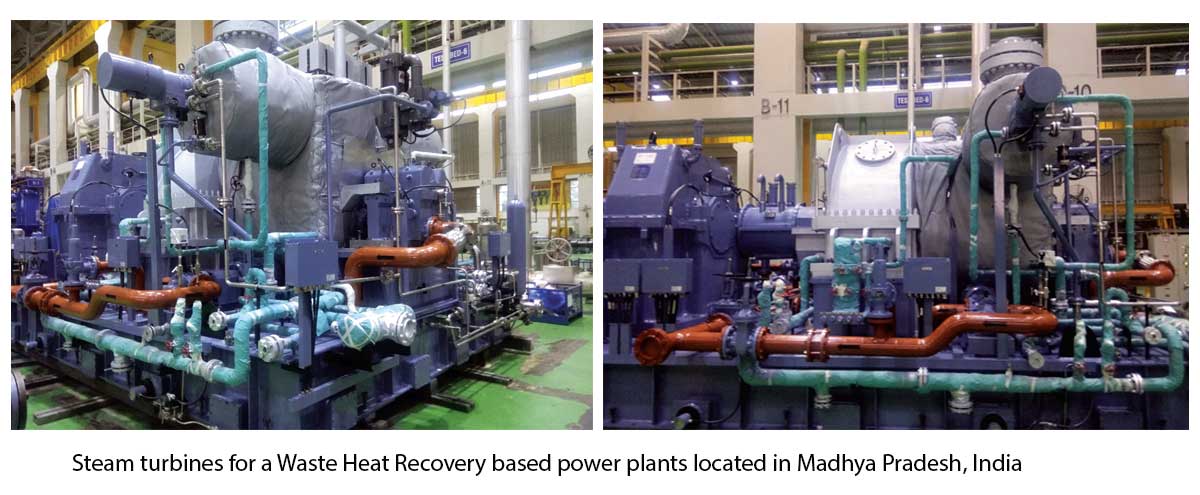
With Waste Heat Recovery as a viable alternative for the power needs of cement plants, Triveni Turbines presents case studies to support their findings on the role of thermal renewable fuels in aiding the cement sector inch closer to its goal of a sustainable future.
The cement industry is an energy-intensive industry. On an average, the energy cost is around 40 per cent of the cost of production for cement manufacturing. The heat generated in cement processes is generally lost up to 30 to 40 per cent.
Cement plants in India have Captive Power Plants (CPP), which are fired using fossil fuel (coal). These are in operation for several decades. Nowadays, the CPPs installed in cement plants use heat through Waste Heat Recovery (WHR) to generate power. Typically 20 to 30 per cent of the power requirement for cement plants can be fulfilled using waste heat for power generation.
Globally, WHR based plants installed in the cement industry are based on three processes, namely
- Steam Rankine Cycle System (SRC)
- Organic Rankine Cycle System (ORC)
- Kalina Based System
The function of the WHR is to recover the heat from the hot stream using Heat Recovery Steam Generators (HRSG) or Waste Heat Recovery Boiler (WHRB) to generate superheated steam. It can be used in the process (for co-generation) or to drive a steam turbine (combined cycle).
The WHR based power plants installed in cement processing plants use the heat generated through rotary kiln preheater (PH) and after quenching cooler (AQC) exhaust hot gases for power generation.
In India, the customer prefers SRC for WHR power generation in Cement Plants. Technically, in SRC, the exhaust gases from the rotary kiln pass through PH and go to the PH boiler. Similarly, mid-tapping from AQC gives hot gases to the AQC boiler. One cement kiln line requires 2 PH boilers and 1 AQC boiler. Based on the heat source, these boilers generate low-pressure steam of 12 ata to 18 ata at a temperature of 350 to 450 degree Celsius. and Low Pressure (LP)steam 2 ata to 3 ata pressure and temperature of 175 to 195 degree Celsius.
WHR-based power plants also exist in the sectors like sponge iron, steel and chemicals, which came into existence from the year 2000 onwards in the Indian market. Initially in India, the major cement manufacturers installed cement WHR plants made in China while over the last decade or so, Indian boiler and Turbine OEMs offered products indigenously designed and manufactured catering to the market dynamics, demand requirements and providing sustained long-term aftermarket services.

Cement WHR
Triveni Turbines is associated with cement WHR for many years now and has executed numerous prestigious projects with leading cement manufacturers in India and abroad. The requirement for cement WHR depends on the cement kiln capacity, heat utilisation, and plant efficiency.
Triveni is currently in the process of installing many cement WHR projects and is also working on multiple projects that are either in the enquiry or in the order finalisation stage.
Triveni has developed efficient injection condensing turbines that use medium pressure steam as turbine inlet and low pressure as injection steam. With the addition of 7th generation turbine blades developed by Triveni, power generation output is more for input steam parameters or gas parameters.
Salient features of Triveni’s steam turbines in the cement industry are as follows:
- Integral Lube Oil tank: Triveni offers an Integral Lube Oil tank for Power House Layout and civil cost optimisations of TG House. The benefits include a reduction in the civil cost of the project.
- Mechanical Run Test (MRT): Live steam mechanical run test at Triveni’s manufacturing facility for the steam turbines. The Turbine is tested with live steam from boilers at Bengaluru works with job-mounted turbo supervisory systems, Woodward governor, and gearbox.
- In-house Manufacturing: Turbine components like blades, rotors, and casing are manufactured and assembled at Triveni’s facility.
- Vacuum Tunnel: High-speed balancing of turbine rotor on ‘Schenk’ Vacuum Tunnel
- Gear Box (Triveni Power Transmission) assembly is done along with the Turbine on the same base plate and converts into a single product. A separate foundation of the gearbox is not required.
- Inlet Valve: Triveni supplies a customised inlet governing valve is designed in-house to overcome the varied load fluctuations in the cement industry
- Injection Control Valve: Triveni supplies a specially designed globe control valve to maintain the minimum differential pressure to avoid the energy loss which results in the indirect losses in the final output.
Best practices on steam turbine design solution
Large cement companies are primarily considering WHR power plants for their Greenfield projects. Dependency on the Chinese turbines has now declined in the Indian market as the Indian OEM’s adapted to injection condensing turbines technology with a dominant leadership. Triveni has a firm reference of injection condensing turbines supplied to cement WHR plants across India.
Specific design consideration is vital in the injection and admission zone. The rotor designed by Triveni has the higher stability to offset the excitation due to fluctuating injection steam loads. To meet customer requirements for various mid-pressure and low-pressure steam combinations, an injection condensing turbine was developed by Triveni and is successfully working in the Indian Cement Industry. Design and engineering teams carried out Computational Fluid Dynamic (CFD) analysis and creep-fatigue analysis to address this issue. This design philosophy is a value-addition for Triveni for its robust and efficient cement
WHR solution.
Environmental concerns and the solutions offered
According to industry sources, cement manufacturing accounts for an estimated 4 to 8 per cent of the world’s carbon dioxide (CO2) emission, making it a significant contributor to global warming. Increasing the energy efficiency of cement plants by replacing fossil fuels with thermal renewable fuels (such as waste heat) and capturing and storing the CO2 to contain greenhouse gas (GHG) emissions are some of the solutions common to the cement industry and other industrial sectors.
WHR power potential
There is a vast potential for power generation from waste heat across the world. The installation of cement WHR based power plants in China is over 80 per cent, much ahead of India. Similarly, Europe, the USA, and Latin America plan to implement WHR in their cement plants. It is observed that waste heat recovery-based power plants are emerging as an excellent value addition to the existing captive power plants. Other than reducing energy costs significantly, it can also be a reliable source of power.
Case studies of Triveni
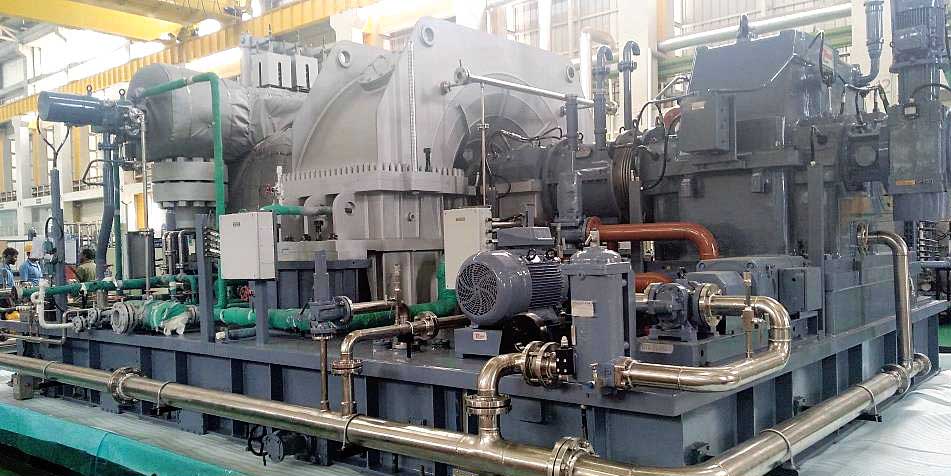
a. Waste Heat Recovery based Power plant in Madhya Pradesh, India
Driven by Triveni 1*22.5 MWe Injection Condensing steam turbines with an inlet steam parameter of 12 Bar and 425 degree Celsius with 0.2 Bar Exhaust
Customer challenge
The steam flow in this project was from multiple sources (i.e., multiple boilers). Steam generation depends on the waste heat generated from hot gas temperature from the preheating process and AQC process. There is a variation in the steam inlet at Medium Pressure (MP) and Low Pressure (LP) side and load variation in load or power output.
Solution
The steam turbine we proposed is an Injection condensing turbine that receives MP steam as an inlet and LP steam as an injection in the middle steam path. The steam collected was from 4 No’s of Preheater (PH) boilers and 2 No’s of After Quenching Cooler (AQC) Boilers from the two cement kilns of 7,000 TPD and 8,000 TPD capacity.
The steam turbine generator (STG) is suitable for an air-cooled condenser with a new generation blade design and reaction stages. Despite various challenges, the commissioning of the Turbine was executed with quick delivery of eight months, which set a benchmark for Triveni in the cement industry.
Benefits
The company does not have a captive power plant installed, and this WHR plant has offered many benefits. The waste gas generated at around
400 degree Celsius is cooled to 130 degree Celsius, thus safeguarding the environment and simultaneously utilising the waste heat to generate almost free power.
b. Waste Heat Recovery based Power plant installed overseas
Driven by Triveni 1*30 MWe Bleed condensing steam turbines with an inlet steam pressure of
65 Bar and 505 degree Celsius with 0.1 Bar
Exhaust pressure
Customer challenge
The customer proposed installing a power plant and expanding the company’s manufacturing capacity and was on the lookout for a steam turbine solution provider. The customer wanted to generate the necessary power by banking on their captive power capacities and to ensure a steady supply for critical processes.
Solution
Triveni offered the best solution to meet the plant efficiency by utilising the waste heat recovered from the existing blast furnace for power generation.
Benefits The company entrusted Triveni’s expertise in manufacturing robust and highly reliable products. It awarded us with the supply contract of a steam turbine that benefits from improving the plant’s energy efficiency, reducing the energy cost, and transmitting surplus electricity to the grid.
To complement the above new product portfolio, Triveni’s refurbishment arm Triveni REFURB steps up to provide an aftermarket solution for the complete range of rotating equipment across the globe. From steam turbines, compressors to the gas turbine range, we have adapted ourselves to ensure that customers find a one stop solution.
Over a period of time, the existing turbines degrade thereby reducing the efficiency of the turbines by consuming more steam. The Triveni REFURB team provides solutions to enhance the efficiency of turbines of ‘Any make, Any age’ by only replacing the critical components of the turbine i.e., rotor, guide blade carriers and bearings, which ensures the efficiency is restored and thereby reducing the carbon footprint.
Triveni REFURB converts the existing turbine into injection mode turbine. The turbines are then re-engineered to allow additional steam to be injected into the turbine and improve the efficiency of the plant.
a. Conversion of Bleed Condensing Turbine to Injection Condensing
A Chinese Turbine 1*25MWe Bleed Condensing Turbine with 84 Bar 515 degree Celsius inlet conditions and 0.176 Bar Exhaust pressure
Customer challenge
A major cement Industry customer wanted to convert their existing Chinese make turbine from a 3 bleed condensing to injection condensing turbine. The pressure at the inlet was reduced to 13 Bar 425 degree Celsius as against 84 bar 515 degree Celsius. The injection parameters are 2.25 Bar 185 degree Celsius.
Solution
Due to the steep drop in inlet pressure the volumetric expansion was almost three times the original condition. We had proposed to modify the Inlet valve of the turbine and the first stage nozzles to accommodate this expansion. Two bleed ports were closed and the injection would be taken from the third bleed port. Complete re-engineering of the turbine was undertaken to adopt the upgraded steam flow path.
Benefits By keeping the existing casing and civil foundation, customers benefited by lower expenditure and improved efficiency. This would enable the customer to get a faster Return on Investment (within 2 years) and enhanced life of the turbine.
Author: Arun Mote, Executive Director, Triveni Turbine Limited













Meghalaya Cabinet Approves MCCL Closure, Writes Off Rs. 244.3 mn

Fornnax Wins AIRIA’s Special Export Award for Rubber Machinery in 2025-26

Cement Prices Likely to Rise Rs. 10-15 per Bag from Mid-October

Nuvoco Marks 10 Years, Targets 35 MMTPA Capacity by FY28

J&K Government Notifies City Gas Distribution Policy
Meghalaya Cabinet Approves MCCL Closure, Writes Off Rs. 244.3 mn
Fornnax Wins AIRIA’s Special Export Award for Rubber Machinery in 2025-26
Cement Prices Likely to Rise Rs. 10-15 per Bag from Mid-October
Nuvoco Marks 10 Years, Targets 35 MMTPA Capacity by FY28
J&K Government Notifies City Gas Distribution Policy
-

 Concrete3 weeks ago
JSW Cement Receives Rs. 2.3 bn GST Demand Notice
-

 Concrete3 weeks ago
Andhra Pradesh Clears Rs. 30 bn My Home Cement Plant
-

 Concrete4 weeks ago
Jammu Division Begins First Cement Rail Traffic to Anantnag
-

 Concrete3 weeks ago
Montra Electric, Wonder Cement Deploy 250-Vehicle EV Fleet