Concrete
Bricking machines for cement plants
Published
5 years agoon
By
admin
Having a cement kiln out of commission can cost a plant tens of thousands of dollars in lost production and profits each day. When that shutdown is an emergency repair rather than scheduled maintenance, the costs can grow exponentially. The key to reducing or eliminating unscheduled downtime and minimising the need for scheduled repairs lies in efficient and quality brick installation. By minimising air gaps, locking rings or loose bricks, the life of kiln lining is extended, and unscheduled or emergency maintenance can be drastically reduced.
While many methods for installation exist, and contractors experienced with one type or another will swear by their process, the proof is in the result. Contractors who have tried multiple techniques typically agree that using a bricking machine leads to extensive savings through installation, quality and safety enhancements.

Time is Money
The old adage that time is money couldn?? be more true than in the case of a cement plant. The tens of thousands of dollars in lost revenue each day is compounded when the right equipment or refractory material is not on site and ready for installation work. This illustrates the importance of planned maintenance rather than emergency repairs.
Bricking machines provide cement plants a way to speed up the refractory installation process, saving them thousands in labour. Many factors affect brick installation, including planning, organisation, accessibility, kiln condition, size of kiln, ability to feed brick to the mason in a timely manner, type of installation, type and size of refractory, crew experience, etc. While most masons believe their method is fastest, many are surprised when they observe the time savings presented by a bricking machine, especially one fabricated with lightweight aircraft-grade aluminum.
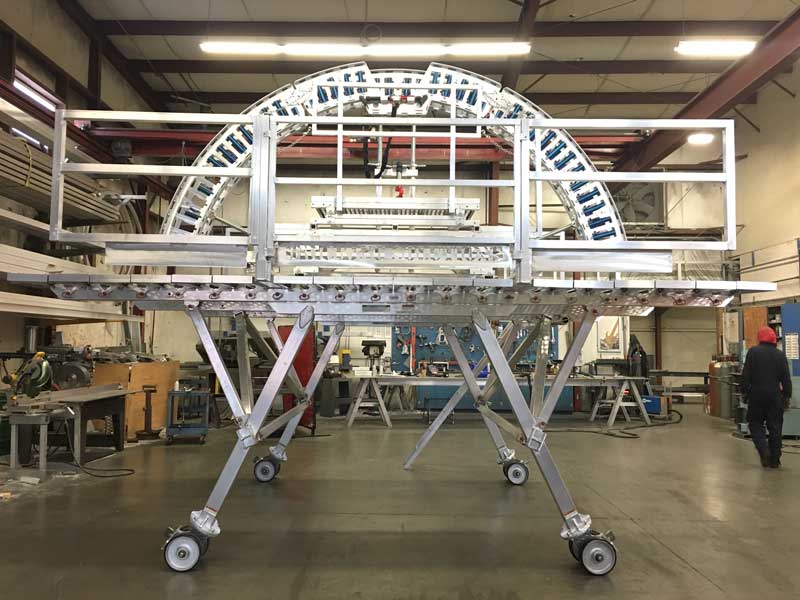
The time savings begins with the type of bricking and setup. A bricking machine constructed of strong, yet lightweight, modular aluminum components requires just one or two men to transport it into the kiln for assembly. These bricking machine models can be installed in just 60 to 90 minutes with an experienced crew. Installation of other bricking machines made up of mostly steel components can take 6 to 8 hours, resulting in a full shift of lost revenue in setup alone.
Once installed, the bricking machine offers a mobile working platform capable of supporting as many as three pallets of bricks, depending on model, the personnel working on it and their tools. The arch is equipped with pneumatic cylinders, which are used to raise the bricks into place against the kiln shell. It is supported by a cart and a rail system to allow the arch to move along the length of the platform scaffold. The latest bricking machine technology incorporates double arches, permitting a second ring of brick to be installed while the first ring is being keyed. This further accelerates installation. Because the arch uses individual cylinder controls, as well as master valves, brick installation is extremely fast. There is no back and forth while installing bricks. The individual control allows single-cylinder extension as needed. Once the arch is complete, actuating the master valve lowers all the cylinders at once. A review of the out dated alternate methods illustrates why they simply can?? compete in efficiency.

Pogo Stick
The Pogo Stick method is common in cement operations and is one of the oldest systems for brick installation. Setup time can take as long as a day in larger kilns, depending on the experience of the crew. This installation approach limits installers to just one course at a time to ensure the jig doesn?? collapse. Because one pogo stick is required for each brick, and must be individually set and retracted, installation time is extended. This method also requires much more physical force to execute, which fatigues workers quickly and slows production.
Mechanical Jack Screws
Like the pogo stick method, one jack screw is required for each brick and installation is limited to just one course at a time. Jack screws also require a significant amount of force to use, increasing the risk of fatigue and quality issues.
Downtime with each of these methods can be lengthy because the brick installation processes are considerably more time and labor intensive than with a bricking machine.
Just switching to a bricking machine installation method isn?? enough, however. The quality of the equipment also matters. The difference in speed and efficiency between styles of bricking machines was proven to plant owners in Midlothian, Texas. Their previous refractory installation method was a Swedish Single Arch bricking machine that had an average of 73.4 hours of outages and downtime per year. After switching to a dual arch bricking machine, the plant?? downtime for maintenance decreased by 44 percent, resulting in a profit increase of $367,000 per year ??providing a return on investment after one installation.
Likewise, a cement plant located in La Calera, Chile, had suffered numerous outages, unscheduled maintenance, damaged equipment and lost refractory. Analysts determined a number of factors were leading to the lost revenue, including mechanical defects of the kiln and inadequate brick installation quality using their Swedish bolt and timber machine. The contractor was no longer used, and instead plant personnel trained staff to replace the refractory brick using a bricking machine. That staff, which works with refractory bricking no more than twice a year, is now able to reline more than 46 feet (14 meters) per shift with a total time of less than a week for heavy coating brick removal and relining of 98 feet (30 meters), cooling and heating included. However, installation time is only one small component and speed is nothing without quality.

Refractory Installation Quality
Refractory issues, such as spiraling and twisting, account for as much as 50 percent of unscheduled outages and are almost always tied to the installation approach. While many refractory brickwork installation methods are accepted, few achieve a tight and good-quality fit, the key to preventing failures and outages.
The La Calera plant saw the cost of quality issues quickly spinning out of control. Experiencing emergency shutdowns at least every three months, plant management reached a breaking point when bricks started falling out just two weeks after a repair. Poor quality installation was determined to be a major catalyst for the unscheduled shutdowns. Poorly installed bricks led to interlocking rings and severe air gaps in the kiln lining. To compound matters, the added pressure of a kiln tire, which placed mechanical stress on the brickwork, contributed to the quick and costly failure. The failure led to an emergency shutdown resulting in more than $360,000 in lost revenue.
Many older, traditional installation methods have inherent design issues that limit the possibility of achieving a quality product. Because these older methods require installers to rotate the kiln, it?? difficult to maintain radial alignment of the brickwork, a critical factor for a stable brick lining. Every mason knows if the brickwork isn?? properly aligned it cannot uniformly absorb the pressure from vertical refractory and could prematurely fail. Rotating the kiln also leaves a large amount of unkeyed brick positioned straight up while the keying section is at the kiln?? waistline. In fact, all traditional methods, whether the kiln is rotated or not, leave unkeyed brick overhead. So, even if the keying is perfect, gravity will cause the unkeyed brickwork to sag, increasing the potential for catastrophic brick ring collapse. This is not only time intensive and costly to rectify, it?? also a major safety concern. In addition, traditional installation methods run a high risk of rings interlocking with adjacent rings ??resulting in a domino effect of failing brick rings ??and air gaps left between the brickwork and shell.
A bricking machine?? arches hold each brick firmly against the kiln shell until the key brick is installed, ensuring a tight fit. The master valve retracts or extends all cylinders simultaneously, allowing the arch to advance to the next row. This quality installation can extend the life of the kiln lining by as much as 25 per cent.
This method provides success based on four principles:
1. The pneumatic cylinders keep bricks pressed firmly against the shell at all times before keying so there is no risk of sagging.
2. A hydraulic jack holds the unkeyed ring when moving the machine?? arch system and provides ample outward pressure in the keying section for tight keying.
3. The pneumatic cylinders are not released until the keying is complete, ensuring proper compressive forces.
4. The cylinders do the physical work that would normally be done with manual forces and traditional methods, such as pogo sticks. This means less physical fatigue and more energy to focus on a quality job.
The efficiency of using a bricking machine is further enhanced with unique design features, such as cut-away sections. This cut-away section in the front arch provides both ease-of-installation and visibility. This section allows key masons an unobstructed area to place the key bricks. Alternate bricking machine designs don?? include an opening in the arch, requiring installers to try to find ways to reach around the arch, reducing speed of installation and ??potentially ??quality. The cut-away section also allows key masons to see the previously keyed ring and use it as a guideline, enabling discovery of bricking errors sooner when all pneumatic cylinders are released to check for sagging.
By changing methods to achieve higher quality installations, the plant in La Calera was able to decrease the number of outages experienced by 75 per cent to an average of three days per year. But even better, they eliminated costly unscheduled repairs, which were once their only stoppages, and now address maintenance on their own schedule when manpower, materials and equipment are ready. A quality installation means less maintenance is required. Prior to using a bricking machine, the plant never went more than 90 days without refractory failure. Now the plant runs as long as 18-months before an outage. In fact, required scheduled maintenance was cut by 66 per cent.

Don?? Discount Safety
No analysis of the bricking installation would be complete without a review of safety. While safety might not make a plant money, it can certainly save money when it comes to lost work, employee claims and rising insurance costs. Because bricking machines let the pneumatic cylinders do the work rather than the bricking team, employees are less likely to become fatigued, a critical factor in major accidents. In addition, the elimination of the manual labor reduces the likelihood of repetitive stress injuries.
Safe and happy employees translate into a more stable labor pool and a stronger bottom line. Improved brickwork quality, faster installation and enhanced safety together offer the greatest impact on ROI.
Conclusion
Thanks to bricking machines, plants can call the shots when it comes to outages and downtime. That kind of reliability and control over kiln work simply can?? be achieved with traditional methods, even with the most skilled masons. The investment is relatively small, too, often just 6 percent of an operation?? total capital costs. Bricking machine ROI may only happen once after the purchase, but kiln ROI lasts the lifetime of the machine.
Bricking Solutions manufactured the industry?? first bricking machine in 1966 to give refractory installers a safer, more efficient alternative to manual installation methods. From that time the company has believed that machines should do the heavy work rather than the people and customer feedback should drive product development. Bricking Solutions manufactures a wide variety of equipment for the cement, foundry and steel industries, including bricking machines, conveyors, pallet transfer systems, platforms, ramps and safety cages. For more information: Bricking Solutions, Inc., 1144 Village Way, Monroe, WA 98272; 1-360-794-1277; info@brickingsolutions.com; www.brickingsolutions.com.
About the Author
Heather Harding, is the managing director for Bricking Solutions, a world leader in kiln refractory installation solutions.

Concrete
Cement Demand Revives As Prices Decline In Q3 FY26
Nuvama reports improved volume growth after price correction
Published
8 hours agoon
February 24, 2026By
admin
A report by Nuvama Financial Services (Nuvama) said cement sector demand revived in the third quarter of fiscal year twenty twenty six as prices declined, supporting volume growth across regions. The note indicated that sequential price correction helped replenish demand that had been subdued by elevated pricing earlier in the year. Nuvama quantified the price decline as a sequential correction that varied across states and segments, facilitating restocking by merchants and traders.
The report suggested that improved affordability after the price correction encouraged housing and infrastructure activity, with developers and contractors adjusting procurement plans. It added that regional dynamics varied, with some markets showing faster recovery while others remained reliant on seasonal construction cycles. Housing demand was driven by both affordable and mid segment projects, while infrastructure segment recovery was contingent on timely execution of public works.
Analysts at Nuvama assessed that the price moderation eased inventory pressures for manufacturers and distributors and supported margin stabilisation at several producers. Demand improvement was visible in both urban and rural segments, although the pace of recovery differed by state and trade channel. Producers were seen balancing price realisations with volume targets and managing input cost volatility through operational efficiencies.
The report recommended that investors monitor volumes and realisations closely as market equilibrium emerges in the coming quarters, noting that sustainability of recovery would depend on monsoon patterns and government infrastructure outlays. Overall, the assessment pointed to a cautiously optimistic outlook for the cement industry as price correction translated into tangible volume gains. Market participants were advised to track early signs of demand broadening beyond core construction hubs to assess the depth of the rebound.
Concrete
Refractory demands in our kiln have changed
Published
5 days agoon
February 20, 2026By
admin
Radha Singh, Senior Manager (P&Q), Shree Digvijay Cement, points out why performance, predictability and life-cycle value now matter more than routine replacement in cement kilns.
As Indian cement plants push for higher throughput, increased alternative fuel usage and tighter shutdown cycles, refractory performance in kilns and pyro-processing systems is under growing pressure. In this interview, Radha Singh, Senior Manager (P&Q), Shree Digvijay Cement, shares how refractory demands have evolved on the ground and how smarter digital monitoring is improving kiln stability, uptime and clinker quality.
How have refractory demands changed in your kiln and pyro-processing line over the last five years?
Over the last five years, refractory demands in our kiln and pyro line have changed. Earlier, the focus was mostly on standard grades and routine shutdown-based replacement. But now, because of higher production loads, more alternative fuels and raw materials (AFR) usage and greater temperature variation, the expectation from refractory has increased.
In our own case, the current kiln refractory has already completed around 1.5 years, which itself shows how much more we now rely on materials that can handle thermal shock, alkali attack and coating fluctuations. We have moved towards more stable, high-performance linings so that we don’t have to enter the kiln frequently for repairs.
Overall, the shift has been from just ‘installation and run’ to selecting refractories that give longer life, better coating behaviour and more predictable performance under tougher operating conditions.
What are the biggest refractory challenges in the preheater, calciner and cooler zones?
• Preheater: Coating instability, chloride/sulphur cycles and brick erosion.
• Calciner: AFR firing, thermal shock and alkali infiltration.
• Cooler: Severe abrasion, red-river formation and mechanical stress on linings.
Overall, the biggest challenge is maintaining lining stability under highly variable operating conditions.
How do you evaluate and select refractory partners for long-term performance?
In real plant conditions, we don’t select a refractory partner just by looking at price. First, we see their past performance in similar kilns and whether their material has actually survived our operating conditions. We also check how strong their technical support is during shutdowns, because installation quality matters as much as the material itself.
Another key point is how quickly they respond during breakdowns or hot spots. A good partner should be available on short notice. We also look at their failure analysis capability, whether they can explain why a lining failed and suggest improvements.
On top of this, we review the life they delivered in the last few campaigns, their supply reliability and their willingness to offer plant-specific custom solutions instead of generic grades. Only a partner who supports us throughout the life cycle, which includes selection, installation, monitoring and post-failure analysis, fits our long-term requirement.
Can you share a recent example where better refractory selection improved uptime or clinker quality?
Recently, we upgraded to a high-abrasion basic brick at the kiln outlet. Earlier we had frequent chipping and coating loss. With the new lining, thermal stability improved and the coating became much more stable. As a result, our shutdown interval increased and clinker quality remained more consistent. It had a direct impact on our uptime.
How is increased AFR use affecting refractory behaviour?
Increased AFR use is definitely putting more stress on the refractory. The biggest issue we see daily is the rise in chlorine, alkalis and volatiles, which directly attack the lining, especially in the calciner and kiln inlet. AFR firing is also not as stable as conventional fuel, so we face frequent temperature fluctuations, which cause more thermal shock and small cracks in the lining.
Another real problem is coating instability. Some days the coating builds too fast, other days it suddenly drops, and both conditions impact refractory life. We also notice more dust circulation and buildup inside the calciner whenever the AFR mix changes, which again increases erosion.
Because of these practical issues, we have started relying more on alkali-resistant, low-porosity and better thermal shock–resistant materials to handle the additional stress coming from AFR.
What role does digital monitoring or thermal profiling play in your refractory strategy?
Digital tools like kiln shell scanners, IR imaging and thermal profiling help us detect weakening areas much earlier. This reduces unplanned shutdowns, helps identify hotspots accurately and allows us to replace only the critical sections. Overall, our maintenance has shifted from reactive to predictive, improving lining life significantly.
How do you balance cost, durability and installation speed during refractory shutdowns?
We focus on three points:
• Material quality that suits our thermal profile and chemistry.
• Installation speed, in fast turnarounds, we prefer monolithic.
• Life-cycle cost—the cheapest material is not the most economical. We look at durability, future downtime and total cost of ownership.
This balance ensures reliable performance without unnecessary expenditure.
What refractory or pyro-processing innovations could transform Indian cement operations?
Some promising developments include:
• High-performance, low-porosity and nano-bonded refractories
• Precast modular linings to drastically reduce shutdown time
• AI-driven kiln thermal analytics
• Advanced coating management solutions
• More AFR-compatible refractory mixes
These innovations can significantly improve kiln stability, efficiency and maintenance planning across the industry.
Concrete
Digital supply chain visibility is critical
Published
5 days agoon
February 20, 2026By
admin
MSR Kali Prasad, Chief Digital and Information Officer, Shree Cement, discusses how data, discipline and scale are turning Industry 4.0 into everyday business reality.
Over the past five years, digitalisation in Indian cement manufacturing has moved decisively beyond experimentation. Today, it is a strategic lever for cost control, operational resilience and sustainability. In this interview, MSR Kali Prasad, Chief Digital and Information Officer, Shree Cement, explains how integrated digital foundations, advanced analytics and real-time visibility are helping deliver measurable business outcomes.
How has digitalisation moved from pilot projects to core strategy in Indian cement manufacturing over the past five years?
Digitalisation in Indian cement has evolved from isolated pilot initiatives into a core business strategy because outcomes are now measurable, repeatable and scalable. The key shift has been the move away from standalone solutions toward an integrated digital foundation built on standardised processes, governed data and enterprise platforms that can be deployed consistently across plants and functions.
At Shree Cement, this transition has been very pragmatic. The early phase focused on visibility through dashboards, reporting, and digitisation of critical workflows. Over time, this has progressed into enterprise-level analytics and decision support across manufacturing and the supply chain,
with clear outcomes in cost optimisation, margin protection and revenue improvement through enhanced customer experience.
Equally important, digital is no longer the responsibility of a single function. It is embedded into day-to-day operations across planning, production, maintenance, despatch and customer servicing, supported by enterprise systems, Industrial Internet of Things (IIoT) data platforms, and a structured approach to change management.
Which digital interventions are delivering the highest ROI across mining, production and logistics today?
In a capital- and cost-intensive sector like cement, the highest returns come from digital interventions that directly reduce unit costs or unlock latent capacity without significant capex.
Supply chain and planning (advanced analytics): Tools for demand forecasting, S&OP, network optimisation and scheduling deliver strong returns by lowering logistics costs, improving service levels, and aligning production with demand in a fragmented and regionally diverse market.
Mining (fleet and productivity analytics): Data-led mine planning, fleet analytics, despatch discipline, and idle-time reduction improve fuel efficiency and equipment utilisation, generating meaningful savings in a cost-heavy operation.
Manufacturing (APC and process analytics): Advanced Process Control, mill optimisation, and variability reduction improve thermal and electrical efficiency, stabilise quality and reduce rework and unplanned stoppages.
Customer experience and revenue enablement (digital platforms): Dealer and retailer apps, order visibility and digitally enabled technical services improve ease of doing business and responsiveness. We are also empowering channel partners with transparent, real-time information on schemes, including eligibility, utilisation status and actionable recommendations, which improves channel satisfaction and market execution while supporting revenue growth.
Overall, while Artificial Intelligence (AI) and IIoT are powerful enablers, it is advanced analytics anchored in strong processes that typically delivers the fastest and most reliable ROI.
How is real-time data helping plants shift from reactive maintenance to predictive and prescriptive operations?
Real-time and near real-time data is driving a more proactive and disciplined maintenance culture, beginning with visibility and progressively moving toward prediction and prescription.
At Shree Cement, we have implemented a robust SAP Plant Maintenance framework to standardise maintenance workflows. This is complemented by IIoT-driven condition monitoring, ensuring consistent capture of equipment health indicators such as vibration, temperature, load, operating patterns and alarms.
Real-time visibility enables early detection of abnormal conditions, allowing teams to intervene before failures occur. As data quality improves and failure histories become structured, predictive models can anticipate likely failure modes and recommend timely interventions, improving MTBF and reducing downtime. Over time, these insights will evolve into prescriptive actions, including spares readiness, maintenance scheduling, and operating parameter adjustments, enabling reliability optimisation with minimal disruption.
A critical success factor is adoption. Predictive insights deliver value only when they are embedded into daily workflows, roles and accountability structures. Without this, they remain insights without action.
In a cost-sensitive market like India, how do cement companies balance digital investment with price competitiveness?
In India’s intensely competitive cement market, digital investments must be tightly linked to tangible business outcomes, particularly cost reduction, service improvement, and faster decision-making.
This balance is achieved by prioritising high-impact use cases such as planning efficiency, logistics optimisation, asset reliability, and process stability, all of which typically deliver quick payback. Equally important is building scalable and governed digital foundations that reduce the marginal cost of rolling out new use cases across plants.
Digitally enabled order management, live despatch visibility, and channel partner platforms also improve customer centricity while controlling cost-to-serve, allowing service levels to improve without proportionate increases in headcount or overheads.
In essence, the most effective digital investments do not add cost. They protect margins by reducing variability, improving planning accuracy, and strengthening execution discipline.
How is digitalisation enabling measurable reductions in energy consumption, emissions, and overall carbon footprint?
Digitalisation plays a pivotal role in improving energy efficiency, reducing emissions and lowering overall carbon intensity.
Real-time monitoring and analytics enable near real-time tracking of energy consumption and critical operating parameters, allowing inefficiencies to be identified quickly and corrective actions to be implemented. Centralised data consolidation across plants enables benchmarking, accelerates best-practice adoption, and drives consistent improvements in energy performance.
Improved asset reliability through predictive maintenance reduces unplanned downtime and process instability, directly lowering energy losses. Digital platforms also support more effective planning and control of renewable energy sources and waste heat recovery systems, reducing dependence on fossil fuels.
Most importantly, digitalisation enables sustainability progress to be tracked with greater accuracy and consistency, supporting long-term ESG commitments.
What role does digital supply chain visibility play in managing demand volatility and regional market dynamics in India?
Digital supply chain visibility is critical in India, where demand is highly regional, seasonality is pronounced, and logistics constraints can shift rapidly.
At Shree Cement, planning operates across multiple horizons. Annual planning focuses on capacity, network footprint and medium-term demand. Monthly S&OP aligns demand, production and logistics, while daily scheduling drives execution-level decisions on despatch, sourcing and prioritisation.
As digital maturity increases, this structure is being augmented by central command-and-control capabilities that manage exceptions such as plant constraints, demand spikes, route disruptions and order prioritisation. Planning is also shifting from aggregated averages to granular, cost-to-serve and exception-based decision-making, improving responsiveness, lowering logistics costs and strengthening service reliability.
How prepared is the current workforce for Industry 4.0, and what reskilling strategies are proving most effective?
Workforce preparedness for Industry 4.0 is improving, though the primary challenge lies in scaling capabilities consistently across diverse roles.
The most effective approach is to define capability requirements by role and tailor enablement accordingly. Senior leadership focuses on digital literacy for governance, investment prioritisation, and value tracking. Middle management is enabled to use analytics for execution discipline and adoption. Frontline sales and service teams benefit from
mobile-first tools and KPI-driven workflows, while shop-floor and plant teams focus on data-driven operations, APC usage, maintenance discipline, safety and quality routines.
Personalised, role-based learning paths, supported by on-ground champions and a clear articulation of practical benefits, drive adoption far more effectively than generic training programmes.
Which emerging digital technologies will fundamentally reshape cement manufacturing in the next decade?
AI and GenAI are expected to have the most significant impact, particularly when combined with connected operations and disciplined processes.
Key technologies likely to reshape the sector include GenAI and agentic AI for faster root-cause analysis, knowledge access, and standardisation of best practices; industrial foundation models that learn patterns across large sensor datasets; digital twins that allow simulation of process changes before implementation; and increasingly autonomous control systems that integrate sensors, AI, and APC to maintain stability with minimal manual intervention.
Over time, this will enable more centralised monitoring and management of plant operations, supported by strong processes, training and capability-building.
Cement Demand Revives As Prices Decline In Q3 FY26
Refractory demands in our kiln have changed
Digital supply chain visibility is critical
Redefining Efficiency with Digitalisation
Cement Additives for Improved Grinding Efficiency
Cement Demand Revives As Prices Decline In Q3 FY26
Refractory demands in our kiln have changed
Digital supply chain visibility is critical
Redefining Efficiency with Digitalisation
Cement Additives for Improved Grinding Efficiency
Trending News
-
Concrete4 weeks agoAris Secures Rs 630 Million Concrete Supply Order
-
Concrete4 weeks agoNITI Aayog Unveils Decarbonisation Roadmaps
-
Economy & Market3 weeks agoBudget 2026–27 infra thrust and CCUS outlay to lift cement sector outlook
-
Concrete4 weeks agoJK Cement Commissions 3 MTPA Buxar Plant, Crosses 31 MTPA