

Concrete
Engineering safer conveyors: Art meets science


All new conveyor systems will inevitably succumb to the punishing bulk handling environment and begin the slow process of degradation. The system will eventually require more time and labor for maintenance, shorter spans between outages, longer periods of downtime, and an ever-increasing cost of operation. This period is also accompanied by an increased chance of injury or fatality as workers are progressively exposed to the equipment to perform cleaning, maintenance and to fabricate short-term fixes to long-term problems. A total system replacement is cost- prohibitive, but to remain compliant and/or meet ever-increasing production demands, upgrades and repairs are unavoidable.
When examining the safety of a system, improving efficiency and reducing risk can be achieved by utilizing a hierarchy of control methods for alleviating hazards. The consensus among safety professionals is that the most effective way to mitigate risks is to design the hazard out of the component or system. This usually requires a greater initial capital investment than short-term fixes, but yields more cost-effective and durable results.
Science: Hierarchy of control methods
Examining the US Occupational Safety and Health Administration (OSHA) accident database reveals the dangers of working around conveyors.[1] Studies have revealed that the highest prevalence of accidents is near locations where cleaning and maintenance activities most frequently take place: take-up pulley, tail pulley, and head pulley.
Designs should be forward-thinking, exceeding compliance standards and enhancing operators??ability to incorporate future upgrades cost-effectively and easily by taking a modular approach. Designing hazards out of the system means alleviating causes with the intent to bolster safety on a conveyor system, but the methods of protecting workers can vary greatly.
In many cases, it will be necessary to use more than one control method, by incorporating lower-ranked controls. However, these lower-ranking approaches are best considered as support measures, rather than solutions in and of themselves.
PPE includes respirators, safety goggles, blast shields, hard hats, hearing protectors, gloves, face shields, and footwear, providing a barrier between the wearer and the hazard. Downsides are that they can be worn improperly, may be uncomfortable to use through an entire shift, can be difficult to monitor and offer a false sense of security. But the bottom line is that they do not address the source of the problem.
Administrative controls (changes to the way people work) create a policy that articulates a commitment to safety, but written guidelines can be easily shelved and forgotten. These controls can be taken a step further by establishing ??ctive??procedures to minimise the risks. For example, supervisors can schedule shifts that limit exposure and require more training for personnel, but these positive steps still do not remove the exposure and causes of hazards.
Warning Signage is generally required by law, so this is less of a method than a compliance issue. It should be posted in plain sight, clearly understood and washed when dirty or replaced when faded. Like most lower-tier methods, signs do not remove the hazard and are easily ignored.
Installing systems such as engineering controls that allow remote monitoring and control of equipment??r guards such as gates and inspection doors that obstruct access??reatly reduce exposure, but again, do not remove the hazard.
Using the substitute method replaces something that produces a hazard with a piece of equipment or change in material that eliminates the hazard. For example, the manual clearing of a clogged hopper could be replaced by installing remotely triggered air cannons.
Examples of eliminate by design are longer, taller, and tightly sealed loading chutes to control dust and spillage or heavy-duty primary and secondary cleaners to minimize carryback. By using hazard identification and risk-assessment methods early in the design process, engineers can create the safest, most efficient system for space, budget, and application.
Economic analysis of prevention through design (PtD)
Another way of saying ??liminate by design??is PtD (Prevention through Design), the term used by The National Institute of Occupational Safety and Health (NIOSH). As a department of the U.S. Centers for Disease Control (CDC), the organisation spearheaded the PtD initiative.[3] In its report, the Institute points out that, while the underlying causes vary, studies of workplace accidents implicate ??ystem design??in 37 per cent of job-related fatalities.
Cost is most often the main inhibitor to PtD, which is why it?? best to implement safer designs in the planning and initial construction stages, rather than retrofitting the system later. The added engineering cost of PtD is often less than an additional 10 per cent of engineering but has enormous benefits in improved safety and increased productivity.
The cost of PtD initiatives after initial construction can be three to five times as much as when the improvement is incorporated in the design stage. The biggest cause of expensive retroactive improvements is cutting corners initially by seeking the lowest-bid contracts.
Low-bid process and lifecycle cost
Although the policy is generally not explicitly stated by companies, the low-bid process is usually an implied rule that is baked into a company?? culture. It encourages bidders to follow a belt conveyor design methodology that is based on getting the maximum load on the conveyor belt and the minimum compliance with regulations using the lowest price materials, components, and manufacturing processes available.
But when companies buy on price, the benefits are often short-lived, and costs increase over time, eventually resulting in losses. In contrast, when purchases are made based on lowest long-term cost (lifecycle cost), benefits usually continue to accrue and costs are lower, resulting in net savings over time.??sup>[4]
The Art: Design Hierarchy
Rather than meeting minimum compliance standards, the conveyor system should exceed all code, safety, and regulatory requirements using global best practices. By designing the system to minimize risk and the escape and accumulation of fugitive material, the workplace is made safer and the equipment is easier to maintain.
Life cycle costing should play into all component decisions. Buying on lifecycle cost and anticipating the future use of problem-solving components in the basic configuration of the conveyor provides improved safety and access, without increasing the structural steel requirements or significantly increasing the overall price. It also raises the possibility for easier system upgrades in the future.
Best practices: The ??a href=’https://indiancementreview.quintype.com/story/5985400b-6cad-4420-a931-43741b043db2’>Evolved Basic Conveyor??/strong>
Using the hierarchy of controls along with the design hierarchy, engineers will be able to construct an ??volved basic conveyor??that meets the needs of modern production and safety demands. Built competitively with a few modifications in critical areas, an evolved basic conveyor is a standard bulk material handling conveyor designed to allow easy retrofitting of new components that improve operation and safety, solving or preventing common maintenance problems.
Installing or providing maintenance-minded solutions in the loading zone can greatly improve safety and reduce man-hours and downtime. These components include slide-in/slide-out idlers, impact cradles and support cradles. On larger conveyors, maintenance aids such as overhead monorails or jib cranes assist in the movement and replacement of components. Also, designers should ensure adequate access to utilities??ypically electricity and/or compressed air??o facilitate maintenance and performance. Next-generation conveyor designs may even feature a specially-engineered idler capped with an independent power generator that uses the conveyor?? movement to generate power for a wide array of autonomous equipment.
Dust, spillage, and belt tracking are top concerns for many safety professionals. Field tests have shown that enlarged skirtboards and engineered settling zones promote dust settling, and reduce fugitive material. Curved loading and discharge chutes control the cargo transfer for centered placement and reduced turbulence. As the load is centered on the belt, guides ensure even travel through the takeup to promote consistent belt tracking.
Any transfer point is prone to buildup and clogging under the right conditions, be it ambient humidity, material wetness, volume or surface grade. Flow aids such as vibrators or air cannons on chutes can sustain the material movement, improve equipment life and reduced the safety hazards associated with manually clearing clogs.
Conclusion
Engineering safer conveyors is a long-term strategy. Although design absorbs less than 10 percent of the total budget of a project, additional upfront engineering and applying a life cycle-cost methodology to the selection and purchase of conveyor components proves beneficial.
By encouraging the use of the hierarchy of controls at the planning stage, along with the design hierarchy at the design stage, the system will likely meet the demands of modern production and safety regulations, with a longer operational life, fewer stoppages, and a lower cost of operation.
References
1. Conveyor Accident Database, OSHA, US Dept. of Labor. Washington, DC. 2018. https://www.osha.gov/pls/imis/AccidentSearch.search?acc_keyword=%22Conveyor%20Belt%22&keyword_list=on
2. ??oundations for Conveyor Safety?? Ch. 31, pgs. 404-440. Martin Engineering. Worzalla Publishing Company, Stevens Point, Wisconsin. 2016. https://www.martin-eng.com/content/product/690/safety-book
3. Howard, John, M.D. ??revention through Design: Plan for the National Initiative?? National Institute of Occupational Safety and Health (NIOSH), U.S. Centers for Disease Control (CDC), Department Of Health And Human Services. Washington, DC. 2010. https://www.cdc.gov/niosh/docs/2011-121/pdfs/2011-121.pdf
4. Swinderman, R. Todd. ??he Economics of Workplace Safety: Putting a price on material handling mishaps.??Coal Age. Vol. 123, No. 3, pg. 28-31. April, 2018. https://www.coalage.com/features/the-economics-of-workplace-safety/

Copyright: Martin Engineering
Safety improves as the type of hazard control moves higher up the hierarchy of methods.

Copyright: Martin Engineering
Incorporating effective hazard control techniques are easier and less costly in the early stages of a project. [2]

Copyright: Martin Engineering
Risk assessment applied to design helps create a safer conveyor system.

Copyright: Martin Engineering
The return on better design and quality is realized over the extended life and safety of the system.

Copyright: Martin Engineering
Rather than meeting minimum compliance standards, conveyor
systems should exceed code, safety and regulatory requirements.

Copyright: Martin Engineering
Components of an evolved basic conveyor facilitate operations, maintenance and safety.

Copyright: Martin Engineering
A properly configured conveyor minimizes emissions for improved safety and easier maintenance.











Concrete
Nuvoco Marks 10 Years, Targets 35 MMTPA Capacity by FY28
Nuvoco celebrates a decade of growth, targeting 35 MMTPA cement capacity by FY28.

Concrete
J&K Government Notifies City Gas Distribution Policy
Policy targets PNG and CNG expansion across all 20 districts
Concrete
JSW Cement Commissions 1 MTPA Grinding Unit at Nagaur
Nagaur unit lifts JSW Cement’s grinding capacity to 25.10 MTPA


Nuvoco Marks 10 Years, Targets 35 MMTPA Capacity by FY28

J&K Government Notifies City Gas Distribution Policy

JSW Cement Commissions 1 MTPA Grinding Unit at Nagaur

JSW Cement Commissions 1 MTPA Unit in Rajasthan

Wonder Cement appoints Mahesh Singh as VP Corporate Brand Communication
Nuvoco Marks 10 Years, Targets 35 MMTPA Capacity by FY28
J&K Government Notifies City Gas Distribution Policy
JSW Cement Commissions 1 MTPA Grinding Unit at Nagaur
JSW Cement Commissions 1 MTPA Unit in Rajasthan
Wonder Cement appoints Mahesh Singh as VP Corporate Brand Communication
-
 Concrete4 weeks ago
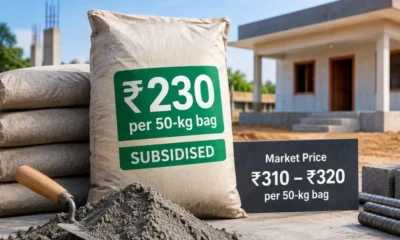
Telangana to Supply Subsidised Cement for Indiramma Houses
-

 Concrete2 weeks ago
Andhra Pradesh Clears Rs. 30 bn My Home Cement Plant
-

 Concrete2 weeks ago
JSW Cement Receives Rs. 2.3 bn GST Demand Notice
-

 Concrete4 weeks ago
Centre Defers Clearance for Limestone Mine Near Bustard Habitat