Flexible, cost-effective and reliable material transport.
Environmentally sensitive topography. Excessive dust and noise emissions. Restricted operating spaces. Unprotected commodities. Tight curves and large angles of inclination. Rough, broken and hilly terrain. Expensive transfer towers. These all can be challenges when you need to convey material efficiently and safely from point to point.
FLSmidth-engineered pipe conveyors are a cost-effective and reliable material transport solution that meets all these challenges head on. It secures the material and protects the environment with a dust- and noise-controlled conveyor system. They are suitable for all types of bulk material, from hot cement or clinker to coal, limestone, fly ash, phosphate granulates, and wood chips. These pipe conveyor systems can easily be integrated into existing and new installations and handle bulk material transport for reliable in-plant and long-distance conveying. Including two way conveying, where raw material is loaded at the jetty for bringing it to the plant and cement/clinker loaded on the same conveyor from the plant to the jetty.
How does it work?
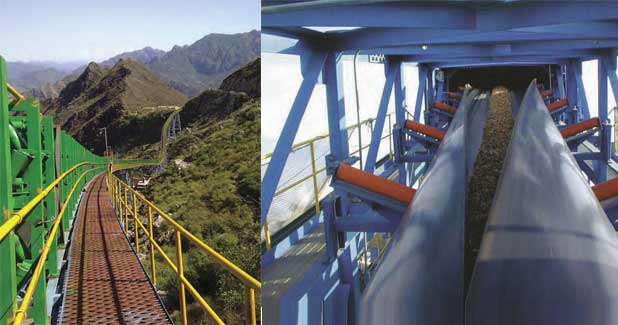
In the material loading area, the conveying belt is still open when the material loads onto the belt similar to conventional belt conveyors. Over a length of several metres, the belt closes and is formed by special devices into a tubular shape. From that point, the belt becomes an enclosed pipe that travels the entire conveying line before opening at the discharge end.
Flexibility
The flexible belt pipe design allows directional changes without the need for additional transfer stations. Its curves can either be horizontal or vertical, or a combination of both. The belt opens on its own before reaching the material discharging point. Following the material discharge, the belt on the lower strand is closed again on its return. This eliminates spilt material over the pipe conveyor line and has the advantage that the carrying side of the belt is once again inside the tube, before opening up near feed end.
Protection for your material and for the environment
The enclosed conveying means that your material is protected against external environmental factors, such as wind, humidity and rain, while the pipe configuration protects the environment against dust or any potential material loss. Where the environment is a concern, pipe conveyors have become the default choice, even preferred by regulatory bodies. There is no spillage on the return strand of enclosed section of conveyor, and extremely low dust occurrence during transport. Our systems are designed to handle up to 30-degree inclinations. We have engineered and installed systems with conveying angles from plus 29 degrees to minus 26.5 degrees, that includes conveying limestone, cement and other hot materials up to 160 degree Celsius.
A cost-effective solution
Our pipe conveyor systems are the go-to solution if you want to connect your mine or port to your plant for raw material; plant to port for finished product; or from plant to mines for waste disposal through the same conveyor. If you are upgrading an existing brownfield plant and have space constraints or are looking to tackle spillage from material handling conveyor systems, the pipe conveyors provide a cost-effective solution. In turn, maintenance and operating costs are also lowered. With more than 300 references and over 200 km of conveying length located in over 40 countries, our pipe conveyors are clearly the world’s foremost solutions in this area.
Features:
- Reduced dust and spillage
- Lower noise emissions
- Inclines up to 30 degree
- Horizontal and vertical curves starting with as small as 54 metres
- Steep downhill conveying with high slope angles
- Multiple feed and discharge points
- Eight km and greater distances possible without transfer stations
- Simultaneous conveying of different materials in both directions
- Intelligent drive control systems reducing belt stress by torque-sharing
- Lump sizes up to 200 mm (pipe diameter = 2.5 to three times maximum lump size)
Why choose FLSmidth to supply your pipe conveyor solution? Our systems incorporate patented features to deliver enhanced performance:
Belt rotation monitoring system to ensure that the pipe conveyor is not damaged due to uncontrolled rotation.
For two-way conveying systems, a unique pretzel arrangement of the crossing of the carry and return lines simplifies discharge end design and improves overall layout. Roller holding brackets that ensure ease of installation and maintenance.
Additional reasons why you should consider operating our pipe conveyors.
Safety elements ensures the pipe conveyor is not damaged because of oversized load or overfilling – in the case of overfilling, the upper part will be lifted, and an electrical switch will be activated to immediately stop the conveyor.
Apply energy saving technologies to reduce OPEX cost per tonne of material transport.
Our pipe conveyors are specially designed to ensure high availability and low investment costs for the transport of all types of bulk material. We incorporate our extensive know-how of conveyor design and experience working with a varied range of material into each pipe conveyor and varied applications we build. Our numerous specially developed design elements, many of them patented, have been fully tested and optimised in actual operation.
FLSmidth – a partner you can trust
We approach your project not just as suppliers, but as partners invested in your success. We provide equipment, software and advisory services to bring your pipe conveying operation to full potential, including electrical automation services for multi-drive synchronisation. We also provide aftermarket support. Our vast experience and knowledge ensure that you are given the advantage of global technology with a local presence.
ABOUT THE AUTHOR: The article is authored by Vivek Chaturvedi, Process Line Manager – Pipe Conveyors, FLSmidth Private Limited.
Communication by the management of the company