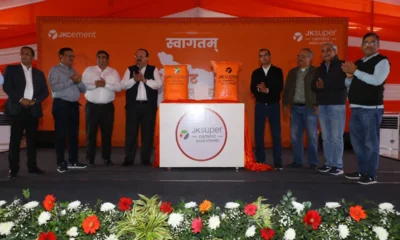
The mines department had signed 17 MoUs, with a proposed investment worth Rs 45,532 crore, during the Resurgent Rajasthan summit in November 2015. However, till April 2017, only Rs 4,395.27 crore (or 9.65 per cent) investment had materialised. The government had hailed the summit for bringing in much needed private investment. Industry players, however, said that hurdles remain, especially land acquisition, as stringent rules under the Land Acquisition Act 2013 make it a tough proposition. Among the big-ticket investors were Ambuja Cement, Jindal Saw, Reliance Cement, Steel Authority of India Ltd, Rashtriya Ispat Nigam Ltd and Ultratech Cement. Now, many of the proposals have been put on hold or entirely dropped because of delay in land acquisition, as land is either charagah (pasture) or forest land.
Arihant to invest Rs 4k cr on housing projects
Real estate firm Arihant Superstructures will invest about Rs 4,000 crore over the next six years on construction of its 15 ongoing projects in Navi Mumbai and Jodhpur, a top company official said. The Mumbai-based developer has completed around 2.5 million sq ft area across nine projects.
‘We are currently developing 15 projects in Navi Mumbai and Jodhpur comprising 12.9 million sq ft area,’ the company’s Chairman and Managing Director Ashok Chhajer told. The company is developing around 12,000 units in these projects. ‘We focus on affordable housing. Out of our total portfolio, 66 per cent is low-cost homes in a price range of Rs 20-50 lakh,’ he said.
Asked about investment in the ongoing projects, Chhajer said the land cost is already paid while Rs 4,000 crore would be required to complete construction of these 15 projects. The construction cost would be funded through internal accruals, bank loans and advances from customers. Arihant is expecting Rs 6,000 crore revenues from these 15 projects over the next six years. Out of 15 projects, around 10 are in Navi Mumbai and rest in Jodhpur.
Chhajer said the company is concentrating on project execution and delivered about 1,100 flats covering 1 million sq ft area during last fiscal. This year, the company is targeting delivery of 1.5 million sq ft. On sales bookings, he said they have improved and the company sold 580 units worth about Rs 200 crore in the first half of this fiscal. Arihant is also looking to develop more projects in Navi Mumbai and Mumbai metropolitan region. The company achieved a turnover of Rs 186 crore last fiscal and is expecting about 25 per cent growth in 2017-18.
JDA to allot 1,396 affordable houses in Nov
The Jaipur Development Authority (JDA) is all set to allot 1,396 houses for economic weaker section (EWS), lower income group (LIG) and middle income group (MIG) categories in November. The houses have been constructed by private developers under Mukhyamantri Awas Yojna and will be allotted on affordable housing rates fixed by the state government. Maximum number of houses have been developed in zone-14. Rest of the houses are in zones 7, 9, 10, 11 and 12.
‘In the financial year 2017-2018, JDA’s target was to construct 20,000 houses for EWS and LIG sections. The civic body, so far, has issued lease deeds to 12,790 house owners falling under these categories,’ a JDA official said. In two-and-a-half years, JDA has issued 35,300 lease deeds. Out of them, 11,000 EWS and LIG houses were developed in JDA schemes. While the remaining houses were earmarked in private colonies.
The Urban Development and Housing (UDH) department has proposed several amendments in the affordable housing policy to motivate developers to construct houses for EWS and LIG on both private and government land. To achieve the target of constructing 10 lakh houses till 2018 under the Housing For All scheme, the state government will now focus on providing free land for affordable housing projects on PPP mode.
Vedanta plans Rs 10k cr investment in Jharkhand
Vedanta Resources Chief Anil Agarwal has lined up a Rs 10,000 crore investment plan for Jharkhand. This includes an iron ore mining project and an integrated steel plant. Agarwal, who hails from the region, said the project will mark his entry into steel. It will also complete Vedanta’s metals portfolio that includes aluminium, zinc, copper and lead.
‘We will invest nearly Rs 10,000 crore in Jharkhand. The state has immense potential to develop and the Chief Minister, Raghubar Das, is leading the way,’ Agarwal told. Sharing his plans for the state, Agarwal said India, and Jharkhand in particular, is endowed with some of the best quality iron ore reserves. ‘We have to develop these resources with due forest and environment safeguards. This way we create jobs within the country instead of using up precious foreign exchange for imports of natural resources,’ he added.
‘We want to set up a bigger steel plant in Jharkhand but will start with an integrated plant of 1million tonne hot metal capacity at Manoharpur,’ Agarwal said. For this, a memorandum of understanding had been signed with the state government in May 2016. At the initial stages, investment on the projects is likely to be around Rs 2,500 crore, a company official said. Out of 437 acres required for the steel plant, some 110 acres have already been purchased. Also, the government is in the process of allotting 41 acres of land it owns.
Cement prices to rise following petcoke ban
Cement prices in northern states of India are expected to rise on the back of rising costs brought about by a ban on the use of petcoke in the Delhi NCR region from November 1, according to India Ratings and Research. Petcoke is a key raw material that goes into the making of cement.
‘Cement players in the northern region particularly from Rajasthan (where most of the clinker plants are situated) will have to use either domestic coal or imported coal from 1 November 2017. This will result in an increase in power and fuel cost per tonne per bag by Rs 8-10,’ Ind-Ra said in a release. Cement producers are likely to pass the hike in costs to the final consumer, leading to an increase in cement price.
According to Environmental Pollution (prevention and control) Authority’s clarification dated 27 October 2017, such ban will be applicable only in those districts of Uttar Pradesh, Haryana and Rajasthan which fall under NCR; however if the state governments fail to issue a similar notification, then the ban will automatically be applied to the whole state, impacting all cement manufacturers. Industries using pet coke and furnace oil will have to comply by the norms issued by Central Pollution Control Board latest by 31 December 2017.
Cement firm to recycle non-bio waste
In a novel attempt to clear space at Perambalur municipality’s (Tamil Nadu) dump yard, the civic body has started sending a portion of the segregated waste to a private cement firm in Ariyalur for use as fuel in the boilers. Reusable non-biodegradable waste collected from municipality limits would be packed and sent to the factory in order to make space in the dump yard and also prevent the waste from serving as breeding ground for mosquitoes.
According to the municipality officials, about two acres of the dump yard situated within city outskirts has been accommodating 30 tonnes of waste, including 20 tonnes of recyclable waste, generated by the city a day. The municipality, with 21 wards, has roped in a private cement manufacturing plant in Ariyalur to use the waste dumped in the yard for being used as a fuel for the boilers in the industry.
‘Ultratech would move the required waste such as clothes and leather sourced from the municipality’s dumpyard to their facility once a week. By doing so, we can free space in the yard which could be well used for making compost from the organic waste collected,’ R Murali, Commissioner, Perambalur Municipality, said.
A team to monitor ‘slow’ smart city projects
Criticism regarding slow progress of work in Smart Cities Mission projects has prompted the Union government to monitor them. A team of Union government officials will keep a watch on the projects and an official will visit the city soon to check the ground reality.
The Pune Smart City Development Corporation Limited (PSCDCL) and Pune Municipal Corporation (PMC) have been tasked with the responsibility of executing the projects. Altogether 14 projects were launched in the city in 2016 in presence of Prime Minister Narendra Modi. ‘The team will review projects that are being named as smart cities project. They will visit the sites where work under the mission are being carried out or are being proposed to be carried out. Reports will be published at regular intervals,’ said sources. They said that the team was expected to visit the city this month. Along with elected members of opposition parties, activists and citizens too had raised doubts over the projects under smart cities mission. Even leaders of ruling BJP had expressed displeasure over the delay in execution of the work. Two smart cities projects were launched in the city in October. Expressing disappointment over slow pace of work under the smart cities mission, guardian minister Girish Bapat had urged the civic body to expedite the projects. Sources said the pace of projects had slowed down and like metro rail, ring road and development plan projects, they had failed to maintain the momentum.
Aundh, Baner and Balewadi areas have been identified for projects under the Smart City Mission. Some pan-city initiatives have been planned to cover bigger areas. Pune was among the first few cities to have been selected under the mission.
BRO to issue fresh tenders for NS bridge
After wasting nearly eight years, the Border Roads Organisation (BRO) is now mulling to issue fresh tenders for the completion of reconstruction work of Nand Singh bridge (NS bridge) on Srinagar-Muzaffarabad Highway near Uri Town of North Kashmir’s Baramulla district.
A BRO official said with a total project cost of Rs 200.27 lakh, the tender was allotted to Lokpaul Fabrication Construction but non-compliance from the company has forced them to cancel their allotment and issue fresh tenders. ‘The company did not follow the design which was approved by the BRO,’ he said.
The locals of the area said a tussle between the construction company and the BRO has delayed the completion of the Bridge and alleged that Government was acting as a mute spectator even as people continue to face extreme hardships.
‘In last eight-nine years, we have only seen workers welding the iron slabs. It is shame on part of Government that it has failed to provide us a proper connecting link. It pays no heed to our problems,’ he said.
The locals said the bridge was declared unsafe for vehicular movement after it was damaged in year 2005 earthquake. They said after the bridge was damaged, several villages of Uri remained cut off for a while until BRO constructed a makeshift bridge at its place. ‘The makeshift structure got damaged, during the flash floods of 2014 and people are putting their lives at risk by using it,’ Mushtaq Ahmad, a local said, adding the construction company who was given the job to carry out the reconstruction work abandoned the work only after few months.
Mohali airport road foundation to be re-laid by Dec-end
The Greater Mohali Area Development Authority (Gmada) has dug up the airport road at four places to relay the foundation and make it motorable. Gmada Chief Administrator Ravi Bhagat said the repair work will be completed by December end before onset of winters enabling vehicular movement on the road. The work was expedited after Punjab chief minister Amarinder Singh constituted a technical committee headed by Lieutenant General (Retd.) BS Dhaliwal, chief engineer national highway PWD (B&R) AK Singla, chief engineer Gmada Sunil Kansal and principal scientist and head of flexible pavements division, Central Road Research Institute (CRRI) Manoj Kumar Shukla who recommended that the road must be dug up to relay the foundation instead of re-carpeting of it on surface.
Jammu smart city project to start by Dec
The work on Jammu smart city project is likely to start by December. Jammu Municipal Corporation Commissioner Ramesh Kumar said the first installment of Rs 200 crore of Rs 3,600 crore project is scheduled to be released next month by the Centre.
‘The ground work for Smart City project is in final stages and before December the first installment of Rs 200 crore will be released by Government of India,’ he told the Excelsior.
Jammu and Srinagar have been selected in the list of the Smart cities to be developed across the country and is one of the flagship programmes of the Modi Government. The project is aimed to give a better experience in the cities with host of measures and schemes. Ramesh, who had recently taken over the charge, though agrees to it’s challenging nature.
‘The smart City is to be created at the same site within a given and limited space. So managing thickly populated cluster, haphazardously raised and ill planned areas will be a tough task,’ he said. NC MLA and provincial president had criticised the Government for creating Smart city at the same place.