Connect with us

Economy & Market

India’s largest clear span building, delivered by Interarch

Published

on

Shares

For certain usage of a building, the design of a structure is extremely critical. In cement plants, one such utility is coal handling coupled with stacker and reclaimer. Here is an example of how PEBs can offer appropriate solutions.

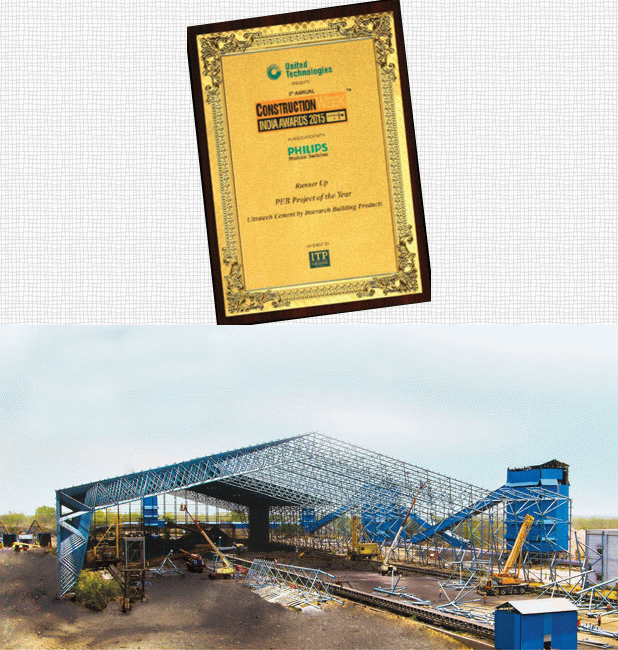
In 2015, Interarch designed & engineered, manufactured and delivered the largest clear span building in India for UltraTech Cement Ltd in Rawan. The building is spread over an area of 35,000 sq m. Interarch’s scope of work included design & engineering, fabrication, supply & logistics, and erection of four buildings in Rawan, Chhattisgarh. The four buildings required were clear-span buildings ranging from 62 m, 85 m, and 95 m to 99.8 m.

On the basis of customer needs and functional usage, Interarch’s expert design & engineering team proposed an open Web portal frame structure for the 99.8 m clear span building using CHS sections & other three buildings in built-up sections. The building was designed for the seismic zone 3 and IS 800:2007. The loading design has been applied on the structure in accordance with IS-875 (Part 1, 2 &3). The pipe structure, once completed, will be one of the biggest milestones in Interarch’s recent history. Once erected, the building will span 99.8 m wide & 353 m long, with a clear height of 24 m at the peak.

Interarch certified builders and employees had to work under very stringent quality & safety conditions in line with international standards to achieve many challenges at the site. The erection of the 99.8 m clear span building was done near three operating conveyer belts surrounded by heaps of coal, dust in the environment and lack of space to erect the building, which caused lot of difficulty to the erection team. The Interarch team had to construct a crossover bridge and constantly spray water to keep the dust settled. All workers wore face masks and safety goggles to tackle the dust.

Interarch deployed almost 15-20 dedicated safety and quality engineers at the site to ensure the highest standards of safety and quality controlled execution. The total time taken for erection of the building was six months.

Project Key Features: Recipient of "Best PEB Project of the Year" by Construction Week India Awards 2015 for UltraTech Cement Ltd.

Project Feature
?$HS Bracing
??0 m bay spacing along the length of the building
??oof slope 1in 4
??uilding design as per IS 800-2007
??pecial tripod CHS portal frame
??re Galvanised purlin & girts
??hot blasted structure finished with epoxy paint
??ust load 0.5 KN/M2 on roof
??oof – 0.47 m Tracdek Hi-Rib bare Galvalume (550 Mpa)
??all – 0.50 M Tracdek Hi-Rib color coated Galvalume (550 Mpa)

Action against RMC plants
In the month of March 2016, 32 ready-mix-concrete (RMC) plants in the city of Mumbai were asked to shut down because of pollution caused in their operations, by the Maharashtra Pollution Control Board (MPCB). There were number of complaints filed against RMC operators regarding dust and noise pollution. A non-governmental organisation (NGO) – Watchdog Foundation – had taken up the cause for local residents.

ICR spoke to G Pimenta of ‘Watchdog.’
Kindly introduce your organisation ‘Watchdog’ to the readers.
We wish to introduce ourselves as a part of a non-governmental organisation i.e., Watchdog Foundation, which has launched a website www.thewatchdog.in that provides a networking platform for ordinary citizens to engage with governmental organisations, as we believe that citizen’s viewpoints are necessary for all-round holistic and workable solutions for social and civic problems.

Can you please provide us details of the complaints lodged by ‘Watchdog’ regarding dust pollution?
We have filed a number of complaints against RMC Plant Operators, as and when such complaints were reported to us by the locals. The said complaints were received from Malvani (3 plants), Kurla (2 plants) and Dahisar (2 plants).

How do the regulations regarding running of RMC plants in our city differ function?
We are not against running of RMC plants which adhere to the law of the land. Under RTI we have ferreted out information in as many as 33 cases, which shows that these RMC plants are not compliant with environmental norms and have openly flouted Consent to Operate granted by MPCB.

In your opinion, why do RMC producers not comply with the regulations?
The issue is twin-fold. Firstly it is profit motive and the higher capital costs involved in clean technologies and there being no incentives from the government to use and promote environment friendly green technology.

Do you feel that shutting down of a running RMC plant is the only answer to the problems?
Shutting down any industry is no good answer, but at the same time adherence to law is also equally important and many a times it is found that these RMC plants do comply with the stipulations stated in Consent to Operate.

For more information,
please contact: info@interarchbuildings.com
or visit www.interarchbuildings.com

Project Name

UltraTech Cement Limited (Unit – Rawan Cement Works)

Project Location Rawan, Chhattisgarh
Building Usage Coal Stacker & Re-claimer Covering Shed
Tonnage 2115 mt
Length 353 m
Width 99.8 m Clear Span
Height 14 m height at eave and 24 m at ridge
Area of Project 35,000 sq m

Continue Reading
Click to comment

Leave a Reply

Your email address will not be published. Required fields are marked *

Concrete

Cement Makers Reaffirm Commitment to Sustainable Growth

Published

on

By

Shares

World Environment Day spotlight on innovation and circularity

On World Environment Day, the Indian cement industry reiterated its commitment to supporting India’s climate ambitions through sustainable manufacturing, resource efficiency and the adoption of cleaner technologies.

The Cement Manufacturers’ Association (CMA) said the sector remains aligned with the Government of India’s Net Zero commitments and is accelerating efforts to reduce its environmental footprint while supporting the country’s infrastructure and development agenda.

Parth Jindal, President, CMA and Managing Director, JSW Cement, said the industry is increasingly adopting cleaner technologies, improving energy efficiency and expanding the use of alternative fuels and raw materials. He also highlighted the growing importance of circular economy practices, where industrial by-products and waste streams from one sector are utilised as resources in another.

“The Indian Cement Industry is aligned to the Government’s commitments on carbon mitigation and is accelerating the adoption of cleaner technologies, resource efficiency and circular economy practices while actively exploring the potential of Carbon Capture, Utilisation and Storage (CCUS) as a critical pathway for deep decarbonisation,” said Jindal.

He added that coprocessing industrial waste and by-products helps conserve natural resources, reduce disposal requirements and lower the environmental footprint across multiple sectors.

According to Jindal, sustainability is no longer limited to manufacturing processes but is increasingly influencing investment decisions, innovation strategies and long-term growth plans within the industry.

Echoing similar views, Dr Raghavpat Singhania, Vice President, CMA and Managing Director, JK Cement, said sustainable development extends beyond emissions reduction and must also focus on responsible resource utilisation and waste minimisation.

“Sustainability in the built environment cannot be measured by emissions alone. It is equally about how efficiently we use resources, how effectively we minimise waste and how responsibly we create the infrastructure that will serve future generations,” said Singhania.

He noted that the cement industry is advancing its sustainability agenda through greater resource efficiency, increased circularity, technological innovation and continuous improvements in manufacturing practices. As a key contributor to India’s infrastructure development, the sector has a critical role to play in balancing economic growth with environmental responsibility.

On the occasion of World Environment Day, industry leaders reaffirmed their commitment to supporting India’s climate goals while delivering the materials required for resilient, durable and sustainable infrastructure.


Continue Reading

Concrete

Building a Greener Future Together

Published

on

By

Shares

Environmental sustainability requires immediate action, not just long-term commitments and discussions. Recycling, circular economy practices, and technology-driven waste management can help industries reduce environmental impact while supporting sustainable growth.

Author: Jignesh Kundaria, Director and CEO, Fornnax Technology

World Environment Day serves as an important reminder that environmental sustainability can no longer remain confined to discussions, reports, or long-term commitments. The environmental challenges facing the world today demand immediate, measurable, and collective action. Across industries and communities, waste generation continues to outpace our ability to process it responsibly, placing increasing pressure on ecosystems, natural resources, public health, and the well-being of future generations.

One of the most significant shifts required today is a change in how society perceives waste. Rather than being viewed as a material to be discarded, waste must be recognised as a valuable resource that can contribute to both economic growth and environmental protection when managed through the right technologies and systems. This mindset forms the foundation of the circular economy model that countries across the world are increasingly adopting to reduce landfill dependence, recover valuable materials, and create more sustainable industrial ecosystems.

India has made meaningful progress in strengthening awareness around sustainability, recycling, and environmental responsibility over the past decade. Significant efforts are being made to formalise the recycling sector through improved infrastructure, technology adoption, policy implementation, and broader stakeholder participation. These developments are creating a stronger foundation for responsible waste management and resource recovery across the country.

However, achieving long-term environmental impact requires collaboration from all stakeholders. Industries, policymakers, technology providers, and communities must work together with greater accountability to strengthen recycling ecosystems, encourage responsible waste management practices, and create sustainable outcomes through consistent execution rather than temporary interventions.

As someone closely associated with the recycling industry, I firmly believe that technology will play a decisive role in addressing future environmental challenges. Advanced recycling systems have the potential to recover valuable resources, reduce pollution, minimise landfill burdens, and conserve energy, creating a more sustainable future for generations to come. This belief is deeply reflected in Fornnax’s motto, “Committed to Create a Green Future,” which embodies our commitment to building long-term environmental value through innovation and responsible action.

At the same time, technology alone cannot deliver meaningful change. Real progress requires intent, awareness, participation, and a shared sense of responsibility. Sustainable development can only be achieved when innovation is supported by collective action and a genuine commitment to environmental stewardship.

On this World Environment Day, let us move beyond conversations and take meaningful steps towards creating a cleaner, greener, and more sustainable planet. By embracing innovation, strengthening recycling ecosystems, and acting responsibly today, we can create lasting environmental impact and secure a better future for generations to come.

Continue Reading

Concrete

Dalmia Bharat Acquires Jaiprakash Associates Cement Assets for ₹2,850 Crore

Published

on

By

Shares

Dalmia Cement executed a Business Transfer Agreement with Jaiprakash Associates and Adani Infra, to acquire 5.2 MnTPA of cement capacity across Madhya Pradesh and Uttar Pradesh.

Dalmia Cement (Bharat) announced on May 22, 2026 that it had signed a Business Transfer Agreement with Jaiprakash Associates Limited and Adani Infra (India) Limited for the acquisition of cement plants located at Rewa in Madhya Pradesh and Churk, Chunar and Sadwa in Uttar Pradesh. The deal was struck at an enterprise value of ₹2,850 crore and is expected to close within two weeks of execution.

The acquired assets from Jaiprakash Associates include 5.2 MnTPA of cement capacity and 3.3 MnTPA of clinker capacity. The package also covers 99 MW of thermal power capacity and railway sidings at Rewa, Chunar, and a common siding at Churk. This infrastructure gives the acquisition immediate operational utility beyond just production tonnage.

The transaction has a long backstory. Dalmia Cement had originally entered into a framework agreement with Jaiprakash Associates in December 2022, covering the sale of these business assets along with a long-term clinker supply arrangement. However, before the deal could be completed, Jaiprakash Associates was admitted to insolvency proceedings under the Insolvency and Bankruptcy Code. The earlier agreements could not be consummated as a result.

In an official statement, Puneet Dalmia, Managing Director & CEO, Dalmia Bharat, said, “I am very excited about addition of these assets in our portfolio. This serves as a great strategic fit for Dalmia. It helps us move forward in our journey to be a pan India player and provide a strong head start to serve the high potential markets in Central region. I am optimistic that the expansion potential of these assets along with close proximity with Dalmia’s captive mines will help us create a capacity hub for the future”.

Following the approval of Adani Group’s resolution plan for Jaiprakash Associates under the IBC framework, Dalmia approached the new management to revive discussions. The fresh Business Transfer Agreement was executed to settle all pending disputes, legal proceedings, and arbitration matters arising from the original framework agreement with Jaiprakash Associates.

Expanding market reach

Dalmia added, “Our familiarity with these assets under the earlier tolling arrangement gives us a deep understanding of the facilities and helps us establish strong connect with channel partners and vendors. We believe that this will help us in faster ramp up of capacities and quicker inroads into the market. As we look forward, I am very confident that we will be able to leverage the strengths of Dalmia to operate these assets in a manner where we can maximise value creation for all our stakeholders.”

With the addition of these plants, Dalmia Bharat’s total installed cement capacity will rise to 54.7 MnTPA upon consummation. The company has further expansion projects underway at Belgaum, Pune, and Kadapa, which are expected to take overall capacity to 66.7 MnTPA by Q2 to Q3 FY28.

The Central India location of the Jaiprakash Associates plants gives Dalmia Bharat faster access to markets in Madhya Pradesh and Uttar Pradesh than a greenfield build would have allowed. The company also cited debottlenecking and brownfield expansion as near-term opportunities at the acquired sites. Dalmia Bharat said the assets were expected to contribute positively to EBITDA and overall returns, given the pricing environment in the region and the company’s cost structure.

Continue Reading

Video Thumbnail

    SIGN-UP FOR OUR GENERAL NEWSLETTER


    Trending News

    SUBSCRIBE TO THE NEWSLETTER


    Don't miss out on valuable insights and opportunities to connect with like minded professionals.


      This will close in 0 seconds