Technology
Innovative cement delivery with combilift & mini silos

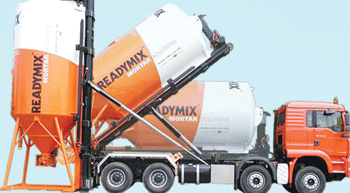
The combilift and mini silos from Meher Velsycon is a new-age solution that saves cost, improves efficiency and averts pollution to contribute towards ?Clean India? drive, writes Anil Tandon.
Converting bags to bulk is a win-win for all stake holders. Meher Velsycon, Mumbai has introduced a new Combilift & Mini Silo system, which helps cement companies as much as it increases efficiency for builders and logistics service providers.
Several big users of cement are already using silos and get cement and fly ash in bulkers. But there are many others who do not have silos. And hence are not able to take advantages of loose bulk. This new solution consists of a truck with combilift, making deliveries to various client sites in 16-20 tonne mini silos. The truck leaves the cement filled silo at construction site and comes back to pick up empty silo, only when the customer has used the cement.
At construction site, the user does not require any infrastructure at all. No silos, no compressors, no godowns, nothing at all.
With labour and space becoming an ever-increasing challenge, mechanisation and optimum usage of space is the only way to complete projects in time. Mini silo is a major solution to help overcome these challenges and a cost-effective alternative in the current work practices. Vertical storage in mini silos and that too movable to the place of consumption of cement are a big plus.
Cement industry in India is largely dominated by bag market with the cement mostly available in 50 kg bag unit. But since last few years, when infrastructure projects started picking up, there was a real need to complete the projects as fast as possible. This demanded efficiency at work site and more work to be done on a daily basis. Cement was demanded in loose bulk, in bulkers. It was practically not possible to handle so many bags each day and hence cement bulkers was a solution.
But in the last 10 years, out of 100 per cent of cement bag market, only 15-20 per cent got converted into bulk. The remaining 80 per cent is still in bags. With this new system, hopefully, another 20-25 per cent will get converted to loose bulk as the benefits are many.
Cement companies need not invest in new packers as more and more cement can be despatched in loose bulk. Construction companies would prefer this system, as after pouring concrete with RMC, the secondary work can now be sped up. A lot of downstream mechanisation is possible with mini silos. One can connect pumps, plastering machines, and mixers etc to mini silo outlets and can convey materials to higher floors as well.
New solution savings
The customers today don?t want to invest a huge amount in erecting silos and install accessory equipment like compressor, as the project demand does not justify such an infrastructure. Combilift and mini silos have addressed this problem effectively and economically. The mini silo can be used to transport cement in bulk that involves zero cost on bags, labour charge, and storage. This also saves from contamination, theft, etc. In this system, the end-user, the client of the cement company, does not have to pay anything since there is no need of silo, power, labour, godown and machine. Cement company or its transporter will come with the truck with the loaded silo to project site, and the driver by himself will unload and erect the silo as the truck is capable to do this. Neither founda?tion, nor special flooring is required, just well compacted soil is fine.
After the erection of the silo, the driver will go back with the truck. The silo will remain at the site till the cement is completely used. The cement inside the silo can be accessed through a butterfly valve, which can open and the cement will flow down with gravitational force. Once the cement is consumed, the cement company will send a new truck with filled silo which comes, erects the new filled silo and take back the empty silo.
The silo comes in various capacities of 5 tonne to 30 tonne. It?s a win-win for all stake holders
Benefit to cement companies
Each truck fitted with Combilift can save more than 3,00,000 bags per year. Three lakh bags not be be bought, not to be filled, not to be handled, with just one Combilift and few silos.
It provides quick despatches from plants and grinding units, and better capacity utilisation. The whole process is environment-friendly and very safe. Cement companies will have great advantage as their carbon footprint will improve because of the power saving by not using bagging machine. Another advantage is that there is no pollution and a good working environment for people, which is a corporate social responsibility. There will be no spillages and no wastage. The plant will become less accident prone because of less people, less machine, etc are involved. All these are big benefits to cement companies.
Benefit to transporter
The transporter is the second element of this logistics chain. With one truck, he can handle many mini silos. Thus his output per truck goes up. He does not have to wait at loading/unloading points, so his number of trips goes up. Now even in the night, or very early morning, the truck can deliver and erect the silo. In such a delivery system, the transporter can employ 2-3 drivers a day on 8 hour duty round-the-clock, because he has to only go, leave the filled silo, pick the empty silo and come back. So, at the end of the month, the revenue generated per vehicle goes up tremendously, which is the bottom line for him.
Benefit to construction company
The construction company doesn?t have to invest either in godowns or in machines, bag opening, labour, etc. They only have to give a place for the silo, and their savings are huge. Normally, cement bags are stored in the godown and moved to the point of consumption either by people or by elevators or cranes etc. From mini silos, one can directly pump it to 30-40 floors. and even higher floors by pumping again. First-in-first-out will now bring better quality in construction. Usually, we order more bags of cement when the earlier is about to be finished. So, once the new lot comes in, the bags down below do not get used and overtime will become non-usable. This is wastage and also decreases the quality of construction. This is completely eliminated by the new system.
Add-ons
The mini silo can be connected to a wide range of ancillary equipment. To facilitate heavy-duty cement pumping for the construction of high-rise buildings, Meher Velsycon supplies a pump fitted with a battery and diesel genset. On-site mixers together with plastering spray guns and other machinery is also available.
Efficiency and faster completion
This is a significant advantage. With this mechanisation, the buildings can be completed earlier than planned, and the construction projects can be completed ahead of time. This is a big saving of Interest on Capital cost. A project of Rs 50-100 crore when completed earlier, by a month, can bring in great savings. Bigger project will have much bigger savings.
Total cost advantage
When a cement company does not have to buy a bag costing Rs 10-12, it doesn?t have to fill and load at a cost of Rs 5-6 per bag, and unloading at site Rs 5-6 per bag.
So the overall cost saving for the whole chain is Rs 20-25 per bag which is huge. Further savings of no godown at site, wastage of 2-3 per cent, are extra and would vary from site to site. Pollution free and environment friendliness are added advantages.
Flexibility and multi-function
During monsoon and low season period, when construction sites are not working as fast requirement of these silos can be less. During these occasions, the cement company or the transporter will have the truck available to use. With some minimal changes, the truck with Combilift can do bag deliveries during this period. Bags can be palletised or just put inside a container or body.
Way ahead
Availability of labour and space is a major challenge. We are sitting on an upcoming construction boom and mechanisation is the only way forward. In this scenario, the Combilift & Mini Silos from Meher Velsycon is going to be a new revolution in the market.
Mini silos at Ambuja Cement
Ambuja Cement has recently bought 20 silos from Meher Trailers, in which 10 units are deployed in Mumbai and 10 in Kolkata for service.
| Operating cost comparison: Bags vs Mini Silos | ||||||
|---|---|---|---|---|---|---|
| With 50 kg bags | With mini silos | |||||
| Particulars | Unit of measurement | Amount Rs | Rs/tonne/km | Unit of measurement | Amount Rs | Rs/tonne/km |
| Pay load | 20 | 16 T | ||||
| No of trips/day | 1 | 2.5 | ||||
| Load/day | 20 | 40T | ||||
| No of working days/month | 28 | 28 | ||||
| Tonnage load/month | 560 tonne | 1,120 tonne | ||||
| Lead distance (40 x2) | 80 km | 80 km | ||||
| Fuel mileage | 3.5/km/litre | 3.5/km/litre | ||||
| Fuel required | 640 litre | 1600 litre | ||||
| Fuel cost | 640 litre x Rs 52 | 33,280 | 1,600 litre x Rs 52 | 83,200 | ||
| Tyre cost | 3,718 | 9,296 | ||||
| Cost of maintenance | 15,000 | 25,000 | ||||
| Crew cost | 22,000 | 45,000 | ||||
| Cost (A) | 73,998 | 1.65 | 1,62,496 | 1.8 | ||
| Additional costs for bagged deliveries: | ||||||
| Bag cost | 12x20x560 | 1,34,400 | 0 | |||
| Bagging/loading cost | 2x20x560 | 22,400 |
Continue Reading
 Jignesh Kundaria, Director and CEO, Fornnax Technology India is simultaneously grappling with two crises: a mounting waste emergency and an urgent need to decarbonise its most carbon-intensive industries. The cement sector, the second-largest in the world and the backbone of the nation’s infrastructure ambitions, sits at the centre of both. It consumes enormous quantities of fossil fuel, and it has the technical capacity to consume something else entirely: the waste our cities cannot get rid of. According to CPCB and NITI Aayog projections, India generates approximately 62.4 million tonnes of municipal solid waste annually, with that figure expected to reach 165 million tonnes by 2030. Much of this waste is energy-rich and non-recyclable. At the same time, cement kilns operate at material temperatures of approximately 1,450 degrees Celsius, with gas temperatures reaching 2,000 degrees. This high-temperature environment is ideal for co-processing, ensuring the complete thermal destruction of organic compounds without generating toxic residues. The physics are in our favour. The infrastructure is not. Pre-processing is not the support act for co-processing. It is the main event. Get the particle size wrong, get the moisture wrong, get the calorific value wrong and your kiln thermal stability will suffer the consequences. The Regulatory Push Is Real The Solid Waste Management (SWM) Rules 2026 mandate that cement plants progressively replace solid fossil fuels with Refuse-Derived Fuel (RDF), starting at a 5 per cent baseline and scaling to 15 per cent within six years. NITI Aayog’s 2026 Roadmap for Cement Sector Decarbonisation targets 20 to 25 per cent Thermal Substitution Rate (TSR) by 2030. Beyond compliance, every tonne of coal replaced by RDF generates measurable carbon reductions which is monetisable under India’s emerging Carbon Credit Trading Scheme (CCTS). TSR is no longer a sustainability metric. It is a financial lever. Yet our own field assessments across multiple Indian cement plants reveal a sobering reality: the primary barrier to scaling AFR adoption is not waste availability. It is the fragmented and under-engineered pre-processing ecosystem that sits between the waste and the kiln. Why Indian Waste Is a Different Engineering Problem Indian municipal solid waste is not the material that imported shredding equipment was designed for. Our waste streams frequently exceed 40 per cent to 50 per cent moisture content, particularly during monsoon cycles, saturated with abrasive inerts including sand, glass, and stone. Plants relying on imported OEM equipment face months of downtime awaiting proprietary spare parts. Machines built for segregated, low-moisture waste fail quickly and disrupt the entire pre-processing operation in Indian conditions. The two most common failures we observe are what I call the biting teeth problem and the chewing teeth problem. Plants relying solely on a primary shredder reduce bulk waste to large fractions, but the output remains too coarse for stable kiln combustion. Others attempt to use a secondary shredder as a standalone unit without a primary stage to pre-size the feed, leading to catastrophic mechanical failure. When both stages are present but mismatched in throughput capacity, the system becomes a bottleneck. Achieving the 40 to 70 tonnes per hour required for meaningful coal displacement demands a precisely coordinated two-stage process. Engineering a Made-in-India Answer At Fornnax, our response to these challenges is grounded in one principle: Indian waste demands Indian engineering. Our systems are built around feedstock homogeneity, the holy grail of kiln stability. Consistent particle size and predictable calorific value are the foundation of stable kiln combustion. Without them, no TSR target is achievable at scale. Our SR-MAX2500 Dual Shaft Primary Shredder (Hydraulic Drive) processes raw, baled, or loosely mixed MSW, C&I waste, bulky waste, and plastics, reducing them to approximately 150 mm fractions at throughputs of up to 40 tonnes per hour. The R-MAX 3300 Single Shaft Secondary Shredder (Hydraulic Drive), introduced in 2025, takes that primary output and produces RDF fractions in the 30 to 80 mm range at up to 30 tonnes per hour, specifically optimised for consistent kiln feeding. We have also introduced electric drive configurations under the SR-100 HD series, with capacities between 5 and 40 tonnes per hour, already operational at a leading Indian waste-processing facility. Looking ahead, Fornnax is expanding its portfolio with the upcoming SR-MAX3600 Hydraulic Drive primary shredder at up to 70 tonnes per hour and the R-MAX2100 Hydraulic drive secondary shredder at up to 20 tonnes per hour, designed specifically for the large-scale throughput that higher TSR ambitions require. The Investment Case Is Now The 2070 Net-Zero target is not a distant goal for India’s cement sector. It starts today, with decisions being made on the plant floor. The SWM Rules 2026 are already in effect, requiring cement plants to replace coal with RDF. Carbon credit markets are opening up, and coal prices are not going to get cheaper. Every tonne of coal a cement plant replaces with waste-derived fuel saves money on one side and generates carbon credit revenue on the other. Pre-processing infrastructure is no longer just a compliance requirement. It is a business investment with a measurable return. The good news is that nothing is missing. The technology works. The waste is available in every Indian city. The government has provided the policy direction. The only thing standing between where the industry is today and where it needs to be is the commitment to build the right infrastructure. The cement companies that move now will not just meet the regulations. They will be ahead of every competitor that waits. About The Author  Jignesh Kundaria is the Director and CEO of Fornnax Technology. Over an experience spanning more than two decades in the recycling industry, he has established himself as one of India’s foremost voices on waste-to-fuel technology and alternative fuel infrastructure. 
▶

Concrete20 hours ago
UltraTech Cement Expands in Andhra Pradesh with Rs. 26.5 bn
Concrete20 hours ago
Nuvoco reports 13.5% revenue growth in Q2 FY27
Concrete5 days ago
Meghalaya Cabinet Approves MCCL Closure, Writes Off Rs. 244.3 mn
Concrete5 days ago
Fornnax Wins AIRIA’s Special Export Award for Rubber Machinery in 2025-26
Concrete1 week ago
Cement Prices Likely to Rise Rs. 10-15 per Bag from Mid-October
Concrete20 hours ago
UltraTech Cement Expands in Andhra Pradesh with Rs. 26.5 bn
Concrete20 hours ago
Nuvoco reports 13.5% revenue growth in Q2 FY27
Concrete5 days ago
Meghalaya Cabinet Approves MCCL Closure, Writes Off Rs. 244.3 mn
Concrete5 days ago
Fornnax Wins AIRIA’s Special Export Award for Rubber Machinery in 2025-26
Concrete1 week ago
Cement Prices Likely to Rise Rs. 10-15 per Bag from Mid-October
SUBSCRIBE TO THE NEWSLETTER
Don't miss out on valuable insights and opportunities to connect with like minded professionals.
This will close in 0 seconds | |||