Though Blaine analysis is a time tested method of measuring fineness of cement. Today Laser Diffraction technology scores over it mainly due to more accurate and real time measurement. Dr. Michael Caves, India ? Business Development Manager of Malvern AIMIL explains the advantages of laser based particle size analysers.
The final steps in cement manufacturing involve grinding (milling) and blending in order to produce the fine powder that is recognizable as cement. Every step in the manufacture of cement is checked by frequent physical tests, as is finished product, to ensure that it complies with all necessary specifications. Cement is ground to a particular fineness since the influence of particle size on the kinetics of cement hydration and development of strength is well known. A reduction in median particle size generally produces a higher compressive strength. Consequently the fineness of Portland cements has been increased over the years to improve properties such as higher early strengths. Nevertheless, other effects of increased fineness, such as higher water demands and more rapid heat generation in the concrete cannot be ignored. Despite the availability of instrumental methods of measuring particle size distributions, the classical method of air permeametry remains.
Understanding Blaine
Many plants control cement fineness using an air permeability apparatus to measure the Blaine number, a parameter related to the cement particle size. The Blaine surface area measurement has been used since the 1940s to determine cement quality and despite its longevity the limitations of this off-line technique are widely recognized. It is slow and suffers from poor reproducibility, which can lead to significant errors, including unnecessary or inaccurate changes to the classifier speed. Blaine analysis measures the specific surface area of a sample, the surface area per unit mass. Finer particle sizes have higher specific surface area: more area per unit mass, so Blaine is an indirect measure of particle size.
But, Blaine delivers just a single averaged figure. Figure 1 shows analysis of 2 cement samples using a Malvern Mastersizer Laser Diffraction system. Sample 2 contains more fines than sample 1 but also more coarse material. These two differences cancel each other out so average specific surface area remains the same, illustrating why two quite different samples can have the same Blaine. The more important question is ?do we need to know about the difference indicated by the particle size distribution??
Size Distribution Measurements
However two cement samples with identical Blaine figures can show different particle size distributions when measured by laser diffraction. Should we classify these two cements as different or the same?
For answers, we need to look at how the data are used. Cement manufacturers measure Blaine to quantify product quality. The hydration speed of cement particles is a function of particle size and determines the strength of the set cement. Generally, finer particles hydrate more quickly, giving greater strength, and within certain limits finer cement is better cement.
Returning to our samples, these materials will behave differently when used. Very fine cement particles, in the 2 – 3 micron range can cause exothermic cracking. Conversely particles over 50 microns may not hydrate, compromising product strength. Sample 1 contains less of both types of particles and consequently is a superior cement, even though Blaine ranks it the same as sample 2. So, the size distribution data are most certainly relevant.
Switching to laser diffraction
The practicalities of switching to laser diffraction are equally compelling. Laser diffraction, however, is fast and automated. In the lab this means greater productivity and better reproducibility. For processing it means on-line instrumentation and real-time measurement.
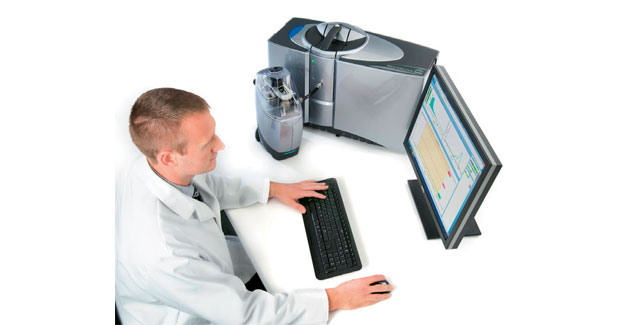
Malvern Mastersizer 3000 (Figure 2), which has a measurement range of 0.01 to 3500 microns, is an essential component of a high-quality cement laboratory. Finished products, as well as replacement material such as fly ash and blast furnace slag and fuels, have varying size distributions and so behavioral understanding and prediction requires Mastersizer analysis.
A vital element in successful laser diffraction particle size analysis is ensuring that samples are dispersed properly. In cement manufacture it is the primary particle size of a sample that is most usually the parameter of interest, rather than the size of any agglomerated material present. When using laser diffraction, samples can be dispersed and measured wet in the form of a suspension, or as dry powders. Dry dispersion, using dry compressed air, has a number of advantages, not least its obvious suitability for water sensitive material such as cement. It also avoids the need for solvent based dispersants and is rapid, thus increasing instrument productivity. The dry dispersion accessory, Aero S, available with Mastersizer 3000 has modular dispersion nozzles with different impaction surfaces. Keeping in mind that flow of abrasive material like cement for a prolonged period of time can cause damage to metal surfaces, there are options available for ceramic coated flow paths. It is worth highlighting the value of considering an analyzer that can switch easily between different samples with a minimum of fuss. Being able to change between different types of samples without fear of cross contamination, or to move simply or quickly from dry to wet measurement (or vice versa) as required, can make a real difference to analytical productivity, helping to maximize the return of investment in the system.
Finally, another important reason to switch to laser diffraction is the possibilities the technique offers for on-line analysis. Insitec systems deliver fully automated real-time analysis of cement particle size distribution from 0.1 to 2500 microns and can be configured to suit practically every process.
Conclusion
Whilst traditional Blaine measurements have served the cement industry well since the development of the Blaine method in the 1940s, the efficiency and quality of production of modern cements can be improved greatly by using Laser Diffraction technology. Efficient data acquisition, adaptable methods, and information-rich data explain the increasing use of the Malvern Mastersizer 3000 and Insitec range of systems in cement production around the world.
For more details, pls contact: Malvern Aimil Instruments Pvt. Ltd. Tel : 011-30810244 Fax : 011-26950011, Email : delhi@aimil.com











 Concrete1 month ago
 Concrete3 weeks ago
 Concrete2 weeks ago
 Concrete1 month ago