Connect with us

Concrete

CemHack for Green Infra Hackathon

Published

on

Shares

Organised by the National Council for Cement and Building Materials-Incubation Centre (NCB-IC), the CemHack for Green Infra hackathon was a first-of-its-kind event for the cement and construction sector.

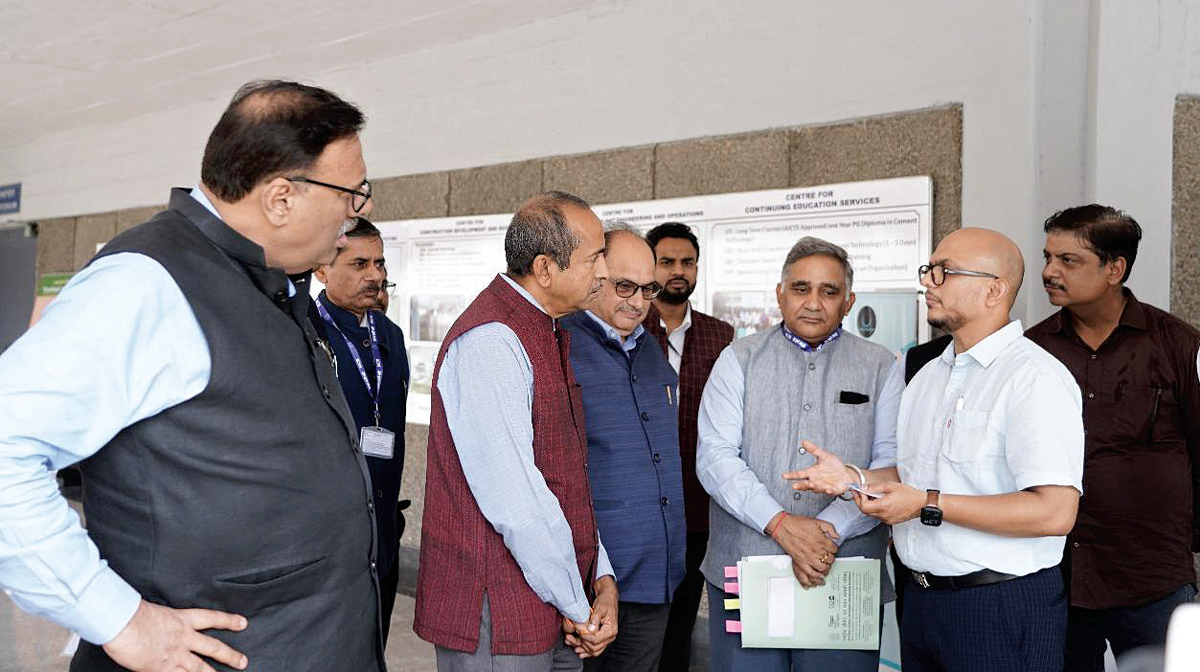
A national-level hackathon called the ‘CemHack for Green Infra’ was launched to encourage innovation and ideation in the construction and cement industries. This unique initiative was inaugurated by Sanjiv, Joint Secretary, DPIIT, Ministry of Commerce and Industry, Government of India, in presence of Professor KK Pant, Director, Indian Institute of Technology, Roorkee; Neeraj Akhoury, Chairman-NCB & MD-Shree Cement; and Dr LP Singh, Director General-National Council for Cement and Building Materials (NCB). The event took place on 20th May 2025 at NCB Ballabgarh, and was attended by research scholars, students, industry experts and NCB scientists and engineers.
Sanjiv, JS-DPIIT, complimented NCB Incubation Centre in organising the hackathon for cement and construction sector on the first anniversary of its establishment. He desired that the reputed institutes and colleges like IITs, NITs, technical universities and regional institutes, should be encouraged for maximum participation in this hackathon. He hoped to see success stories from startups incubated at NCB.
Professor Pant supported NCB’s effort in organising this hackathon as it brought a unique opportunity for students, research scholars and researchers. The participants got the opportunity to showcase their innovative ideas and get support from the industry. He informed that IIT Roorkee is collaborating with NCB on plasma-based electrification and carbon capture and utilisation (CCU) in the cement sector.
In his speech, Akhoury emphasised that the Indian cement industry is at the forefront of adopting newer technologies and innovation. In the light of the MoU between Shree Cement signed MoU and StartUp India, which was signed last year, the company will continue to extend its support to NCB in organising this event and supporting the winners of the hackathon.
While speaking at the event Dr Singh stated that the purpose of organising hackathon to promote innovation in cement and construction sector. He also highlighted the endeavours of NCB towards Net Zero in cement industry including award of project grant to a consortium of NCB-IIT Roorkee-J K Cement, by Department of Science & Technology, Government of India on establishing CCU test beds in cement sector. He also showcased the outline to establish Centre of Excellence at NCB Ballabgarh on CCU in cement sector.
Dr SK Chaturvedi, Joint Director and Secretary-NCB, proposed vote of thanks on the occasion. He thanked DPIIT, Shree Cement, JSW Cement and J K Cement for supporting the hackathon.
The hackathon aims at fostering innovation and building an entrepreneurial ecosystem in the cement, construction, building materials and allied sectors in India. NCB Incubation Centre serves as an umbrella platform providing comprehensive support from start to scale for entrepreneurship and start-ups. It facilitates the commercialisation of ground-level research by promoting innovation and product development.
Dr Kapil Kukreja, GM & Incharge-NCB Incubation Centre briefed about the hackathon ‘CemHack for Green Infra’ and informed that this has been organised to foster innovation and develop sustainable, technology-driven solutions in the cement ecosystem. There will be two tracks in this hackathon: First track for startups, professionals and individuals and second track for students, researchers and academia. Participating teams will address real-world challenges faced by the cement sector. There will be no participation fee.

There are six themes of hackathon as follows:
1. Green Cement (alternative raw materials, higher use and new types of supplementary cementitious materials, new binders, AI/ML application etc.)
2. Green Process (H2, solar thermal, micro grids, waste heat recovery, alternative fuels, AI/ML application etc.)
3. Green Concrete (sustainable and novel materials and special concrete application)
4. Carbon Capture, Utilisation and Storage in Cement Industry
5. Logistics and Supply Chain Management in Cement and Construction Industry
6. Achieving Net Zero and Sustainable Development Goals in Cement and Construction Industry

Rewards and benefits for the winners:

  • Track-1: Startup/professionals/individuals
  • First Place Winner: Rs.1,00,000
  • Second Place Winner: Rs.50,000/-
  • Third Place Winner: Rs.30,000/-

(With incubation opportunity at NCB-IC)

Track-2: Students/Research Scholars/Academia

  • First Place Winner: Rs.75,000/-
  • Second Place Winner: Rs.35,000/-
  • Third Place Winner: Rs.15,000/-

(With certificates and mentoring opportunity at NCB)

NCB is an apex research and development organisation under the administrative control of Department for Promotion of Industry and Internal Trade (DPIIT), Ministry of Commerce and Industry, Government of India. NCB is dedicated to research, technology development and transfer, education and industrial services for cement, allied building materials and construction industries. NCB’s areas of work span over the entire spectrum of cement manufacturing and usage-starting with geological exploration of raw materials through the processes, the machinery, the manufacturing aspects, energy and environmental considerations to the final utilisation of materials in actual construction, condition monitoring and rehabilitation of buildings and structures.


Concrete

Molecor Renews OCS Europe Certification Across Spanish Plants

Certification reinforces commitment to preventing microplastic pollution

Published

on

By

Shares

Molecor has renewed its OCS Europe certification for another year across all its production facilities in Spain under the Operation Clean Sweep (OCS) voluntary initiative, reaffirming its commitment to sustainability and environmental protection. The renewal underlines the company’s continued focus on preventing the unintentional release of plastic particles during manufacturing, with particular attention to safeguarding marine ecosystems from microplastic pollution.

All Molecor plants in Spain have been compliant with OCS Europe standards for several years, implementing best practices designed to avoid pellet loss and the release of plastic particles during the production of PVC pipes and fittings. The OCS-based management system enables the company to maintain strict operational controls while aligning with evolving regulatory expectations on microplastic prevention.

The renewed certification also positions Molecor ahead of newly published European regulations. The company’s practices are aligned with Regulation (EU) 2025/2365, recently adopted by the European Parliament, which sets out requirements to prevent pellet loss and reduce microplastic pollution across industrial operations.

Extending its sustainability commitment beyond its own operations, Molecor is actively engaging its wider value chain by informing suppliers and customers of its participation in the OCS programme and encouraging responsible microplastic management practices. Through these efforts, the company contributes directly to the United Nations Sustainable Development Goals, particularly SDG 14 ‘Life below water’, reinforcing its role as a responsible industrial manufacturer committed to environmental stewardship and long-term sustainability.

Continue Reading

Concrete

Coforge Launches AI-Led Data Cosmos Analytics Platform

New cloud-native platform targets enterprise data modernisation and GenAI adoption

Published

on

By

Shares

Coforge Limited has recently announced the launch of Coforge Data Cosmos, an AI-enabled, cloud-native data engineering and advanced analytics platform aimed at helping enterprises convert fragmented data environments into intelligent, high-performance data ecosystems. The platform strengthens Coforge’s technology stack by introducing a foundational innovation layer that supports cloud-native, domain-specific solutions built on reusable blueprints, proprietary IP, accelerators, agentic components and industry-aligned capabilities.

Data Cosmos is designed to address persistent enterprise challenges such as data fragmentation, legacy modernisation, high operational costs, limited self-service analytics, lack of unified governance and the complexity of GenAI adoption. The platform is structured around five technology portfolios—Supernova, Nebula, Hypernova, Pulsar and Quasar—covering the full data transformation lifecycle, from legacy-to-cloud migration and governance to cloud-native data platforms, autonomous DataOps and scaled GenAI orchestration.

To accelerate speed-to-value, Coforge has introduced the Data Cosmos Toolkit, comprising over 55 IPs and accelerators and 38 AI agents powered by the Data Cosmos Engine. The platform also enables Galaxy solutions, which combine industry-specific data models with the core technology stack to deliver tailored solutions across sectors including BFS, insurance, travel, transportation and hospitality, healthcare, public sector and retail.

“With Data Cosmos, we are setting a new benchmark for how enterprises convert data complexity into competitive advantage,” said Deepak Manjarekar, Global Head – Data HBU, Coforge. “Our objective is to provide clients with a fast, adaptive and AI-ready data foundation from day one.”

Supported by a strong ecosystem of cloud and technology partners, Data Cosmos operates across multi-cloud and hybrid environments and is already being deployed in large-scale transformation programmes for global clients.

Continue Reading

Concrete

India, Sweden Launch Seven Low-Carbon Steel, Cement Projects

Joint studies to cut industrial emissions under LeadIT

Published

on

By

Shares

India and Sweden have announced seven joint projects aimed at reducing carbon emissions in the steel and cement sectors, with funding support from India’s Department of Science and Technology and the Swedish Energy Agency.

The initiatives, launched under the LeadIT Industry Transition Partnership, bring together major Indian companies including Tata Steel, JK Cement, Ambuja Cements, Jindal Steel and Power, and Prism Johnson, alongside Swedish technology firms such as Cemvision, Kanthal and Swerim. Leading Indian academic institutions, including IIT Bombay, IIT-ISM Dhanbad, IIT Bhubaneswar and IIT Hyderabad, are also participating.

The projects will undertake pre-pilot feasibility studies on a range of low-carbon technologies. These include the use of hydrogen in steel rotary kilns, recycling steel slag for green cement production, and applying artificial intelligence to optimise concrete mix designs. Other studies will explore converting blast furnace carbon dioxide into carbon monoxide for reuse and assessing electric heating solutions for steelmaking.

India’s steel sector currently accounts for about 10–12 per cent of the country’s carbon emissions, while cement contributes nearly 6 per cent. Globally, heavy industry is responsible for roughly one-quarter of greenhouse gas emissions and consumes around one-third of total energy.

The collaboration aims to develop scalable, low-carbon industrial technologies that can support India’s net-zero emissions target by 2070. As part of the programme, Tata Steel and Cemvision will examine methods to convert steel slag into construction materials, creating a circular value chain for industrial byproducts.

Continue Reading

Trending News

SUBSCRIBE TO THE NEWSLETTER


Don't miss out on valuable insights and opportunities to connect with like minded professionals.


    This will close in 0 seconds