Connect with us

Economy & Market

Managing factory inspectors is taking more time than running the business.

Published

on

Shares

Sudhir Bhargav,
Proprietor, Vishal Cement & Steel
We have been catering to the cement market in Nagpur (Maharashtra) from last 40 years dispatching around 8000 MT of cement per month. Orient and Birla Gold are two very popular brands in this region.

One of the big problems here is labour shortage. Nagpur has inflow of labour from Chhattisgarh and Madhya Pradesh. Ever since the government started with its scheme to provide 35 kg rice and food grains per person every month, at the rate of Rs 2 per kg, the workers do not feel the need to work anymore. 35 kg is more than one can eat in a month. The rice that they buy at Rs 2 per kg is then sold back in the market at Rs 15-16 per kg. On top of that, the government also provides 18 day wage to all workers registered under its scheme (Mukhya Mantri Rahat) irrespective of whether they have any work to do or not. This is sufficient to keep them away from work creating huge labour shortage for us. Rather than implementing labour laws for the benefit of the workers, or starting with infra projects that will create employment, the UPA government believed in giving them such freebies paid for with our tax money.

In Maharashtra we are paying 32 different types of taxes, and now they have introduced LBT. We have a factory at MIDC for manufacturing concrete tiles and interlocking blocks. Every day we have some inspector coming and asking for all kind of papers and documents. We have to hire people just to tackle these nuisances. Managing factory inspectors is taking more time than running the business.

Continue Reading
Click to comment

Leave a Reply

Your email address will not be published. Required fields are marked *

Concrete

Cortec® Corporation applauded for its strong safety performance

Published

on

By

Shares

Cortec® Corporation has been recognised for its strong safety performance, receiving its sixth Governor’s Workplace Safety Award for its outstanding performance in 2025. As a Silver Achievement recipient, the company continues to maintain safety metrics well above national industry averages, an impressive accomplishment for a chemical manufacturing organisation. This achievement reflects Cortec’s proactive approach to workplace safety, focused on early hazard detection and employee involvement. The company will be formally recognised at the Minnesota Safety and Health Conference in May, highlighting how industrial companies are effectively strengthening workplace safety standards.

Continue Reading

Concrete

Mounting Cost Pressures

Published

on

By

Shares

The Indian cement industry enters the new financial year facing a complex and evolving cost environment shaped increasingly by global geopolitical developments. Ongoing tensions in West Asia have begun to influence the industry’s input cost structure, particularly through rising prices of imported fuels, freight and packaging materials. For an industry where fuel and logistics constitute a significant share of total production cost, these developments are already beginning to reflect in margin pressures across producers.
A large portion of the Indian cement industry’s fuel requirement, which is estimated at nearly 50–60 per cent, is still met through imported petcoke, making the sector highly vulnerable to global energy price volatility. Any disruption in supply chains or shipping routes directly affects fuel costs, which remain one of the largest cost components in cement manufacturing. At the same time, international freight rates have increased, adding another layer of cost pressure for companies dependent on imported fuel and raw materials.
Another emerging concern is the sharp rise in polypropylene (PP) prices, the primary raw material used for cement packaging bags. Since polypropylene prices are closely linked to crude oil prices, fluctuations in oil markets are now directly impacting cement packaging costs. Industry reports also indicate concerns about potential shortages of polypropylene, which could further disrupt cement bag availability and increase packaging costs.
This combination of rising fuel, freight and packaging costs is placing cement manufacturers in a difficult position. While input costs are rising, the ability to pass on these increases to the market remains limited due to competitive pricing dynamics and regional demand-supply conditions.
According to recent industry estimates and credit rating agency ICRA, the Indian cement industry is expected to grow by around 7–8 per cent in FY26, driven by infrastructure spending, housing demand and government capital expenditure. However, profitability is likely to remain under pressure due to elevated input costs and continued global uncertainty.
As the industry moves into the new fiscal year, cost management, operational efficiency and supply chain optimisation will remain critical for cement companies navigating an increasingly uncertain global environment.

Continue Reading

Concrete

SEW Strengthens India Operations

Published

on

By

Shares

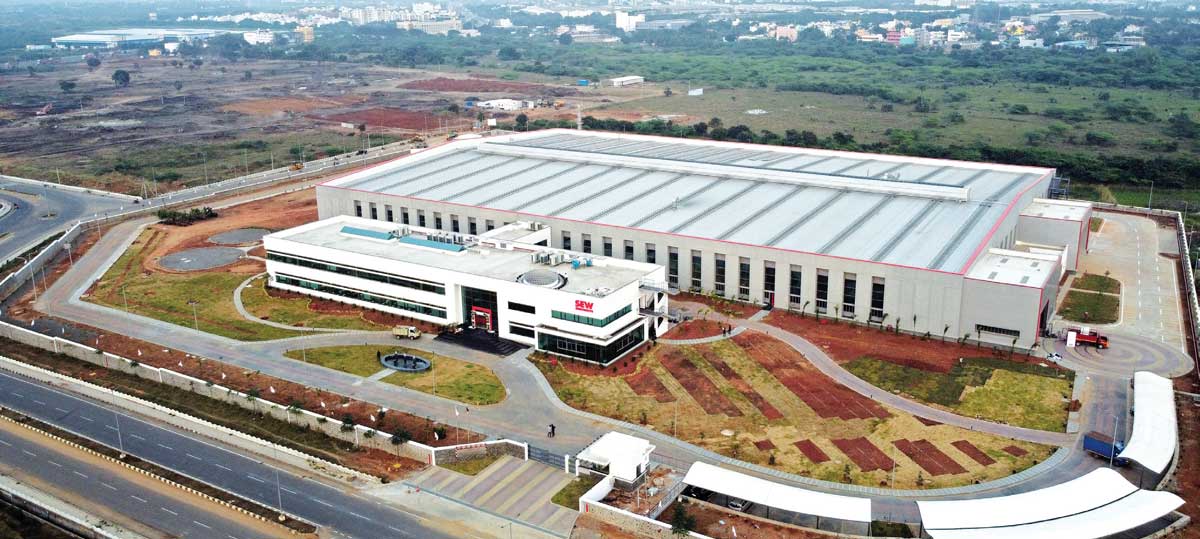
SEW-EURODRIVE India has launched a new Drive Technology Centre in Chennai to enhance responsiveness, scalability, and long-term support for customers across southern and eastern India. The facility combines sustainable infrastructure, advanced assembly systems, and digital-ready operations to drive efficiency, quality, and future growth.

SEW-EURODRIVE India has inaugurated its new Drive Technology Centre (DTC) in Chennai, one of South India’s fastest-growing industrial hubs. Conceived with a long-term perspective, the facility is designed as a robust platform built for generations. It strengthens SEW-EURODRIVE’s ability to serve customers across southern and eastern India with higher responsiveness, reliability, and long-term support.
Spread across 12.27 acres, the 21,350-sqm assembly and service facility provides the scale and flexibility needed to support customer growth, evolving application requirements, and future expansion. It reflects SEW-EURODRIVE’s commitment to sustainable development, technology leadership, and long-term partnership with Indian industry, combining global engineering standards with strong local execution.
The facility complies with green building norms, incorporating natural daylight, solar power generation, and rainwater harvesting. Energy-efficient construction and advanced climate control reduce shopfloor temperatures by up to 3°C, supporting stable production conditions, consistent quality, and improved working environments.
At its core is a 15,000-sqm assembly shop with digitisation-ready, high-productivity assembly cells based on a single-piece flow concept, along with SEW-EURODRIVE India’s first semi-automated painting booth to ensure consistent surface quality and higher throughput.
With this DTC, SEW-EURODRIVE reinforces its role as a trusted partner, investing in capabilities that support customers’ long-term industrial growth in India.

Continue Reading

Video Thumbnail
â–

    SIGN-UP FOR OUR GENERAL NEWSLETTER


    Trending News

    SUBSCRIBE TO THE NEWSLETTER


    Don't miss out on valuable insights and opportunities to connect with like minded professionals.


      This will close in 0 seconds