Connect with us

Concrete

India to impose dumping duty on cold rolled steel imports

Published

on

Shares

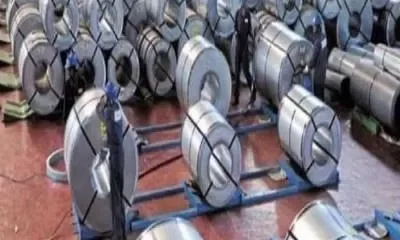
India is likely to impose anti-dumping duty on imports of certain cold-rolled steel products from China, Japan, Korea and the Ukraine.

The duty recommended by the commerce ministry will be the difference between the landed value and the prescribed value ($594 per tonne).

The Directorate General of Anti-Dumping and Allied Duties (DGAD), which operates under the Commerce Ministry, has found that cold-rolled flat products of alloy or non-alloy steel had been exported to India from these countries at below-normal value.

"Accordingly, the authority recommends imposition of provisional anti-dumping duties on the imports of the subject goods, originating in or exported from the subject countries," DGAD said in a notification.

JSW Steel Coated Products Ltd had jointly filed an application before the DGAD for initiation of anti-dumping investigation concerning the imports.

Continue Reading
Click to comment

Leave a Reply

Your email address will not be published. Required fields are marked *

Concrete

Towards Mega Batching

Optimised batching can drive overall efficiencies in large projects.

Published

on

By

Shares

India’s pace of infrastructure development is pushing the construction sector to work at a significantly higher scale than previously. Tight deadlines necessitate eliminating concreting delays, especially in large and mega projects, which, in turn, imply installing the right batching plant and ensuring batching is efficient. CW explores these steps as well as the gaps in India’s batching plant market.

Choose well

Large-scale infrastructure and building projects typically involve concrete consumption exceeding 30,000-50,000 cum per annum or demand continuous, high-volume pours within compressed timelines, according to Rahul R Wadhai, DGM – Quality, Tata Projects.

Considering the daily need for concrete, “large-scale concreting involves pouring more than 1,000–2,000 cum per day while mega projects involve more than 3,000 cum per day,” says Satish R Vachhani, Advanced Concrete & Construction Consultant…

To read the full article Click Here

Continue Reading

Concrete

Andhra Offers Discom Licences To Private Firms Outside Power Sector

Policy allows firms over 300 MW to seek distribution licences

Published

on

By

Shares

The Andhra Pradesh government will allow private firms that require more than 300 megawatt (MW) of power to apply for distribution licences, making the state the first to extend such licences beyond the power sector. The policy targets information technology, pharmaceuticals, steel and data centres and aims to reduce reliance on state utilities as demand rises for artificial intelligence infrastructure.

Approved applicants will be able to procure electricity directly from generators through power purchase agreements, a change officials said will create more competitive tariffs and reduce supply risk. Licence holders will use the Andhra Pradesh Transmission Company (APTRANSCO) network on payment of charges and will not need a separate distribution network initially.

Licences will be granted under the Electricity Act, 2003 framework, with the Central and State electricity regulators retaining authority over terms and approvals. The recent Electricity (Amendment) Bill, 2025 sought to lower entry barriers, enable network sharing and encourage competition, while the state commission will set floor and ceiling tariffs where multiple discoms operate.

Industry players and original equipment manufacturers welcomed the policy, saying competitive supply is vital for large data centre investments. Major projects and partnerships such as those involving Adani and Google, Brookfield and Reliance, and Meta and Sify Technologies are expected to benefit as capacity expands in the state.

Analysts noted India’s data centre capacity is forecast to reach 10 gigawatts (GW) by 2030 and cited International Energy Agency estimates that global data centre electricity consumption could approach 945 terawatt hours by the same year. A one GW data centre needs an equivalent power allocation and one point five times the water, which authorities equated to 150 billion litres (150 bn litres).

Advisers warned that distribution licences will require close regulation and monitoring to prevent misuse and to ensure tariffs and supply obligations are met. Officials said the policy aims to balance investor requirements with regulatory oversight and could serve as a model for other states.

Continue Reading

Concrete

President Murmu Inaugurates Projects In Rourkela

Inaugurates Planetarium, Tribal Museum and civic projects

Published

on

By

Shares

President Droupadi Murmu inaugurated a series of infrastructure projects in Rourkela including a Planetarium and Science Centre, the Nirmal Munda Parivesh Path, a Tribal Museum and an Integrated Command and Control Centre. The initiatives are intended to boost scientific awareness, preserve tribal heritage and strengthen urban governance in the region. The range of facilities reflects a deliberate effort to combine cultural conservation with technological and civic improvements.

Speaking to a public gathering, the President highlighted the rich natural beauty, cultural heritage and vibrant traditions of Sundargarh and described the area as a land of forests, rivers and sporting spirit. She noted that Rourkela has evolved as a cosmopolitan city that has promoted the state’s art, literature, tribal traditions and sports while attracting people from across the country in search of livelihood opportunities. The remarks underlined the role of urban centres in sustaining regional identity and economic mobility.

Emphasising inclusive development, she said national progress depends on the upliftment of all sections of society, particularly tribal communities, and that both central and state governments are implementing welfare schemes to accelerate development in tribal dominated districts such as Sundargarh with an emphasis on economic empowerment. The President called for collective participation in nation building and encouraged citizens to support those who have been left behind in the development process. The appeal framed development as a shared responsibility spanning government programmes and community engagement.

She expressed confidence that India is on course to become a developed nation by 2047 and observed that Odisha will mark 100 years of its formation in 2036. She stressed that realising the vision of a Viksit Bharat and a Viksit Odisha will require the combined efforts of farmers, labourers, youth and tribal communities. The newly inaugurated projects are expected to enhance scientific outreach, strengthen preservation of tribal culture and improve civic services for residents.

Continue Reading

Video Thumbnail

    SIGN-UP FOR OUR GENERAL NEWSLETTER


    Trending News

    SUBSCRIBE TO THE NEWSLETTER


    Don't miss out on valuable insights and opportunities to connect with like minded professionals.


      This will close in 0 seconds