Connect with us

Concrete

Core sectors output growth remain negative for Nov 2020

Published

on

Shares

In November 2020, the eight core sectors output growth remained in a negative trajectory for the ninth successive month. Rather after showing an improvement in September 2020, it has been deteriorated persistently in October 2020 and November 2020. During the month, the eight core sectors output contracted by 2.6 per cent year on year as against the 0.7 per cent growth in the same month of last year. The output growth during the month was also lower than the 0.6 per cent de-growth in October 2020. The decline in growth can be ascribed to persistent fall in crude oil, refineries, natural gas, steel output.

For October 2020, the core sector growth has been revised upwards from -2.5 per cent (prov.) to -0.9 per cent (first revision) on account of improved production in steel, cement and electricity sector.

The cumulative index of eight core sector during April ??November 2020 contracted by 11.4 per cent indicative of the adverse impact on industrial production during the lockdown period compared with the 0.3 per cent growth in the corresponding period of last year. There was a broad based contraction across sectors during this period barring fertilizer, the output of which grew by 3.8 per cent due to favourable monsoon and sowing season this year.

Key highlights:

  • Coal production growth slowed in November 2020 and the output grew by 2.9 per cent at a four month low (11.7 per cent growth in October 2020). However, it was better when compared with the 3.5 per cent contraction in the same month of FY20. Revival in demand for power post easing in lockdown and resumption of industrial activities has along with favourable base has led to increase in output in coal.

  • Crude oil production contracted for three successive years. In November the crude oil production declined at a slower 4.9 per cent compared with the 6 per cent de-growth in November 2020. Fall in production can be ascribed to low realisations due to Covid restrictions/lockdown, technical mishaps due to Covid-19 implications, reservoir issues and shut in of wells and reduced off take.

  • Natural gas production also declined for nearly 2 years. In November 2020, the natural gas output contracted by 9.3 per cent, higher than the 6.4 per cent decline in November 2019. Closure of Gas wells in western offshore due to Hazira Plant shutdown, low upliftment/demand of gas by the major customers like power plants, bandhs/blockade by local people and associations, etc. after the Baghjan Blowout among others weighed on overall production during the month.

  • Refinery production, having high weightage in eight core (28 per cent), contracted for successive 9 months in a row. However, the pace of contraction moderated in November 2020 to -4.8 per cent compared with the -17 per cent de-growth in the previous month. In November 2019, however, the refinery output had grown by 3.1 per cent. Low capacity utilisation and low product demand due to Covid impact led to decline in production during the month.

  • Fertilizer output, grew by 1.6 per cent in November 2020, lower than the 13.6 per cent growth in November 2019 and 6.3 per cent in October 2020. Expected increase in demand during the ongoing Rabi season might have supported the growth during the month.

  • Output of steel sector contracted for the first time in the past 4 months in November 2020 by 4.4 per cent as against the 7 per cent growth in November 2019 and 4 per cent growth in October 2020. Low demand from automobile sector, high raw material costs and relatively muted construction activities with lockdown imposition in parts of the country must have weighed on the steel production.

  • After witnessing a revival in October 2020, the cement production took a hit in November 2020 and contracted by 7.1 per cent compared with the 4.3 per cent growth in November 2019 on account of likely muted construction activities with resurgence in infection cases and subsequent restrictions on activities.

  • Electricity production grew by 2.2 per cent albeit at a slower pace by 2.2 per cent in November 2020 than the 11.2 per cent growth in the previous month but was better than the 4.9 per cent contraction in the same month of last year.

CARE Ratings??View

Going ahead, the eight core sectors growth would be contingent on the ease in restrictions along with high base effect. On account of fall in eight core sector growth the IIP growth for this month could see only marginal improvement between 0 to 1 per cent.

Courtesy: CARE Ratings

ABOUT THE AUTHOR

Dr Rucha Ranadive, Economist, CARE Ratings. Can be contacted at: rucha.ranadive@careratings.com | Tel: +91-22-6837 43406

Disclaimer: This report is prepared by CARE Ratings Ltd. CARE Ratings has taken utmost care to ensure accuracy and objectivity while developing this report based on information available in public domain. However, neither the accuracy nor completeness of information contained in this report is guaranteed. CARE Ratings is not responsible for any errors or omissions in analysis/inferences/views or for results obtained from the use of information contained in this report and especially states that CARE Ratings has no financial liability whatsoever to the user of this report.

Continue Reading
Click to comment

Leave a Reply

Your email address will not be published. Required fields are marked *

Concrete

BMC Cement Concretisation Cuts Pothole Repairs By 70 Per Cent

Project worth Rs 170 billion (Rs 170 bn) aims to concretise 1,900 km by 2027

Published

on

By

Shares

The Brihanmumbai Municipal Corporation’s cement concretisation project, valued at Rs 170 billion (Rs 170 bn), has reduced expenditure on pothole repairs by 70 per cent over three years. Spending on repairs fell from Rs 2.02 billion in 2023–24 to Rs 1.56 billion in 2024–25 and then to Rs 890 million (Rs 890 mn) in 2025–26. The current tender is expected to be about Rs 440 million, representing a further 50 per cent reduction.

The project is being executed in two phases, with Phase I covering 307 km from October 2023 and Phase II covering 370 km from October 2024. The Indian Institute of Technology is auditing Phase II and will now also audit Phase I to ensure quality and accountability. Mumbai’s total road network spans approximately 2,050 km, of which about 1,200 km had been converted to cement concrete before 2022.

Since 2022 an additional 677 km were taken up for concretisation and nearly 71 per cent of that work, amounting to 481 km, has been completed. Municipal officials indicated that 10–15 per cent of the remaining work is expected to be completed by May 2026 and another 10 per cent by December 2026. The entire programme is scheduled for completion by May 2027, by which time nearly 1,900 km of Mumbai’s roads are expected to be fully concretised.

The administration has also developed a real time dashboard that displays detailed information about contracts, contractors and progress and citizens can access the latest updates online. The dashboard includes contact details for the civic officials and contractors responsible for particular roads to enhance transparency and accountability. The commissioner directed that ongoing works be completed by 31 May ahead of the monsoon to safeguard completion targets and minimise disruption.

Continue Reading

Concrete

Shree Cement Approves Rs 1,800 Crore Meghalaya Plant

Integrated unit to be completed by quarter ending March 2028

Published

on

By

Shares

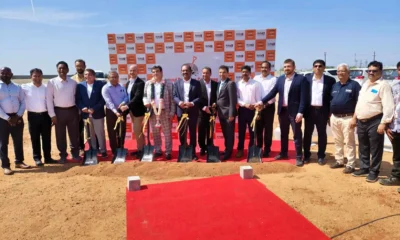
Shree Cement has approved the establishment of an integrated cement plant in Meghalaya, signalling a targeted capacity expansion to serve regional demand. The board cleared a unit at Village Daistong in East Jaintia Hills District with a clinker capacity of zero point nine five million tonnes per annum (mn t) and a cement capacity of zero point nine nine million tonnes per annum (mn t). The project was approved on April four, 2026 and is designed as a new addition to the company’s production network where it currently has no existing plant.

The company has earmarked an estimated investment of Rs 1,800 crore (Rs 18 billion (bn)) for the project, which will be financed through a mix of internal accruals and debt. Management has indicated a balanced financing strategy to preserve cash flows while supporting long-term growth and operational investment. The financing approach is intended to avoid over reliance on external borrowing and to maintain financial discipline during the build out.

The plant is expected to improve logistics efficiency and compress distribution distances to emerging demand centres in the north-east, potentially lowering transportation costs and lead times. By locating production closer to demand the company aims to strengthen market access and respond more effectively to regional construction activity. The project forms part of a broader strategy to diversify the production base across geographies and reduce concentration risk.

Execution is planned over a multi-year window with completion targeted by the quarter ending March 2028 and the company will proceed with construction and requisite regulatory clearances. The integrated design is intended to enhance operational control and production efficiency once operational. The decision follows a regulatory filing dated April four, 2026 and the disclosed details have not been independently verified.

Continue Reading

Concrete

WCA Welcomes SiloConnect as associate corporate member

Published

on

By

Shares

The World Cement Association (WCA) has announced SiloConnect as its newest associate corporate member, expanding its network of technology providers supporting digitalisation in the cement industry. SiloConnect offers smart sensor technology that provides real-time visibility of cement inventory levels at customer silos, enabling producers to monitor stock remotely and plan deliveries more efficiently. The solution helps companies move from reactive to proactive logistics, improving delivery planning, operational efficiency and safety by reducing manual inspections. The technology is already used by major cement producers such as Holcim, Cemex and Heidelberg Materials and is deployed across more than 30 countries worldwide.

Continue Reading

Video Thumbnail
â–

    SIGN-UP FOR OUR GENERAL NEWSLETTER


    Trending News

    SUBSCRIBE TO THE NEWSLETTER


    Don't miss out on valuable insights and opportunities to connect with like minded professionals.


      This will close in 0 seconds