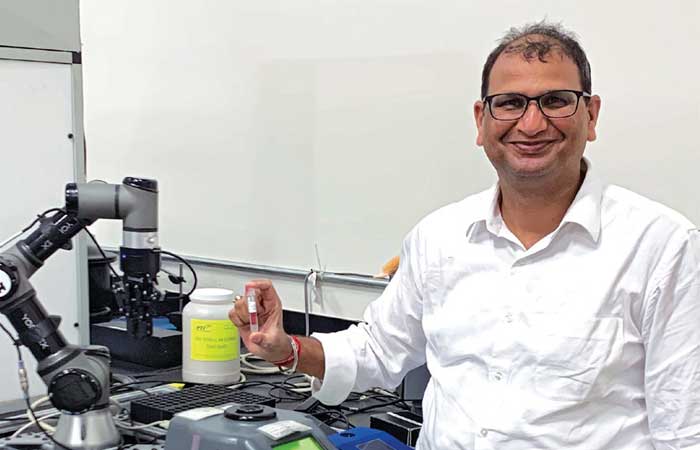
Gaurav K Mathur, Chief Executive, Global Technical Services, discusses the importance of contamination-free lubrication to keep machinery working at optimum capacities.
What is Total Lubrication Management System.
Cement plants are process plants, with thousands of rotating machines operating 24×7, 365 days. Availability of these machines are critical and plant reliability is vital; operating conditions of cement plants are highly dusty; lubricants can get contaminated before being filled in machines; if not stored according to the well-established system. Therefore, system-oriented approach for contamination-free lubrication is the foremost requirement of the cement industry.
Our Total Lubrication Management (TLM) is implemented at the plants as per Standard Operating Procedures (SOP), for uniform adaptation of best lubrication practices to ensure clean lubricants are fed to machines. Good lubricants storage, handling and dispensing of lubricants is essential for good lubrication programme in any industry.
The important aspects of the SOP are:
- Roles and responsibilities of all responsible for implementing TLM at every site.
- Good housekeeping: clean environment in Central Lubrication Cell.
- Storage of oil and grease barrels: to ensure feed clean lubricants to machines.
- Colour Coding system: to eliminate contamination.
In-house laboratory and testing procedures:
to establish condition base oil change and oil conservation.
- Online filtration: to keep oil clean in service at all times
- Management of spillage and leakages
- Management of minor and major leakage
- Regeneration of drained oil and its usage
after lube-testing – a must for oil conservation. Lubricating oil is expensive and needs to be saved.
Some of the largest cement plants in the country have outsourced their lubrication activities on a single window basis to us (GTS), entrusting the responsibility of storage, handling, dispensing, regeneration, and condition monitoring of lubricants for the plants and mines. All resources required for world class lubrication are deployed by GTS including dedicated manpower and a well-equipped oil testing laboratory at each site, beside lubrication equipment, and fifth generation oil filtration systems (they can remove water/moisture besides suspended dust, and wear particles).
How often do you audit or review your implemented systems?
The team of engineers from our Mumbai office visit each site regularly and review our site team work, and discuss with the plant’s mechanical maintenance team for their feedback and further improvement required. Then we make a time bound schedule and implement the same. This is our ongoing process for all sites.
The frequency of reviewing or auditing TLM is a continuous process, quality service requires various yardsticks to identify gaps for continuous improvement. We are pleased to convey that our customers are quite satisfied with our working. We make every effort to achieve world class lubrication management at our sites. We are now in the process of implementing software-based TLM System at some of our sites. Once it is established properly, we will be doing the same at all our sites.
Each cement plant has thousands of lubrication points and each and all points have their lubrication frequency monitoring of lubrication, etc. has been incorporated in the software. Thousands of lubrication points are generating a very large quantum of data and once this software with artificial intelligence (AI) is developed shall a great boon for us and the industry. One of the key challenges today is contamination free lubrication and condition-based oil change system, with the assistance of the site laboratory leading to oil conservation (this shall also be integral part of the AI-based software).
We have developed fifth generation oil filtration system and we have been able to conserve approximately 18 to 20 per cent lubricants at our site, on yearly basis. ‘Oil never dies – it only gets contaminated.’ Once these contaminations are removed, oil is fit for further use. And yes, laboratory test report is important.
How do you maintain quality for the lubricant products provided to the cement manufacturers?
Lubricants are manufactured by well-established oil companies with extensive R&D, high value lubricants are handed over to the industry, however if not stored properly at the industry’s site the high-quality lubricants can get contaminated. Since oil in a machine is like blood in human body, the contaminated lube oil can be damaged the machine. We store the oil very carefully to ensure no dust, dirt or moisture go into the oil barrel and therefore we adopt covered indoor storage and keep the barrels in our Central Lubrication Cell (CLC), which is provided by the site management to us and we develop it to our operating requirements. We do all lubrication activities for the site from CLC. We also establish Oil Test Laboratory at this location (Central Lubrication Cell.)
How do lubricants improve functionality at cement plants?
Cement manufacturing plants work under highly dusty environment. They are located in remote areas away from the major towns. Keeping the oil as clean as possible within the machine is extremely important. This helps improve machine condition, production reliability and ultimately profitability of our customers.
How do you incorporate sustainability in your process and operations?
One of the pillars of TLM regeneration of lubricants. These tested oils are crafted to match the performance of fresh oil, resulting in conservation of lubricants leading to sustainability.
What is the role of automation and technology?
Modern day manufacturing is a lot more demanding, with advancement in technology, data becomes vital and customised software is not developed enough to track assets parameters. There has been a need for software for route planning and execution of lubrication activities – these activities are so many in numbers to monitor them without an AI based software leaves enough room for error.
We are implementing TLM software at plants where TLM is being implemented by us. This software helps micro level operational ease and counter check of activities. All activities data is logged through secured servers. Bringing meaningful, actionable data on the palm top is the key, and all modern technologies are being adopted for the same, including industrial internet of things (IIOT) and autonomous monitoring. We are implementing a mix of technology to have a robust system in the plant, while implementing TLM.
Which innovations are in the pipeline?
It is important that we adopt a system- and AI-based TLM at all the plants. We have established a world class oil testing laboratory at site and a mother oil testing laboratory with modern equipment such as Inductively Coupled Plasma (ICP), covering 5-6 plants and with test results available within 48 hours for oil condition monitoring.
We are developing technologies involving AI, drones, robotics, software and sensors coupled with robust databases, all specifically for machine monitoring, to attain the dream of ‘Machine
for Life’.