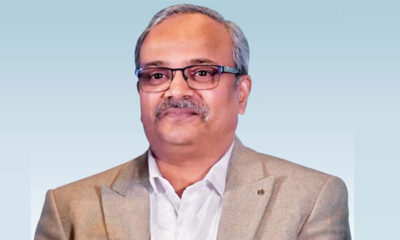
With the net zero deadline looming above us, the cement industry is racing against time. Maarten van Roon, Chief Commercial Officer, Carbon8, puts forth his ideas on how Carbon Capture, Utilisation and Storage (CCUS) can help the cement industry decarbonise, and help make it a more circular sector.
Tell us more about the Accelerated Carbonation Technology (ACT).
Carbon8’s Accelerated Carbonation Technology (ACT) is based on one of nature’s ways of sequestering carbon. Carbonation occurs naturally but it is an extremely slow process. ACT controls, manages, and accelerates this reaction so that it takes between 15-30 minutes.
Essentially, we help enable circularity for hard-to-abate industrial sectors by combining captured carbon from their operations with industrial residues, from the very same operations, to manufacture new materials for the construction industry.
In cement production specifically, cement bypass dust (CBD) and cement kiln dust (CKD) are produced as a by-product. CBD and CKD are reactive to CO2 because of the compounds they contain, making them a potential carbon sink. Our technology solution captures CO2 directly from the cement plant and permanently stores it in products, by valorising
those residues. The product that ACT currently manufactures is CircaBuild, a carbon-negative alternative to natural aggregate.
CircaBuild has various applications in the construction industry, including concrete blocks, ready-mix concrete, road fill and green roofing substrate. Regardless of which application CircaBuild materials are used in, they reduce the carbon footprint of any construction project by replacing the need for virgin materials while themselves containing captured carbon.
What happens to the carbon that is captured permanently through ACT?
ACT enables the captured carbon to be permanently locked in the products and it will not be re-released. The calcium and magnesium oxides, hydroxides and silicates within the residues react with the CO2, changing it into carbonates. Through this, the carbon is permanently sequestered into carbon-negative aggregate – CircaBuild. For example, if CircaBuild is used in concrete blocks for buildings, the
carbon will not be re-emitted if the building is demolished. It is truly permanent sequestration; it is Carbon Capture, Utilisation AND Storage – ‘CCU’ with the ‘S’.
The captured carbon becomes a direct ingredient in our process. What this means for the carbon capture, is that the system taps directly into the flue stack of the cement plant and removes a portion of the carbon directly. This does not need to be treated or purified but can directly be used within the process. The captured carbon is diverted into the CO2ntainer where, under specifically engineered conditions, it is exposed to the CBD or CKD.
Tell us about the process of setting up the containers that capture carbon at the sites of cement manufacturing and how can the units implement that?
The CO2ntainer is our modular and mobile CCUS solution. It is the realisation of ACT as a compact, easily deployable CCUS innovation. The Plug ‘n Play system allows for frictionless transportation and implementation while using CO2 captured at point source to carbonate industrial residues destined for landfill. This is something that we will be delivering to the cement industry with the help of our commercial partners FLSmidth.
Our system can be integrated and retrofitted directly to a client’s cement plant with minimal downtime. Through this, the client is able to decarbonise its operation, while avoiding the cost associated with the landfill of the CBD and CKD by valourising it, and producing it into a product directly. This makes it economical and sustainable – demonstrating how the circular economy can exist within heavy industry.
Tell us more about how your company has scaled-up and your deployment at Vicat.
Carbon8’s solution dates back to over 20 years of research by our two-founding scientists, Dr Paula Carey and Professor Colin Hills. They founded the company as a spin-out from the University of Greenwich, England where our technology was originally developed.
Since then, we proved the technology at full-scale, using pure CO2 and APCr from Energy from Waste plants in the UK. A key milestone in the company’s development was the invention of the CO2ntainer in 2018. This was the realisation of the technology in its modular and mobile form, which led to successful pilots and demonstrations at a CRH cement plant in Ontario, Canada and at Hanson, part of the Heidelberg Group, in the UK.
Our first commercial deployment was at Vicat Group’s cement plant in Montalieu, France in 2020. Vicat has set ambitions to be climate neutral by 2050 and we are proud to be one of its solutions to achieve this. Like other cement plants around the world, Vicat produces cement bypass dust – which we expect will increase as Vicat, and the wider industry, move towards Alternative Fuels. These require Bypass Systems and so needed a solution to address
this. Our CO2ntainer fits into this roadmap as we can help Vicat decarbonise while giving their
CBD a new life in the form of carbon-negative CircaBuild aggregates, that they are using in concrete block production.
What other efforts can be taken by the cement industry to manage carbon emissions?
Every cement plant will have slight differences in their operations and geographic location that will determine the best ways they can manage their carbon emissions. For example, CCS may be challenging to cement works in remote locations, distant from planned CCS industrial clusters.
To adequately answer these questions, we do need to consider it in relation to what can be done today and what will be done in the future. This was also represented in the Global Cement and Concrete Association’s (GCCA) road map, which clearly showed that there are multiple levers necessary to achieve net zero ambitions, across different time horizons.
For some solutions, like full-scale CCS, there will be a time lag for the necessary infrastructure to be in place. However, we are seeing the appetite and drive necessary to implement changes today. ACT is just one of a number of different technologies that are ready today. Industrial players can be early adopters and should be, too, if net zero is to be achieved. This isn’t something where we can wait for 30 years of proof of concept. There needs to be trust in delivery and a leap of faith to get there.
What are the various benefits of carbon capture and how does it support the environment?
The need to stop the temperature of the planet at 1.5oC has been clear for some time now, and this was reemphasised again at COP26, held last year in Glasgow, UK. Specifically, in the cement industry, it is widely acknowledged and accepted that carbon capture is necessary for the industry to reach its net zero ambitions. In the GGCA’s net zero roadmap, 36 per cent of carbon reductions can be achieved from carbon capture, utilisation and storage (CCUS).
As the question suggests, there are various ways that carbon capture can benefit the planet and it will depend on the solution we are speaking about. However, if we focus on CCUS, rather than just CCS, there is a clear benefit in the ‘utilisation’ element. This goes beyond just carbon capture and storage but uses the carbon for another purpose. This is what we, at Carbon8, focus on.
Our technology captures, utilises, and permanently stores carbon in solid form. This not only helps the cement industry decarbonise, but also become a more circular sector.
Tell us more about your contribution towards achieving the net zero mission.
Carbon8 is a Circular Impact company; we can help the global cement industry decarbonise, as well as transition to more circular operations.
Our technology can be deployed as a standalone plant using bottled CO2 or in the containerised form directly to the site. The CO2ntainer can treat up to 12,000 tonnes of CBD annually, diverting this from landfill and avoiding the associated cost. CBD can have reactivity to CO2 of up to 33 per cent by weight, making it a carbon sink for the CO2 captured onsite. The preliminary Life Cycle Assessment (LCA) using the aggregate manufactured at the Vicat site showed a 30 per cent overall improvement of the LCA compared to the disposal of the residue and the manufacture of a concrete block with or without the carbon-negative aggregate. Depending on the reactivity of the residue, a singular CO2ntainer can permanently capture and store between 1,500 tonnes – 4,000 tonnes of CO2. In summary, we address two core sustainability issues faced by the cement industry today; decarbonisation and the sustainable management of the residues produced in its operations.
With the Indian cement industry being the second-largest producer of cement in the world, only second to China, with about 8 per cent of global installed capacity, we believe that there is considerable scope for our ACT solution to be deployed in India over the coming years.
-Kanika Mathur













 Concrete1 month ago
 Concrete4 weeks ago
 Concrete1 month ago
 Concrete3 weeks ago