Connect with us

Concrete

RBI asks cement industry to use green tech to reduce emissions

India’s cement output is likely to reach 381 mt by 2021-22

Published

on

Shares

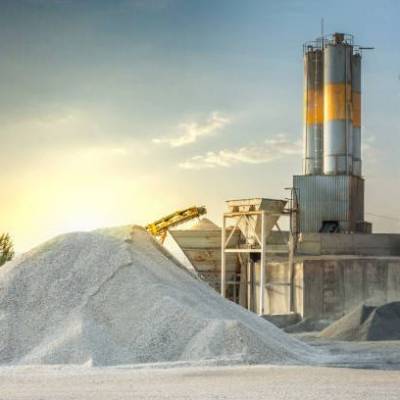
The Reserve Bank of India (RBI) urged technological intervention to reduce these carbon emissions from the cement sector, which would help India to achieve its net-zero emission objectives.

The RBI said that India’s goal of obtaining half of its energy needs from renewable sources and reducing the economy’s carbon intensity by 45% by 2030 requires a policy relook across sectors, especially where carbon emission is high, and the cement industry is one of them.

Recent advancements in green technology, notably in reverse calcination, present promising potential for the cement industry.

As per the RBI report, India’s cement output is likely to reach 381 million tonnes (mt) by 2021-22, while consumers would be about 379 mt. The report noted that a renewed focus on large infrastructure projects such as the National Infrastructure Pipeline, low-cost housing (Pradhan Mantri Awas Yojana), and the government’s push for the SMART cities mission would likely increase cement demand in the future.

It said that the net-zero emission regulations commitment of India is threatened by this promise.

The RBI’s analysis is by the India Energy Outlook 2021, which states that most of the buildings that will exist in India in 2040 have yet to be completed, and the country’s growing economy, population, urbanisation, and industrialisation would all contribute to this.

Given this future situation, the RBI has advised that India’s economic goals be aligned with its climate objectives by integrating developing green technology solutions.

It explained that calcination accounts for a large portion of CO2 emissions in cement production, with the balance coming from coal and other fossil fuels.

The studies show that the most efficient strategy to decarbonise the cement industry is to capture CO2 emissions before they could enter the environment and store it through reverse calcination.

Currently, reverse calcination can sequester up to 5% of cement emissions, but with advancements in technology, this might be increased to 30%. This method may be improved even further by using renewable energy instead of fossil fuels to do the calcination.

RBI said that biomass such as municipal and industrial waste may be utilised as an alternative to fossil fuels.


Image Source


Also read: Cement companies are investing in new age technologies

Concrete

UltraTech to Deploy 600+ Electric Trucks by Dec 2026

Cement major expands green logistics to cut emissions across supply chain

Published

on

By

Shares
UltraTech Cement Limited, an Aditya Birla Group company, plans to expand its electric vehicle fleet in logistics operations to more than 600 EV trucks by December 2026, strengthening its green transport initiatives.
The company has signed service agreements with leading EV prime mover manufacturers, including Tata Motors, Ashok Leyland, IPLTech, Energy in Motion and Sany, along with their subsidiaries and logistics partners, for deploying electric trucks.
The expanded fleet will transport around five million MT of clinker and other key materials annually across Gujarat, Uttar Pradesh, Madhya Pradesh, Rajasthan, Chhattisgarh, Maharashtra and Odisha. Once operational, the fleet is expected to reduce annual CO₂ emissions by over 1,17,000 tonnes and replace nearly 39 million litres of diesel consumption.
K C Jhanwar, Managing Director, UltraTech Cement Limited, said the company is extending sustainability beyond its manufacturing plants by adopting greener logistics solutions and decarbonising its value chain.
UltraTech has been among the early adopters of sustainable transport in the cement sector, introducing CNG trucks in 2021 and electric trucks in 2024. The company currently operates more than 850 trucks under its green logistics programme, including CNG and electric vehicles.
With a grey cement capacity exceeding 200 MTPA in India, UltraTech is integrating electrification across its logistics network, covering mine-to-plant movement and inter-plant transportation of clinker and other materials.

Continue Reading

Concrete

UltraTech Cement expands green logistics with 600+ electric truck fleet

Published

on

By

Shares

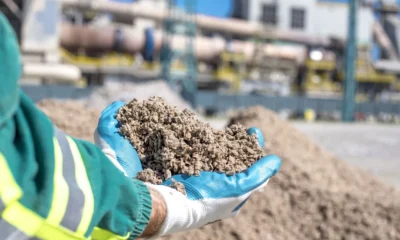
The e-truck fleet will be used to transport five million MT of clinker and other key materials with potential of over 1,17,000 tonnes of net annual CO₂ reduction, displacing the equivalent of 39 million litres of diesel per year.

Mumbai

UltraTech Cement Limited, an Aditya Birla Group company and the world’s largest cement company by sales volume and capacity outside China, has announced that it will scale up its electric vehicle fleet in its logistics operations to 600+ EV trucks by December 2026.

UltraTech has signed service contracts with leading EV prime mover manufacturers including Tata Motors, Ashok Leyland, IPLTech, Energy in Motion and Sany, along with their subsidiaries and other third-party logistics providers, to deploy EV trucks.

The total fleet of 600+ EV trucks will transport about five million MT of clinker and other key materials per annum across Gujarat, Uttar Pradesh, Madhya Pradesh, Rajasthan, Chhattisgarh, Maharashtra and Odisha. Once fully operational, this fleet of over 600 EV trucks will enable a net annual CO₂ reduction of more than 1,17,000 tonnes, displacing the equivalent of 39 million litres of diesel per year.

K C Jhanwar, Managing Director, UltraTech Cement Limited, said, “UltraTech is expanding sustainability beyond its plants by adopting greener logistics solutions. This large-scale transition to green logistics underscores our focus on decarbonising every link of our value chain and supports our commitment to achieving Net Zero.”

UltraTech has been a pioneer in advancing sustainable transport in the cement sector, being the first cement company to deploy heavy-duty electric trucks for long-haul transport of clinker and other materials at scale. The company was among the first in India to introduce green logistics, deploying CNG trucks in 2021 and electric trucks in 2024. UltraTech currently operates 850+ trucks as part of its green logistics operations, including CNG and electric trucks.

UltraTech, with a grey cement capacity of over 200 MTPA in India, operates one of the country’s most complex logistics networks. Its electrification strategy covers the entire supply chain—from mine-to-plant movement to inter-plant transport of clinker and other key materials.

The $ 10 billion UltraTech, the cement flagship company of the Aditya Birla Group, has a total Grey Cement capacity of 205.5 MTPA and White Cement/Putty capacity of 3.2 MTPA. It is a signatory to the GCCA Climate Ambition 2050 and has committed to the Net Zero Concrete roadmap announced by GCCA.

Continue Reading

Concrete

CarbonStrong Raises Rs 125 Million To Scale Low Carbon Cement Tech

To build capacity of 100,000 tonnes a year

Published

on

By

Shares


CarbonStrong has raised Rs 125 million (125 mn) to scale a low carbon cement technology and build commercial production capacity. The startup was founded in 2022 by Harsh Jain and Vikramaditya Singh and has moved from customer trials to plans for industrial supply. The company said its material replaces up to 50 per cent of cement in concrete while reducing costs and improving durability.

CarbonStrong states the product is around 30 per cent cheaper than cement and compatible with existing concrete plants, reducing the need for new equipment and operational disruption. Trials and paid pilots have been conducted in Bengaluru, Hyderabad and Chennai with demonstration projects involving ready-mix firms and precast manufacturers. Compatibility with current workflows forms a central part of the commercial strategy, aiming to ease adoption by builders and contractors.

The funding will support construction of a facility with capacity of up to 100,000 tonnes (100,000 t) a year over the next two years to supply early customers commercially. The firm is also developing materials from steel slag, copper slag and mine tailings to expand its feedstock base, while noting the technical challenge of homogenising different waste streams. Recognition by HCL ClimaForce in 2026 and by the Avaana-Startup India-NITI Aayog AIM Grand Challenge in 2025 has underscored progress.

Industry adoption remains the principal test and will require consistent material performance, supply reliability and competitive economics. CarbonStrong projects the Indian market for cement substitutes could reach Rs 250 billion (250 bn) by 2030 and has set an ambition to produce 10 million tonnes a year by 2035 (10 mn t), a target far above its near term capacity. Moving from pilots to production demands capital, manufacturing discipline and customers willing to specify the material beyond demonstrations. The recent Rs 125 million raise is intended to fund the next phase of scale and to demonstrate that industrial waste can become a dependable input for lower carbon construction.

Continue Reading

Video Thumbnail

    SIGN-UP FOR OUR GENERAL NEWSLETTER


    Trending News

    SUBSCRIBE TO THE NEWSLETTER


    Don't miss out on valuable insights and opportunities to connect with like minded professionals.


      This will close in 0 seconds