Automation and robotics are not new to the Indian industry, but judicious use of human beings along with automation is the call of the day. thyssenkrupp shares its experience about laboratory automation.
Silently, the people working in modern Indian cement plants have started welcoming their new colleague – a robot that works 24 hours consistently without any break. In spite of constant whizzing around, the new employee is not complaining or even sweating. It is ensuring that the produced cement meets their customer’s expectation again and again.
In a way, they ensure the survival of their company by assuring that their clients would be delighted with the quality and consistency of their cement. Most of these (robotic laboratory automation systems) have been commissioned in the last decade. But between the manual laboratories from the past and the state-of-the-art robotic laboratories, do the cement producers have choices? Can they choose a fully automated solution without a robot? Can the existing plants justify investment in a new laboratory automation system? Let’s look at some answers. But first, a quick status check!
History
As per CMA India, after the decontrol in 1982, the cement industry grew manifolds to 61.74 MT in just six years. According to www.cmaindia.org, it took eight decades to reach the first 100 MTPA, while the next hundred took 11 years and the third hundred was added in just three years. And, buoyed by the country’s high GDP growth, by 2014, India became number two, after China.
Nevertheless, with an estimated 400 MT of annual capacity, about 10 per cent cement is produced by plants that use automated laboratories (AL). Though we have 100+ years of history, most of the ALs have come up in the last 10 years. During this period, the cement industry demonstrated that it can imbibe new technologies and perform better than international counterparts. Clearly, this attracted many international players.
Trends driving automation in quality
As the discerning buyers increase their focus on consistency in quality of cement, they have started installing their own small laboratories. This, in turn, has made the cement producers look for parameters that correlate better to the client’s requirement – soundness, initial and final strengths, workability, water demand, etc. For example, focusing on the ratio of clinker phases C3S and C2S to achieve 3-day or 28-day strength will ensure that we save on grinding costs later.
This focus led to producers investing in XRD analysers. Further, as the equipment sizes or throughput increased, it became important for them to sample at regular and frequent intervals. This meant – one hourly sample representing 400 to 600 tonnes of material. And then, the use of alternative fuels clearly impacts cement production. For example, the sulphur in pet coke could result in higher grindability of clinker, unless it is managed. Also, the missing ash-bearing content will lead to lesser production due to no or reduced ash. It is, hence, imperative that such new tech?nologies are used to keep quality on a tight leash.
The new normal
Traditionally, we use screw samplers u motorised or hand-operated – to collect material from the process. It is, then, hand-carried to the laboratory by a sample boy. The laboratory operator uses a manual pulverising mill to grind it in a tungsten carbide or often steel, bowl to a fine powder. Then, he removes the heavy bowl and puts some of it into a pellet-making press, after adding a measured quantity of grinding aid-cum-binder.
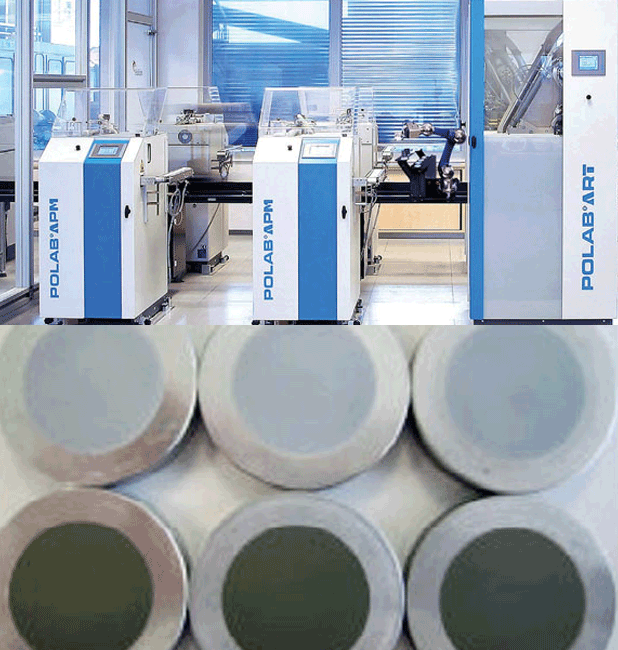
The prepared pellet is (Figure 1) then, analysed by an X-ray analyser. The results of the analysis are used to change the raw material mix. The ratio of this mix is determined from the set targets of plant moduli, like LSF (lime saturation factor), AM (Alumina Modulus) and SM (Silica Modulus), or an oxide, like MgO. Similarly, control can be performed on the ratio of materials being fed into the clinker grinding mill.
Parallelly, a part of the original sample is used for particle sizing or permeability analysis. Another part is sent for building composite sample over the day. But, these procedures are from the era, where the main focus of quality control was only elemental or related to just chemistry. Currently, the world over, there is significant interest in analysing both major and minor mineral phases or mineralogy, using time-consuming and skill-dependent electron microscopy or the much faster and well-correlated diffractometer, supplemented with quantitative Rietveld analysis.
Figure 1
This helps them achieve the cement performance they promised and even identify minor phases that can reduce the production or even force a stoppage. The days of using the free lime channel in the existing XRF or using stand alone XRD analyser are over. This leaves out the bulk mineralogy of the sample.
And then, they also want their material to be sampled at the right time and brought to the laboratory as quickly as possible, at about 10 m/s. If the sample boys did this, they would possibly compete with Usain Bolt! That is, if they were not checking their smart phones during the manual sample transport.
Also, the separate milling and pressing machines are remnants of the past, when only chemistry and Bogue’s calculations were the order of the day. Today, latest low-energy combined mill-cum-press machines provide far more accurate dosing, grinding and pellet making, giving high repeatability in sample analysis. This is because of reduced human intervention. To recapitulate, in this section, we reviewed how we collected and processed samples since ages and what the current level of automation has to offer for consistency in quality. Let us now look at different levels of automation in a cement plant laboratory.
Levels of laboratory automation
Level 1: Semi-Automatic sampling & Automatic Sample Preparation
Here, the material is sampled using a semi-automatic sampler. The sample remains in an attached air-tight sample collecting device till it is collected by a sample boy, who takes it to the central laboratory. At the laboratory, the sample is prepared in a fully automatic mill-cum-press. Thereafter, it is manually placed in an X-ray equipment for analysis. The results are read by an optional quality control software and then, it issues fresh set-points for weigh-feeders to control the mix of various materials. One could also use a belt conveyor to automatically move the sample pellet between the X-ray equipment and sample preparation equipment. Please refer Figure 2, POLAB 1 option.
Level 2: Automation of Sample Transportation & Automatic Sample Preparation
In this level, an automatic sampler and sending station collect material from the process over a defined period of time. Then, a statistically representative portion of it is sealed in a capsule and sent pneumatically to the central laboratory, where it is manually removed. After opening the sample carrier, part of it is fed into a combined mill-cum-press, which automatically returns a pellet. As in the previous case, another variation in this level is that the prepared pellet can be automatically sent to an X-ray equipment on a conveyor belt. After the analysis, the pellet is returned for breaking and cleaning the steel ring for reuse. Similar to level 1, the optional software reads the analysis data and sends fresh set points to the plant control system to modify the material feed rates based on set quality targets. Ref. Fig. 2 POLAB 2 option. Level 3: Automation of sample collection, tra?n?sport, preparation, sample handling at the laboratory
This level is the most advanced and complete sampling, sample transport, sample receipt and dosing, sample handling, sample preparation, particle sizing and composite sample formation is done untouched by human hand. Compared to level 2, the sample carrier is received by an automatic sample receiving system, which doses the sample for different purposes. A mandatory software manages all tasks and prioritises them apart from the mix control. It also has a repository of communication drivers to several analytical equipment. It can be implemented in several ways:
Robot-free: To keep the system simple, this version does not use a robot. Instead, it relies on a compact and interlaced design that suits a single integrated line or a clinker grinding facility. Though small in footprint, it packs formidable accuracy and speed of sample handling and preparation. With one automatic receiving station, one mill-cum-press, one composite store and an optional particle size analyser in a compact enclosure, it needs no supervision to automatically collect, prepare, analyse, a sample and send corrective set-points. Upto 8 samples per hour.
Robot-Single: Using a central robot, housed in an enclosure, the sample is deftly handled. The sample dosed by the automatic receiving system is promptly delivered to either a mill-cum-press, a composite sample container or the particle size analyser. Multiple sample preparation equipment and sample receivers can be implemented in a single system.Upto 24 samples per hour.
Robot-multiple & mobile: This is an innovative concept that allows the robots and humans to share a common workspace. With multiple low kinetic energy mobile robots, the system is flexible and can grow as the new lines are added. The receiving stations, sample preparation equipment, sample stores, analytical equipment, etc., can be laid out in different ways, providing flexibility to modify the arrangement later as the plant capacity gets augmented. This design is particularly suited to plants where multiple lines are envisaged over a few years. Ref. Fig. 2 POLAB 3 option.
Choosing the right levels of automation
While securing budget is important, one can decide the type or level of a system based on several factors, influencing the decision are listed below:
Size: As the throughput of the plant increases, the investment in and automation gets more justified. That is, every sample now represents many more tonnes of material. Therefore, timely correction of mix and a highly auto?mated system becomes imperative.
Integrated plant or a grinding unit: While a complete line entails the need of an automated system, some new clinker grinding units are showing an inclination towards the robotic options.
Know-how and skills: Modern cement plants rely on mineralogy as well as chemistry for quality control. However, a few plants still use a high-end XRD machine to just measure free lime, often due to lack of knowledge in mineralogy and its correlation to cement quality. Moreover, skills required or available in the plant to maintain laboratory automation must be evaluated and the suitable solution must be opted for.
Alternative fuels and special clinkers: Use of pet coke to optimise energy cost results will cause other issues like reduced production due to the reduced ash-bearing content. Or, the sulphur content causes higher C2S content, which in turn increases clinker grindability. On the other hand, making mineralised clinker demands advanced quality control to verify the increased rate of C3S formation at lower temperatures.
Plants opting for the semi-automatic system can upgrade them later. This means their investment can be spread over few years. But, how do we justify the capex?
Economic benefits of lab automation
While many believe investments in laboratory automation cannot be justified, ThyssenKrupp has published several papers[2] describing a financial model that translates the quality parameters into financial benefits. While a detailed review is beyond the purview of this article, a brief description is provided for the sake of brevity.
The following areas provide scope for reduction of costs:
The cost of raw mix: Good quality control ensures smaller standard deviation of quality parameters. This, in turn, leads to less usage of expensive third-party additives/materials. To elucidate, higher standard deviation of LSF would mean more off-spec material. In order to offset this, costly high-grade limestone needs to be added. This increases the raw mix costs and on the other hand, LSF higher than targeted could result in more free lime. To correct this, one would then need to burn more fuel.
The cost of clinker: This depends on the cost of kiln feed fuel and electricity costs. A tight control will result in stable kiln operation, higher clinker volume and consequently lower cost of production per unit of clinker produced. While a complete line entails the need for an automated system, some clinker grinding units are inclined towards a robotic solution.
The cost of cement produced: Cement plants use advanced quality control to reduce clinker factor but increase the percentage of supplementary cementitious materials like fly ash or slag. For example, if the plant is able to keep the clinker reactive enough, a higher amount of fly ash could be added.
Kiln stoppages and cyclone blockages: Haeseli[1] used a POLAB? hot meal sampler to collect hot meal samples and analyse them for mineralogical composition. He discovered a correlation between clogging in the cyclones and concentration of spurrite and Ca-langbeinite in the hot meal. Maintaining their concentrations at safe levels, he achieved minimum clogging tendency and improved the kiln performance by quantitative XRD analysis.
To summarise, laboratory automation is the new standard and hence, let’s be ready to welcome a robot as your new colleague – a never-tiring robot! Different levels of complexity can be implemented, depending on the plant conditions and skills. Nevertheless, each level has a potential to reduce the cost of production and assure consistency. Therefore, careful selection of a system from a choice of semi-automatic to fully automatic or robot-free to multiple robots, based on plant need and availability of skills, is important. The selection can be justified by calculating the potential savings for years to come. Nevertheless, the Indian cement industry is in omnia paratus and the robots are here to stay!
(This article has been authored by Sudeep Sar, Associate Vice President, Laboratory Automation, thyssenkrupp Industries India).
References:
[1] Haeseli, U. (2010): Step by step application of phase analysis for process optimisation. – AXSCEM 2010, Karlsruhe
[2] Enders, M.; Sar, S. (2015): ROI of Lab Automation: Can we quantify economic effects of investment in quality? – NCB Seminar, 2015, New Delhi